
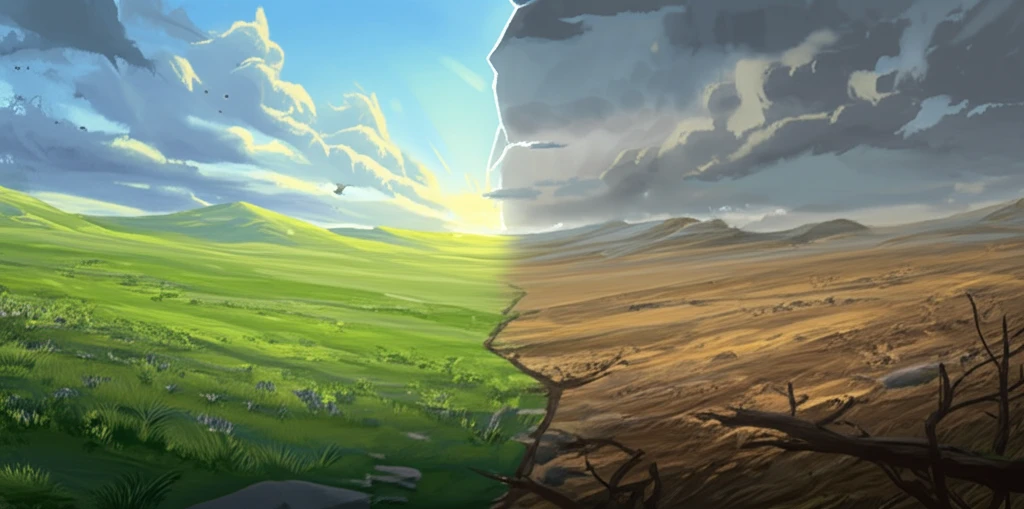
Central Asia's Grasslands: A Climate Crossroads

"Uncover how climate change and human activities are reshaping the fragile ecosystems of Central Asia, with surprising impacts on the region's future."
Across the globe, ecosystems are facing unprecedented changes. From shifts in climate to the increasing pressures of human activities, our planet's natural landscapes are in constant flux. Nowhere is this more evident than in the arid and semiarid regions of Central Asia, where vast grasslands serve as both a vital carbon sink and the foundation for the livelihoods of millions.
Central Asia's grasslands, spanning Kazakhstan, Uzbekistan, Tajikistan, Turkmenistan, and Kyrgyzstan, are uniquely vulnerable. These ecosystems, already challenged by sparse vegetation and infertile soils, are now at the forefront of a battle against climate change and unsustainable human practices. Understanding the forces at play is crucial not just for the region, but for global efforts in ecological conservation and sustainable development.
Recent research delves into the intricate relationship between climate change and human activities, revealing how these factors have reshaped Central Asia's grasslands over the past several decades. By disentangling these impacts, scientists are providing critical insights that can inform better management strategies and safeguard these precious ecosystems for future generations.
A Vast, Degraded Biome
Central Asia spans Kyrgyzstan, Tajikistan, Turkmenistan, Uzbekistan, and most of Kazakhstan, and its landscapes include montane grasslands and shrublands, deserts and xeric shrublands, and temperate coniferous forests. Across the region's grasslands, the flora contains a large number of C4 species (roughly 20%, mostly dicots), yet vegetation is generally dominated by C3 species, mostly perennial grasses. These grasslands are extensively used for pastoral livestock grazing, a traditional land use now characterized by intensifying grasslands into more productive pastures, a shift that affects biodiversity and diminishes the grasslands' ecological role. Researchers report that Central Asian grasslands have been severely degraded in recent decades through a dynamic process accelerated by factors such as climatic variation.
Classification Challenges Across Borders
A consistent scientific overview of Asian grassland types is currently difficult to achieve because classification approaches vary strongly between and even within countries. In Central Asia, the vast grasslands known as steppes are a defining feature of the region's geography, which is otherwise marked by prominent mountain ranges. One standard method for characterizing these ecosystems examines photosynthetic pathways, finding that roughly 20% of the grassland flora consists of C4 species (mostly dicots) while the vegetation is generally dominated by C3 species, mostly perennial grasses. The diversity of classification systems across borders limits the comparability of such typologies.
A Legacy of Pastoralism and Cultural Significance
Central Asian grasslands have a long history of human use, anchored in pastoral livestock grazing that remains the region's traditional land use. Beyond their ecological function, these lands carry deep cultural significance for the peoples who have lived on them, much like grasslands elsewhere in Asia ranging from semiarid tracts to high-altitude and cold desert grasslands. Popular historical accounts describe the region's endless grasslands as the setting for centuries of Central Asian history, including the story of the Tartarian peoples. Contemporary research notes that this traditional grazing is now intensifying into more productive pastures, a change that affects biodiversity and diminishes the grasslands' ecological role.
The Tipping Point: How Central Asia's Grasslands Reached a Turning Point
Central Asia's grassland ecosystems have experienced significant fluctuations between 1982 and 2015. The study pinpoints a critical turning point around 1999, marking a shift in the dominant forces driving grassland dynamics. Before 1999, climate change was the primary factor influencing grassland health, with precipitation levels playing a crucial role. Post-1999, human activities, particularly overgrazing, emerged as the leading cause of degradation.
- Climate Change Impact: Before 1999, climate change was the dominant driver of grassland degradation.
- Human Activity Impact: After 1999, human activities, especially overgrazing, took over as the primary cause.
- Regional Variations: The five Central Asian countries showed different vulnerabilities. Uzbekistan and Turkmenistan saw increased degradation due to human activities.
- Precipitation: Precipitation is a critical factor influencing grassland health in most areas.
Recent Work on Grazing Intensification and Spring Phenology
Recent research on Central Asian grasslands emphasizes that they are extensively used for pastoral livestock grazing, a traditional land use now characterized by intensifying grasslands into more productive pastures, a change that affects biodiversity and diminishes the grasslands' ecological role. Findings on this point appear in multiple peer-reviewed outlets, reflecting wide scholarly interest in the region's grazing systems. Complementary modeling studies highlight that simulating the spring phenology of grasslands is crucial for understanding how ecosystems respond to climate change and for precisely modeling the carbon, water, and energy balance in terrestrial ecosystems.
The Case for Treating Grasslands as Critical Ecosystems
A counter-narrative to the long-standing view of grasslands as marginal wastelands stresses that they are critical ecosystems for nature, climate, and people, with organizations such as the GRaSS Alliance committed to protecting and restoring them. Development analysts add that Asia's extensive grasslands are vital to food systems, climate stability, and rural livelihoods. At the same time, they face mounting pressure from land fragmentation, the declining mobility of pastoralists and their livestock, and unsustainable use. These converging pressures point to recurring governance and management failures that underscore the need for smarter approaches.
Among the World's Ten Largest Grasslands
On global rankings of grassland size, the Central Asian Grasslands appear among the ten largest in the world. They stretch across Turkmenistan, Uzbekistan, and surrounding regions, covering about 350,000 square miles. Within this expanse, grass heights can reach up to 4 feet. This scale places Central Asia's steppes alongside the other major grassland systems of the world.
Securing the Future of Central Asia's Grasslands
The study underscores the urgent need for targeted interventions to mitigate human-induced degradation. Sustainable grazing practices, coupled with proactive measures to combat climate change, are essential for preserving these vital ecosystems. By understanding the specific vulnerabilities of each region and tailoring conservation efforts accordingly, it's possible to safeguard Central Asia's grasslands for future generations, ensuring both ecological integrity and the livelihoods of those who depend on them.
Weighing Climate Against Human Drivers
One synthesis study of Central Asian grasslands covering 1982 to 2015 set out to disentangle the relative impacts of climate change and human activities on these arid and semiarid ecosystems. Using abrupt change analysis, linear regression analysis, and net primary productivity (NPP), the researchers studied the spatiotemporal patterns of grassland ecosystems across the region. The findings point to both climatic and anthropogenic forces acting on grassland dynamics over the three-decade record, with the balance between them varying across space and time.
Open Questions for the Coming Decades
Looking ahead, much remains uncertain about how Central Asian grasslands will respond to continued climate change and evolving land use. Future trajectories for biodiversity, water balances, and carbon dynamics depend on assumptions that are still being tested by researchers. Better monitoring, expanded field data, and integrated modeling will likely be needed to reduce these uncertainties, though the specific outlook for the region's grasslands remains an open question.
Divergent National Trajectories and Unresolved Drought Effects
The five Central Asian countries showed widely divergent relative impacts of climate change and human activities on NPP changes over the study period. In Uzbekistan and Turkmenistan, anthropogenic decreases in grassland NPP intensified during 1982-2015, while negative anthropogenic effects were also documented in other parts of the region. At the same time, the temporal link between grassland development and drought is asymmetric, yet a quantitative assessment of the temporal effects of multiscale drought on Central Asian grasslands has yet to be explored.
Carbon Cycle Importance and Regional Divergence
Human activity has had a measurable hand in grassland change, with the five Central Asian countries showing widely divergent relative impacts of climate change and human activities on NPP; in Uzbekistan and Turkmenistan, anthropogenic decreases in grassland NPP intensified between 1982 and 2015. Because Central Asian grasslands form the core of the world's largest contiguous temperate grassland belt, they play a crucial role in the global carbon cycle. This makes tailored grassland carbon management strategies a matter of real-world consequence for the people and economies that depend on these lands.