
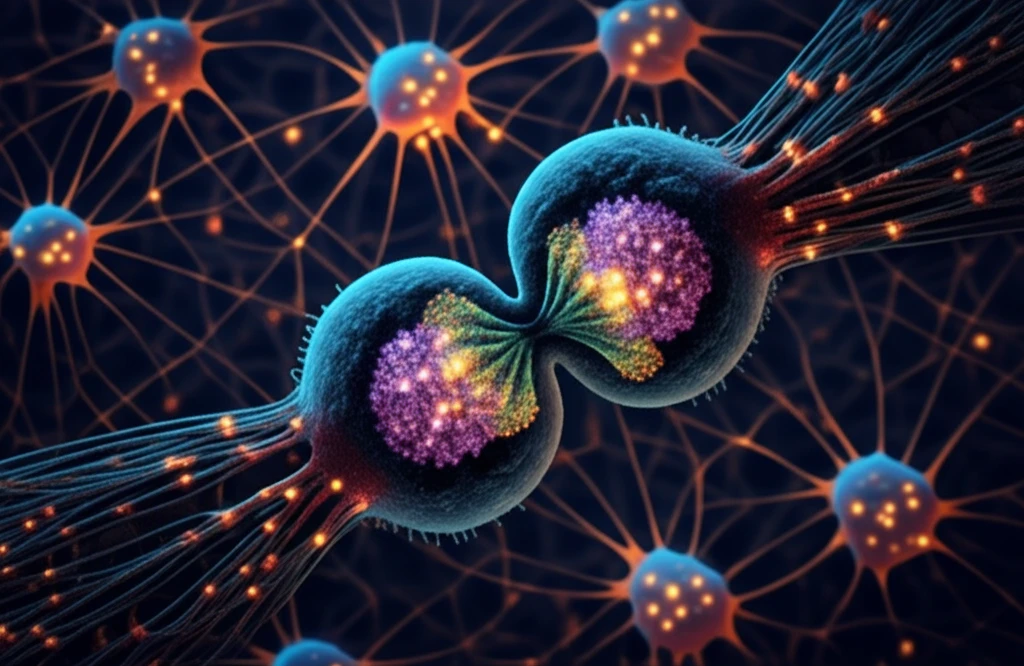
Cell Division Secrets: How a Little-Known Protein Could Hold the Key to Cancer Research

"Unlocking the mysteries of RAP55/LSM14 and its pivotal role in mitotic spindle assembly could revolutionize our understanding of cell behavior and cancer treatment."
Cell division, a fundamental process of life, relies on the precise choreography of numerous proteins and molecular structures. Among these, microtubules (MTs) stand out as essential components of the cell's cytoskeleton. These cylindrical structures, composed of tubulin, are responsible for maintaining cell shape, transporting cellular material, and, crucially, separating chromosomes during mitosis.
The MAP (Microtubule-Associated Proteins) family, encompassing both large proteins like MAP-1A and smaller components such as tau, plays a crucial role in regulating microtubule function. In this context, a protein known as RAP55/LSM14 has garnered attention for its potential involvement in mitotic spindle formation and stability.
Recent research has shed light on the previously underappreciated role of RAP55/LSM14 in cell division. A groundbreaking study reveals its dynamic localization during mitosis and its impact on the assembly and stability of the mitotic spindle. This discovery suggests new possibilities for understanding cell behavior and exploring potential therapeutic targets.
RAP55/LSM14 Identified as a Mitotic Spindle Protein
The RNA-associated protein RAP55/LSM14, a 55 kDa protein, was identified as a Mitotic Spindle Protein (MSP) in HeLa cells. Research focused on its localization during mitosis, emphasizing its role in mitotic spindle formation and stability. This finding opened a new avenue for understanding how proteins involved in RNA processing intersect with cell division machinery.
Structural Domains and Localization Mechanisms
RAP55 possesses an Lsm domain and a serine-rich region at its N-terminus, with an FDF domain and RGG-rich domains at its C-terminus. PRMT1-mediated methylation is required for RAP55 to localize to processing bodies (P-bodies). The crystal structure of the LSM domain bound to a C-terminal fragment of 4E-T has been solved, though how LSM14 broadly interacts with mRNA silencing machinery remains poorly understood.
LSM14/Rap55: An mRNA Repressor with Spindle Assembly Role
The LSM domain-containing protein LSM14/Rap55 plays established roles in mRNA decapping, translational repression, and P-body assembly. LSM14A, also known as C19orf13, FAM61A, and RAP55A, is a protein-coding gene on chromosome 19 that acts as a repressor of mRNA translation. Beyond RNA metabolism, it may also play a role in mitotic spindle assembly, marking an important convergence of RNA biology and cell division.
RAP55/LSM14: A New Player in Mitotic Spindle Assembly
The study, conducted on HeLa cells (a commonly used human cell line in biological research), identified RAP55/LSM14 as a Mitotic Spindle Protein (MSP). Using GFP-tagged proteins, researchers observed the protein's location throughout mitosis, revealing a previously unreported localization pattern. This novel finding challenges existing assumptions about the key players in cell division.
- Spindle Instability: Depletion of RAP55/LSM14 leads to compromised spindle assembly.
- Cell Cycle Arrest: Cells halt in mitosis, unable to proceed with division.
- Cytoskeletal Disruptions: Various disorders arise, indicating a broad impact on cellular structure.
- Direct Tubulin Binding: RAP55/LSM14 directly interacts with tubulin, a core component of microtubules.
LSM14B as a P-body Scaffold Protein
LSM14B (RAP55B) has been characterized as a scaffold protein essential for processing bodies (P-bodies), where it orchestrates mRNA decapping and 5'→3' decay. Knockout cell lines, such as LSM14B knockout Raji polyclonal cells, are now commercially available as research tools. These models enable more precise investigation into LSM14B's specific contributions to mRNA metabolism and potential roles in disease pathways.
Gaps in LSM14A Functional Characterization
Despite accumulating research on LSM14A — including its role in mitotic spindle assembly and P-body localization — comprehensive functional characterization in many biological contexts remains incomplete. The Atlas of Genetics and Oncology catalogs LSM14A but notes that full understanding of its mutations and disease associations is still developing. PRMT1's requirement for RAP55 localization to P-bodies adds a regulatory layer whose implications for cancer are not yet fully resolved.
Distinguishing LSM14A and LSM14B Paralogs
LSM14A and LSM14B are paralogous proteins with overlapping but distinct functions. LSM14A (RAP55A, encoded on chromosome 19) and LSM14B (RAP55B, also known as C20orf40, FAM61B) share structural features including Lsm domains but differ in expression patterns and regulatory roles. Specific antibodies are available for each paralog, reflecting their non-redundant functions in P-body dynamics and RNA metabolism. Detailed comparative functional studies between the two remain an area of active investigation.
Implications for Cancer Research
The discovery of RAP55/LSM14's critical role in mitotic spindle stability opens exciting new avenues for cancer research. Given that uncontrolled cell division is a hallmark of cancer, targeting RAP55/LSM14 could offer a novel therapeutic strategy. By disrupting the protein's function, it may be possible to selectively inhibit the proliferation of cancer cells, potentially leading to new and more effective treatments.
Bridging RNA Biology and Cell Division
The identification of LSM14 family proteins as both P-body components and mitotic spindle proteins represents a compelling link between mRNA regulation and cell division. While the dual roles of these proteins are increasingly recognized, the field is still in the process of connecting molecular mechanisms to clinical relevance. As with many early-stage research areas, translating these findings into cancer diagnostics or therapeutics will require substantially more work, and researchers should temper expectations accordingly.
LSM14A as an Emerging Therapeutic Target
LSM14A has been cataloged as a target of interest in the NIH Pharos database, signaling growing institutional attention to its biomedical potential. Its dual involvement in innate immunity — mediating interferon-β signaling via viral RNA sensing — and cell division through spindle assembly make it a multifaceted candidate for further study. Expanding the functional annotation of LSM14A, including its interactions and regulatory networks, will be critical for evaluating its therapeutic promise.
LSM14A in Innate Immunity Across Species
LSM14A serves as a key innate immunity component of P-bodies, mediating interferon-β signaling in response to viral RNA. Cross-species studies have extended research beyond humans — for instance, chicken LSm14A (cLSm14A) was cloned and characterized from blue eggshell layer chickens. These comparative immunology studies underscore that LSM14A's role in antiviral defense is evolutionarily conserved, broadening its relevance beyond cancer to infectious disease research.
Translational Potential and Challenges Ahead
The journey from characterizing a protein like LSM14A in HeLa cells to developing real-world clinical applications remains long and uncertain. While the protein's involvement in both cell division and immune signaling suggests broad relevance, the gap between bench research and patient impact is significant. Continued investment in functional studies, cross-species validation, and translational pipelines will determine whether LSM14 proteins ultimately deliver on their promise for cancer research and beyond.