
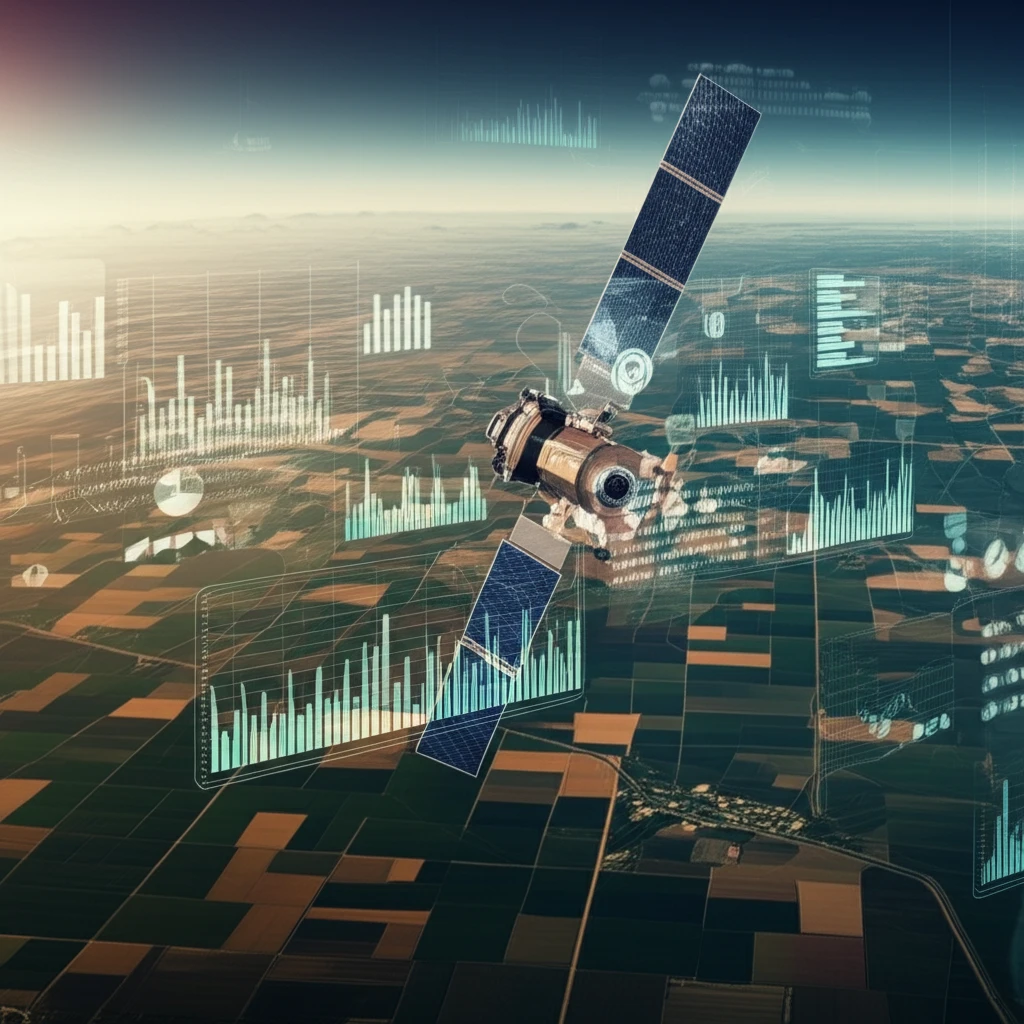
Satellite monitoring agricultural fields, visualizing crop health data.

Can Satellites Predict Your Next Grocery Bill? How Space Tech is Changing Food Prices

"Uncover how NOAA/AVHRR satellite data is revolutionizing crop monitoring and impacting food security worldwide."


In an era of increasing global population and climate uncertainty, understanding and predicting crop yields has never been more critical. Governments and organizations worldwide need accurate, up-to-date information to make informed decisions about food security, agricultural policies, and resource allocation. This is where the innovative use of satellite technology comes into play.

Traditional methods of crop monitoring, such as on-the-ground surveys and weather data analysis, can be time-consuming and geographically limited. However, advancements in remote sensing technology, particularly the use of satellite imagery, offer a powerful tool for assessing crop health and predicting yields over large areas with greater efficiency and accuracy.

One such technology, the NOAA/AVHRR (National Oceanic and Atmospheric Administration/Advanced Very High Resolution Radiometer) satellite data, is proving to be a game-changer in agricultural monitoring. By combining the Normalized Difference Vegetation Index (NDVI) and Land Surface Temperature (LST) data derived from these satellites, researchers and policymakers are gaining valuable insights into crop development, stress levels, and potential yields.

How Does Satellite Data Predict Crop Health?

Satellite monitoring agricultural fields, visualizing crop health data.

The integration of NOAA/AVHRR satellite images allows for the monitoring of soybean crops by assessing vegetation conditions through the combination of two key indicators: the Normalized Difference Vegetation Index (NDVI) and Land Surface Temperature (LST). NDVI measures the greenness of vegetation, reflecting photosynthetic activity and overall plant health. LST, on the other hand, provides information about the temperature of the land surface, which can indicate water stress or other environmental factors affecting crop development. Together, these indicators offer a comprehensive view of crop conditions.

Here's a breakdown of how the data is used:

  • NDVI (Normalized Difference Vegetation Index): This index measures the difference between near-infrared (which vegetation strongly reflects) and visible light (which vegetation absorbs). Higher NDVI values indicate healthier and denser vegetation.
  • LST (Land Surface Temperature): This measures the actual temperature of the ground. Stressed vegetation often has a higher temperature.
  • Data Combination: Researchers combine NDVI and LST data to detect areas where vegetation might be stressed due to drought or other factors. A healthy crop typically shows high NDVI and lower LST.
By monitoring these indicators throughout the growing season, it’s possible to detect early signs of stress, estimate potential yields, and inform timely interventions.

The Future of Food Security: A High-Tech Approach

The use of satellite data in agriculture is more than just an interesting application of technology; it's a critical tool for ensuring food security in a changing world. By providing timely and accurate information about crop conditions, these technologies enable more informed decision-making, more efficient resource allocation, and ultimately, a more resilient food system. As climate change continues to impact agricultural regions around the globe, expect satellite-driven insights to become even more vital in ensuring a stable and affordable food supply for everyone.

About this Article -

This article was crafted using a human-AI hybrid and collaborative approach. AI assisted our team with initial drafting, research insights, identifying key questions, and image generation. Our human editors guided topic selection, defined the angle, structured the content, ensured factual accuracy and relevance, refined the tone, and conducted thorough editing to deliver helpful, high-quality information.See our About page for more information.

This article is based on research published under:

DOI-LINK: 10.1590/s0034-737x2013000200007, Alternate LINK

Title: Integração De Imagens Noaa/Avhrr: Rede De Cooperação Para Monitoramento Nacional Da Safra De Soja

Subject: General Agricultural and Biological Sciences

Journal: Revista Ceres

Publisher: FapUNIFESP (SciELO)

Authors: Anibal Gusso

Published: 2013-04-01

Everything You Need To Know

1

How does NOAA/AVHRR satellite data assist in predicting crop yields and ensuring food security?

NOAA/AVHRR satellite data plays a crucial role by providing key indicators such as the Normalized Difference Vegetation Index (NDVI) and Land Surface Temperature (LST). NDVI measures the greenness of vegetation, reflecting its photosynthetic activity and overall health. LST indicates the temperature of the land surface, helping to identify water stress or other environmental factors affecting crop development. By combining NDVI and LST data, researchers can assess crop health, detect early signs of stress, and estimate potential yields, enabling informed decisions about food security and resource allocation. Furthermore, while the technology offers promise, it's crucial to integrate this satellite information with on-the-ground assessments and weather data for a more comprehensive and accurate analysis.

2

What is the Normalized Difference Vegetation Index (NDVI), and how does it help in monitoring crop health using satellite imagery?

The Normalized Difference Vegetation Index (NDVI) is a key indicator derived from satellite data, specifically NOAA/AVHRR, used to measure the greenness and density of vegetation. It quantifies the difference between near-infrared light, which vegetation strongly reflects, and visible light, which vegetation absorbs. Higher NDVI values indicate healthier and denser vegetation, signifying greater photosynthetic activity and overall plant health. By monitoring NDVI values throughout the growing season, researchers can assess crop development, detect stress, and estimate potential yields. The NDVI is limited as it can be affected by soil background and atmospheric conditions, so other indices like the Enhanced Vegetation Index (EVI) may be used in conjunction.

3

Can you explain Land Surface Temperature (LST) and its significance in determining crop conditions using satellite data?

Land Surface Temperature (LST) is a crucial parameter derived from satellite data that measures the actual temperature of the ground. Stressed vegetation often exhibits higher temperatures due to reduced transpiration, making LST a valuable indicator of water stress, disease, or other environmental factors affecting crop development. By monitoring LST in conjunction with the Normalized Difference Vegetation Index (NDVI), researchers can gain a comprehensive understanding of crop conditions, detect areas where vegetation might be stressed, and inform timely interventions. However, LST alone may not provide a complete picture; factors like soil moisture and air temperature should also be considered.

4

How do governments and organizations leverage insights from NOAA/AVHRR satellite data to make decisions about agricultural policies and food security?

Governments and organizations use insights from NOAA/AVHRR satellite data, including the Normalized Difference Vegetation Index (NDVI) and Land Surface Temperature (LST), to obtain accurate, up-to-date information on crop conditions and potential yields. This data enables them to make informed decisions about agricultural policies, resource allocation, and food security strategies. By monitoring these indicators, policymakers can identify areas at risk of crop failure, implement timely interventions, and ensure a stable and affordable food supply, particularly in the face of climate change and increasing global population. Still, satellite data is part of a bigger process that includes logistical planning and economic forecasting.

5

What are the implications of using satellite data like NOAA/AVHRR to monitor crops on the prices consumers pay for groceries?

The use of satellite data like NOAA/AVHRR, specifically the Normalized Difference Vegetation Index (NDVI) and Land Surface Temperature (LST), to monitor crops can have significant implications for grocery prices. By providing early warnings about potential crop failures or reduced yields, this technology enables more informed decision-making and efficient resource allocation. This can lead to more stable and predictable food supplies, reducing the risk of price spikes due to scarcity. Also, governments and organizations can create policies and financial instruments to protect the farming community. Efficient crop monitoring and prediction may help to stabilize prices and avoid volatility, ultimately affecting what consumers pay at the grocery store. While it can help, factors like transportation costs and market demand are also highly influential.

Newsletter Subscribe

Subscribe to get the latest articles and insights directly in your inbox.