
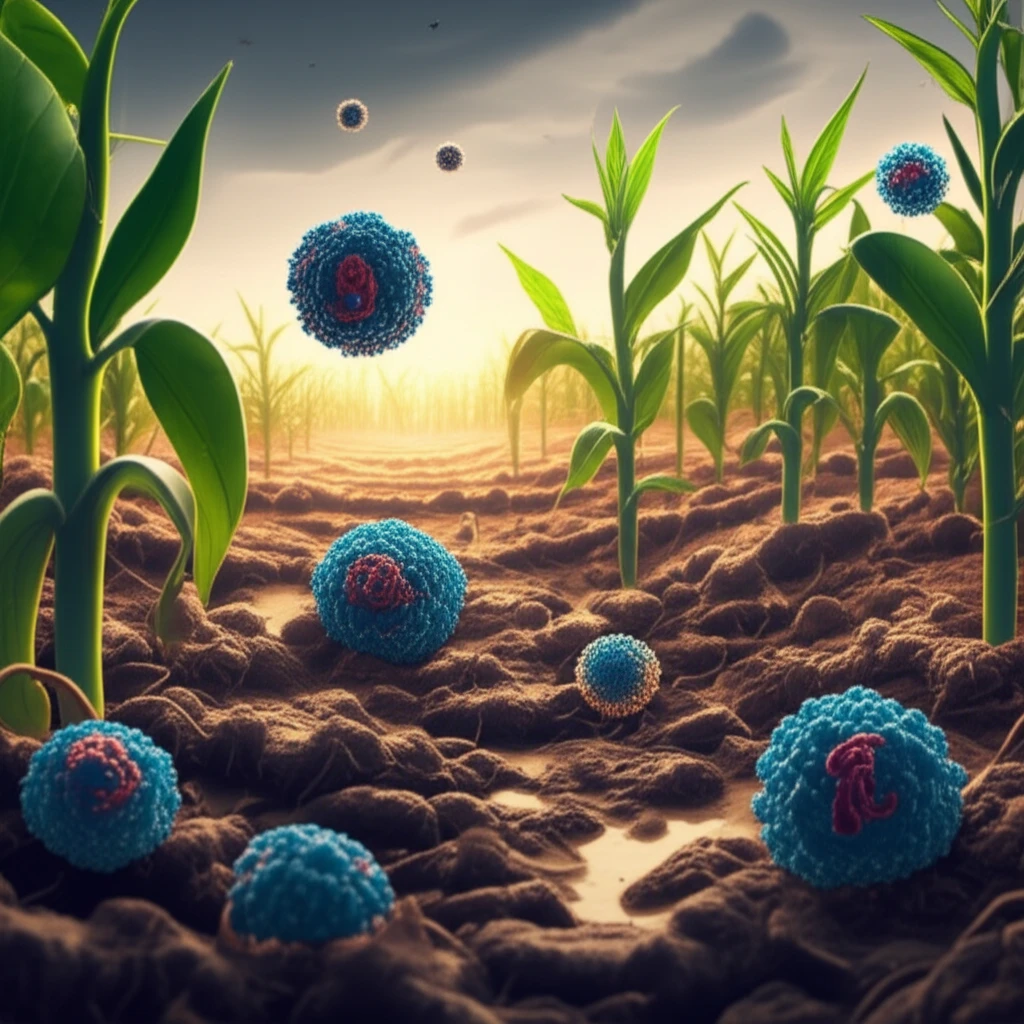
Can Nanotechnology Clean Up Our Farms? How Nanomaterials Offer a New Solution for Herbicide Pollution

"Innovative Nanocomposites Show Promise in Breaking Down Harmful Herbicides Like Imazapyr, Paving the Way for Safer Agriculture"
For years, the agricultural industry has heavily relied on herbicides to boost crop yields and manage unwanted vegetation. However, the widespread use of these chemicals, particularly herbicides like imazapyr, has led to significant environmental concerns. These substances can leach into the soil and groundwater, causing lasting damage to ecosystems and potentially impacting human health. The challenge lies in finding effective ways to mitigate the harmful effects of these pollutants without compromising agricultural productivity.
Traditional methods of removing herbicides from the environment, such as chemical oxidation and adsorption, often come with their own set of drawbacks. Some processes may produce secondary pollutants that are equally or even more harmful than the original compounds. This has spurred researchers to explore innovative solutions that are both efficient and environmentally friendly. Nanotechnology, with its unique ability to manipulate materials at the atomic and molecular level, has emerged as a promising field in this endeavor.
Recent research has focused on the development of nanomaterials capable of breaking down herbicides into less harmful substances through a process called photocatalysis. This method uses semiconductor materials, like gallium oxide (Ga2O3) and titanium dioxide (TiO2), in the form of nanocomposites. When exposed to light, these materials can catalyze the degradation of organic pollutants, offering a sustainable and effective way to clean up contaminated environments. This article will delve into how these nanomaterials work and their potential to revolutionize herbicide pollution management.
How Do Ga2O3-TiO2 Nanocomposites Degrade Herbicides?
Scientists have been exploring various metal oxides for their photocatalytic properties, with particular interest in those containing specific electron configurations. Semiconductors with a d¹⁰ electron configuration, such as gallium oxide (Ga2O3), have shown remarkable photocatalytic activity because their conduction bands facilitate the generation of highly mobile photoexcited electrons. Gallium oxide, in particular, exhibits strong performance in water-splitting and degrading organic pollutants.
- Mixing a triblock copolymer surfactant (F127) with ethanol.
- Adding hydrochloric acid, tetrabutyl orthotitanate (TBOT), and acetic acid to the solution.
- Introducing a calculated amount of gallium(III) nitrate hydrate to form a mesophase.
- Aging the mesophase in a humidity chamber to form a gel.
- Calcinating the gel at high temperatures to remove the template and produce the nanocomposite.
The Future of Nanomaterials in Environmental Cleanup
The development and application of mesoporous Ga2O3-TiO2 nanocomposites represent a significant step forward in addressing herbicide pollution. These materials offer a sustainable and efficient way to degrade harmful chemicals, protecting our soil and water resources. Further research and development in this field could pave the way for broader applications of nanomaterials in environmental cleanup, ensuring a safer and more sustainable future for agriculture and beyond.