
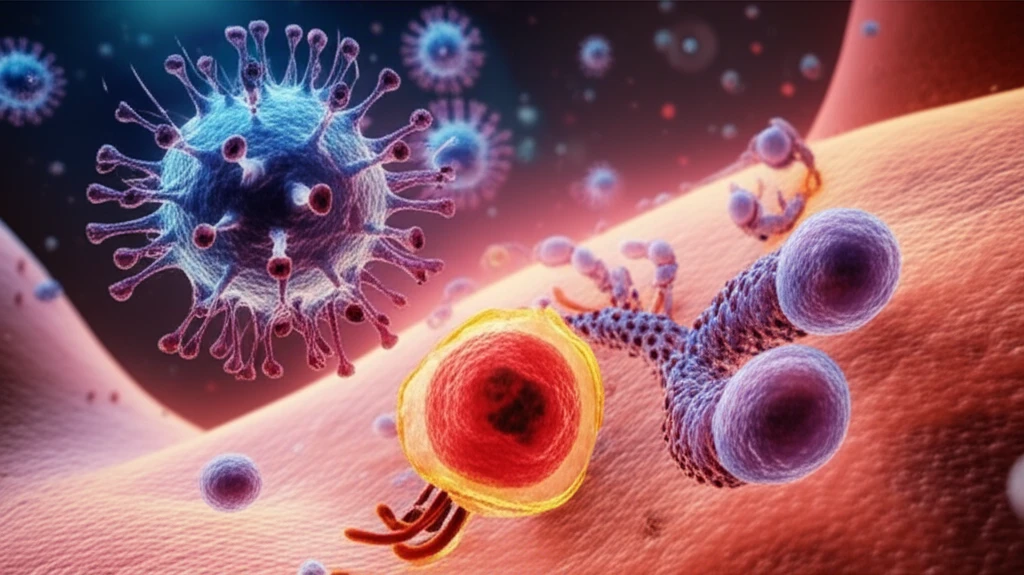
Newcastle Disease Virus interacting with a lung cancer cell.

Can Mitophagy Be the Key to Beating Lung Cancer? How Newcastle Disease Virus Hijacks Cell Defenses

"New research uncovers how Newcastle Disease Virus (NDV) uses mitophagy to replicate and evade cancer cell defenses, paving the way for innovative cancer treatments."


The quest to improve cancer treatments through oncolytic virotherapy—using viruses to target and destroy cancer cells—is heavily reliant on understanding the intricate mechanisms at play within cancer cells. Newcastle disease virus (NDV), a virus known for its oncolytic properties, has shown promise in clinical studies. Understanding exactly how NDV interacts with cancer cells is crucial for enhancing its effectiveness and safety.

Apoptosis, or programmed cell death, is a well-known mechanism by which NDV combats tumors. However, autophagy, a protective response that cells activate under stress, including viral infections, adds another layer of complexity. Researchers are now exploring how autophagy interferes with NDV's oncolytic activity, seeking ways to tip the balance in favor of cancer cell destruction.

Recent studies have illuminated that the NDV La Sota strain induces autophagy while maintaining autophagic flux in non-small cell lung cancer cells. This process allows NDV to promote viral replication by preventing cancer cells from undergoing caspase-dependent apoptosis. The virus cleverly uses mitophagy, a selective form of autophagy, to control cytochrome c release, thereby blocking intrinsic pro-apoptotic signals. This discovery sets the stage for new therapeutic strategies that combine NDV with autophagy inhibitors to enhance cancer therapy.

How Does NDV Exploit Mitophagy to Its Advantage?

Newcastle Disease Virus interacting with a lung cancer cell.

The study reveals that NDV infection triggers autophagy in lung cancer cells, preserving the autophagic flux—the process by which cells degrade and recycle cytoplasmic components. This induction of autophagy leads to the formation of autophagosomes, cellular structures responsible for engulfing and breaking down damaged or unnecessary cell parts.

One of the key findings is that NDV recruits SQSTM1, a protein that acts as a signaling hub, to mediate mitophagy. Mitophagy is the selective removal of damaged mitochondria, which are essential for triggering apoptosis. By controlling cytochrome c release, mitophagy effectively blocks the intrinsic pro-apoptotic signaling pathway, preventing the cancer cells from self-destructing.

Here’s a closer look at the key steps in this process:
  • Autophagy Induction: NDV infection triggers the formation of autophagosomes in lung cancer cells.
  • SQSTM1 Recruitment: The virus recruits SQSTM1 to mediate mitophagy.
  • Mitochondrial Control: Mitophagy controls the release of cytochrome c, a critical component of apoptosis.
  • Apoptosis Prevention: By preventing cytochrome c release, NDV blocks the intrinsic pro-apoptotic signaling pathway.
To further validate these findings, scientists used autophagy inhibitors like 3-methyladenine (3-MA) to block autophagy. They observed that inhibiting autophagy enhanced NDV's oncolytic effects, leading to more cancer cell death. Interestingly, the timing of the autophagy inhibition was crucial: delaying the administration of 3-MA until 24 hours after NDV infection resulted in a more profound antitumor effect.

Future Directions for NDV-Based Cancer Therapy

These findings highlight a novel strategy where NDV subverts mitophagy to promote its replication by blocking apoptosis. This discovery provides a rationale for combining NDV with autophagy inhibitors in cancer therapy, potentially leading to more effective treatments. Future research will likely focus on refining this therapeutic approach, exploring optimal timing and dosages of autophagy inhibitors, and investigating the potential of this combination therapy in various cancer types.

About this Article -

This article was crafted using a human-AI hybrid and collaborative approach. AI assisted our team with initial drafting, research insights, identifying key questions, and image generation. Our human editors guided topic selection, defined the angle, structured the content, ensured factual accuracy and relevance, refined the tone, and conducted thorough editing to deliver helpful, high-quality information.See our About page for more information.

Everything You Need To Know

1

What is the primary role of Newcastle Disease Virus (NDV) in the context of lung cancer treatment?

Newcastle Disease Virus (NDV) functions as an oncolytic virus, meaning it is designed to target and destroy cancer cells. The research focuses on understanding how NDV interacts with lung cancer cells to improve its effectiveness and safety in cancer treatments. NDV achieves this by exploiting cellular processes like mitophagy and autophagy to replicate and evade cancer cell defenses, as opposed to directly destroying cancer cells via apoptosis which is a well-known mechanism.

2

How does Newcastle Disease Virus (NDV) exploit Mitophagy to promote its replication within cancer cells?

NDV exploits Mitophagy, a selective form of autophagy, to prevent cancer cells from undergoing apoptosis, which is programmed cell death. NDV recruits SQSTM1, a signaling protein, to mediate mitophagy. This process allows NDV to control the release of cytochrome c, a critical component needed for the intrinsic pro-apoptotic signaling pathway. By blocking the release of cytochrome c, NDV effectively prevents cancer cells from initiating apoptosis, thereby allowing the virus to replicate more successfully within the cell.

3

What is the significance of Autophagy and Autophagic flux in the context of NDV's interaction with lung cancer cells?

Autophagy is a protective cellular response that cells activate under stress, including viral infections. In the context of NDV, autophagy interferes with its oncolytic activity. NDV induces autophagy and maintains autophagic flux in non-small cell lung cancer cells. Autophagic flux refers to the process by which cells degrade and recycle cytoplasmic components. This process allows NDV to promote viral replication by preventing cancer cells from undergoing caspase-dependent apoptosis. The research indicates that inhibiting autophagy enhances NDV's oncolytic effects, leading to more cancer cell death.

4

How can autophagy inhibitors potentially enhance the effectiveness of Newcastle Disease Virus (NDV) in cancer therapy?

Autophagy inhibitors like 3-methyladenine (3-MA) can enhance the oncolytic effects of NDV by blocking autophagy. When autophagy is inhibited, it disrupts the process by which NDV promotes its replication and evades apoptosis. The studies have shown that inhibiting autophagy leads to more cancer cell death. The timing of autophagy inhibition is crucial. Administering 3-MA 24 hours after NDV infection resulted in a more profound antitumor effect, suggesting that disrupting autophagy at a specific time can optimize the therapeutic outcome.

5

What are the future directions for research and treatment strategies based on the interaction between Newcastle Disease Virus (NDV) and Mitophagy?

Future research will focus on refining the therapeutic approach of combining NDV with autophagy inhibitors in cancer therapy. The aim is to optimize the timing and dosages of autophagy inhibitors and investigate the potential of this combination therapy in various cancer types. This research will likely explore how NDV subverts mitophagy to promote its replication and block apoptosis, to develop more effective treatments. Understanding these mechanisms provides a rationale for combining NDV with autophagy inhibitors, potentially leading to more effective treatments.

Newsletter Subscribe

Subscribe to get the latest articles and insights directly in your inbox.