
Can Marine Oxygen Carriers Revolutionize Bone Regeneration?

"New research explores how a marine-derived oxygen carrier enhances bone cell growth and differentiation, potentially transforming bone tissue engineering."
In dental surgery, the quest for successful osseointegration – the direct structural and functional connection between living bone and the surface of a dental implant – is a constant pursuit. While dental implants are a standard procedure, compromised bone due to trauma, disease, or irradiation can significantly hinder this process. The challenge lies in creating an environment where new bone can effectively integrate with the implant, ensuring its long-term stability and function.
Tissue engineering offers a promising solution by combining osteocompetent cells, growth factors, and biocompatible scaffolds to create bone-like environments. However, a major obstacle remains: ensuring uniform cell distribution and adequate nutrient and oxygen supply within these three-dimensional scaffolds. Insufficient oxygen, in particular, can lead to cell death and hinder the formation of new bone tissue. The challenge for scientists is in increasing the oxygen to cells.
Now, a team of researchers has explored the potential of HEMOXCell, a marine-derived oxygen carrier, to enhance bone regeneration. Their findings, published in Artificial Cells, Nanomedicine, and Biotechnology, suggest that HEMOXCell can significantly promote bone cell proliferation and differentiation within bone scaffolds, paving the way for more effective bone grafts and implants. This article dives into the details of this study, explaining how HEMOXCell works and its potential implications for the future of bone tissue engineering.
HEMOXCell: Delivering Oxygen for Bone Growth
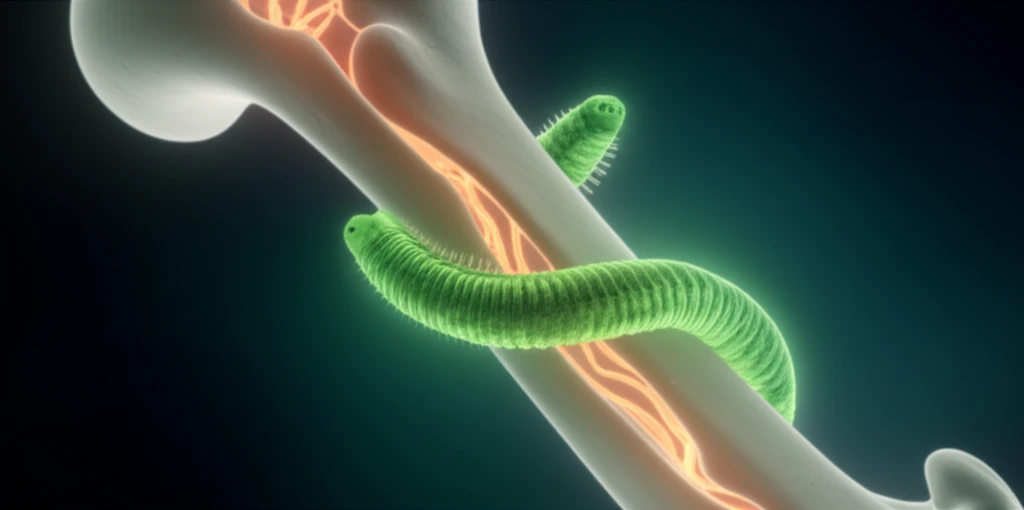
HEMOXCell is an extracellular hemoglobin extracted from the marine worm Nereis virens. Unlike human hemoglobin, HEMOXCell can carry 40 times more oxygen molecules, releasing them according to the oxygen needs of the surrounding cells. This unique property makes it an ideal candidate for improving oxygen delivery in bone tissue engineering.
- Enhanced Cell Proliferation and Differentiation: Perfusion culture with HEMOXCell significantly promoted MSC proliferation and differentiation into osteoblasts (bone-forming cells) throughout the scaffolds.
- Improved Cell Distribution: HEMOXCell facilitated a more uniform distribution of cells within the scaffolds, overcoming the limitations of static culture methods.
- Increased ECM Production: The combination of perfusion culture and HEMOXCell led to enhanced production of extracellular matrix (ECM), the structural framework of bone tissue.
Future Implications: A New Era for Bone Tissue Engineering?
This research provides a promising foundation for the use of HEMOXCell in bone tissue engineering applications. By addressing the critical issue of oxygen supply, HEMOXCell has the potential to significantly improve the success rates of bone grafts and implants, especially in cases where bone is compromised.
While further research is needed to fully understand the long-term effects and optimize the use of HEMOXCell, these findings offer a glimpse into a future where marine-derived compounds play a vital role in regenerative medicine. The ability to enhance oxygen delivery to cells within engineered tissues could have far-reaching implications beyond bone regeneration, potentially impacting the treatment of various other conditions.
For individuals facing bone regeneration challenges, this research offers hope for more effective and reliable treatment options in the future. As tissue engineering continues to evolve, innovative solutions like HEMOXCell are paving the way for a new era of regenerative medicine.