
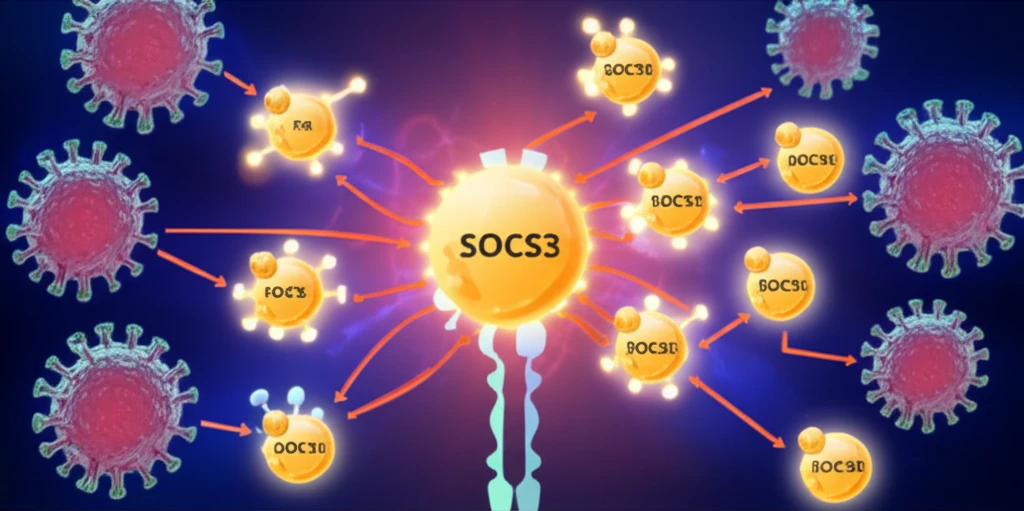
FXR activation inducing SOCS3 expression to suppress liver cancer cells

Can FXR Activation Stop Liver Cancer?

"New research highlights how targeting FXR-SOCS3 signaling could revolutionize HCC prevention and treatment."


Liver cancer, or hepatocellular carcinoma (HCC), is a formidable global health challenge. The intricate mechanisms that drive its development continue to be a focus of intensive research, particularly strategies that can halt or reverse its progression. Suppressor of cytokine signaling 3 (SOCS3) has emerged as a crucial player, known for its ability to suppress the signal transducer and activator of transcription 3 (STAT3), a pathway often hyperactive in cancer.

Enter Farnesoid X Receptor (FXR), a protein abundant in the liver, recognized for its protective functions against liver diseases, including HCC. Scientists have been probing whether FXR's tumor-fighting abilities involve SOCS3 regulation, potentially opening new avenues for treatment.

A recent study sheds light on this connection, revealing how activating FXR can induce SOCS3, leading to the suppression of HCC. This article delves into the key findings, exploring the potential of FXR-SOCS3 signaling as a novel target for preventing and treating liver cancer.

FXR's Impact on HCC: Inducing SOCS3 and Suppressing Cancer

FXR activation inducing SOCS3 expression to suppress liver cancer cells

The study reveals that when FXR is activated using GW4064 in HCC cells, several anti-tumor effects are observed: cell growth is inhibited, cell cycle arrest occurs at the G1 phase, expression of p21 is elevated, and STAT3 activity is repressed. Crucially, when SOCS3 is knocked down using siRNA, these anti-tumor effects are significantly weakened. This indicates that SOCS3 plays a vital role in FXR's ability to combat HCC.

Researchers further demonstrated that FXR directly binds to a specific DNA motif (IR9) within the SOCS3 promoter region. This binding enhances the transcriptional activity of SOCS3, meaning FXR actively boosts SOCS3 production. In live models, treatment with the FXR ligand GW4064 slowed the growth of HCC xenografts, increased SOCS3 and p21 expression, and reduced STAT3 phosphorylation within the tumors.

  • Cell Growth Inhibition: GW4064 drastically reduces the rate of cell proliferation in HCC cells.
  • Cell Cycle Arrest: GW4064 suppresses entry into the S phase, a critical stage of cell division.
  • p21 Up-regulation: Both transcriptional and translational levels of p21, a protein controlling cell cycle progression, are increased.
  • STAT3 Suppression: FXR activation inhibits STAT3 activation.
  • SOCS3 Increase: FXR activation increases SOCS3 expression.
These results suggest that FXR's activation of SOCS3 may be a key mechanism through which FXR exerts its anti-HCC effects, suggesting that FXR-SOCS3 signaling could be a valuable target for HCC prevention and treatment.

A New Horizon in Liver Cancer Treatment

This research underscores the potential of SOCS3 as a tumor suppressor in various cancers, with evidence showing that its overexpression can exhibit anti-tumor activity against HCC and other malignancies. By understanding how FXR activates SOCS3, scientists are paving the way for innovative therapeutic strategies.

The study also highlights a significant correlation between FXR and SOCS3 expression in human HCC specimens. Tumoral FXR and SOCS3 expression were notably lower than in peritumoral tissue, whereas STAT3 was over-activated in HCC lesions. This suggests that the dysregulation of FXR and SOCS3 may contribute to HCC development and progression.

As research progresses, the modulation of FXR and SOCS3 could offer new hope for patients, potentially revolutionizing how liver cancer is approached and treated.

About this Article -

This article was crafted using a human-AI hybrid and collaborative approach. AI assisted our team with initial drafting, research insights, identifying key questions, and image generation. Our human editors guided topic selection, defined the angle, structured the content, ensured factual accuracy and relevance, refined the tone, and conducted thorough editing to deliver helpful, high-quality information.See our About page for more information.

This article is based on research published under:

DOI-LINK: 10.18632/oncotarget.5314, Alternate LINK

Title: Fxr Induces Socs3 And Suppresses Hepatocellular Carcinoma

Subject: Oncology

Journal: Oncotarget

Publisher: Impact Journals, LLC

Authors: Fei Guo, Zhizhen Xu, Yan Zhang, Peng Jiang, Gang Huang, Shan Chen, Xilin Lyu, Ping Zheng, Xin Zhao, Yijun Zeng, Shuguang Wang, Fengtian He

Published: 2015-09-21

Everything You Need To Know

1

What is Hepatocellular Carcinoma (HCC) and why is it important?

Hepatocellular Carcinoma (HCC) is a severe form of liver cancer, posing a significant global health challenge. Its complex nature necessitates ongoing research to discover effective treatments. The implications of HCC involve a high mortality rate and limited treatment options, making the study of potential therapeutic targets, like FXR and SOCS3, crucial for improving patient outcomes.

2

What is Farnesoid X Receptor (FXR) and what role does it play in this context?

Farnesoid X Receptor (FXR) is a protein predominantly found in the liver, known for its protective roles against liver diseases, including HCC. The significance of FXR lies in its ability to induce Suppressor of cytokine signaling 3 (SOCS3), potentially suppressing the development of HCC. Activation of FXR using GW4064 results in multiple anti-tumor effects, including cell growth inhibition, cell cycle arrest, and STAT3 suppression. This makes FXR a promising target for therapeutic interventions, aiming to leverage its protective capabilities against liver cancer.

3

What is Suppressor of cytokine signaling 3 (SOCS3) and why is it significant?

Suppressor of cytokine signaling 3 (SOCS3) is a crucial protein in the context of liver cancer, particularly HCC. It's known for its ability to suppress the signal transducer and activator of transcription 3 (STAT3) pathway, which is often overactive in cancers. The importance of SOCS3 lies in its tumor-suppressing capabilities. The research indicates that FXR activation leads to increased SOCS3 expression, which is directly linked to the suppression of HCC. Its implications involve potentially halting or reversing the progression of liver cancer.

4

How are Farnesoid X Receptor (FXR) and Suppressor of cytokine signaling 3 (SOCS3) related?

The relationship between FXR and SOCS3 is that FXR activation directly leads to increased SOCS3 expression in HCC cells. FXR binds to a specific DNA motif (IR9) within the SOCS3 promoter region, enhancing the transcriptional activity of SOCS3. This activation of SOCS3 is crucial for the anti-tumor effects observed when FXR is activated, such as cell growth inhibition and cell cycle arrest. The implications of this relationship is that targeting the FXR-SOCS3 signaling pathway could be a viable approach for HCC prevention and treatment.

5

What are the key outcomes when FXR is activated, and what do these findings mean?

Activating FXR with GW4064 leads to several anti-tumor effects in HCC cells, including cell growth inhibition, cell cycle arrest at the G1 phase, increased p21 expression, and suppressed STAT3 activity. Moreover, the anti-tumor effects of FXR activation are significantly weakened when SOCS3 is knocked down. The importance of these findings is that they highlight the potential therapeutic benefits of targeting the FXR-SOCS3 signaling pathway for the treatment of HCC. The implications are that by understanding and leveraging the mechanisms by which FXR activates SOCS3, scientists may develop innovative therapeutic strategies to combat liver cancer.

Newsletter Subscribe

Subscribe to get the latest articles and insights directly in your inbox.