
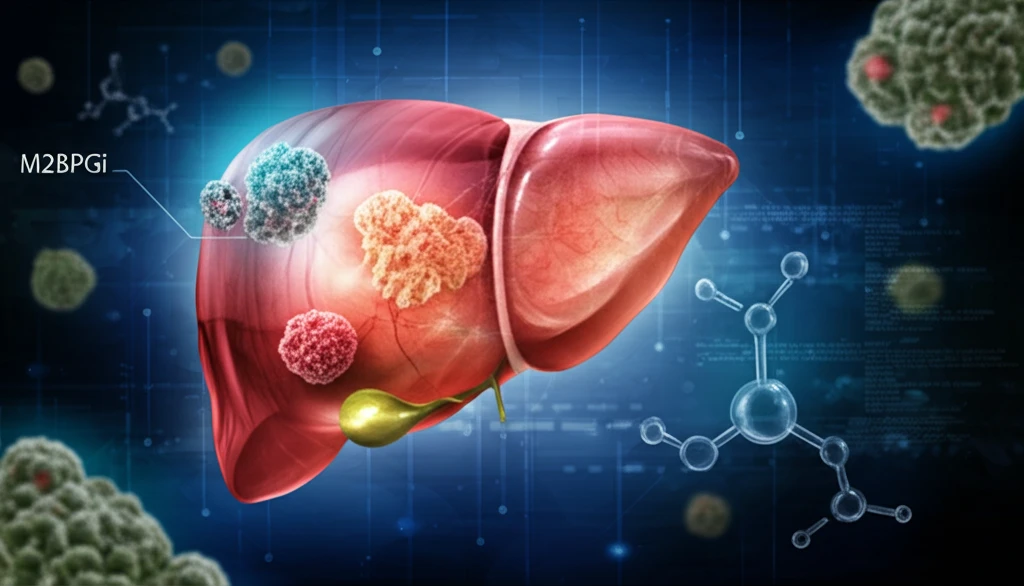
Decoding Liver Health: Can M2BPGi Levels Predict Cancer Risk After Hepatitis B Treatment?

"A groundbreaking study reveals how monitoring M2BPGi could revolutionize hepatocellular carcinoma prediction in chronic hepatitis B patients undergoing antiviral therapy."
Chronic hepatitis B (CHB) affects millions worldwide and poses a significant risk of developing hepatocellular carcinoma (HCC), a primary liver cancer. While antiviral therapies have greatly improved outcomes for CHB patients, the risk of HCC isn't entirely eliminated. This is where biomarkers like Mac-2 binding protein glycosylation isomer (M2BPGi) come into play, offering a potential tool for refined risk assessment.
M2BPGi is a liver-specific isoform of Mac-2 binding protein. Recent research highlights it as a promising biomarker for evaluating liver fibrosis and predicting liver disease progression. The level of M2BPGi in the blood reflects the condition of the liver, but how it changes with antiviral treatment and how it relates to cancer risk is still under investigation.
A new study published in 'Alimentary Pharmacology & Therapeutics' sheds light on M2BPGi's role in patients with CHB undergoing oral antiviral therapy. Researchers followed a cohort of patients, tracking changes in M2BPGi levels and their connection to the development of HCC. The findings have implications for how doctors monitor and manage patients with CHB.
Current Statistics & Impact
Hepatocellular carcinoma (HCC) remains a leading cause of cancer mortality worldwide, with chronic hepatitis B virus (HBV) infection serving as a primary driver in many regions. Despite advances in antiviral therapy that suppress viral replication, a substantial proportion of treated patients remain at risk for HCC development, particularly those with established fibrosis or cirrhosis. Current surveillance strategies rely heavily on imaging and alpha-fetoprotein testing, which have recognized limitations in early detection. The search for non-invasive biomarkers that can stratify post-treatment cancer risk has therefore gained urgency in clinical hepatology. Reliable risk prediction would enable more personalized surveillance and earlier intervention for those most likely to benefit.
Standard Approach, Accepted Methods & Their Limitations
Liver biopsy has long been the reference standard for fibrosis staging, yet its invasiveness, sampling variability, and procedural risks limit routine use, especially for serial monitoring. Non-invasive alternatives such as transient elastography (FibroScan) and serum marker panels have been adopted, but their performance can be affected by inflammation, obesity, and operator dependence. Recent systematic reviews highlight that elevated serum M2BPGi is strongly and consistently associated with HCC development in chronic hepatitis B and C, with the effect persisting across etiologies, treatment status, and measurement timing—including after sustained virological response. A 2026 meta-analysis registered with PROSPERO pooled longitudinal data and confirmed this association through hazard ratio synthesis. Expert consensus further underscores the need for accurate fibrosis staging to guide clinical management in chronic liver disease.
Historical Perspective, Milestones, Foundational Discoveries
Mac-2 binding protein glycosylation isomer (M2BPGi) emerged as a serum glycobiomarker reflecting liver fibrosis through alterations in glycosylation patterns during fibrogenesis. Early cohort studies linked elevated M2BPGi levels to increased HCC incidence, though quantitative synthesis across viral etiologies was lacking until recently. The development of a quantitative M2BPGi (M2BPGi-Qt) assay represented a key milestone, enabling precise measurement and standardization that facilitated broader clinical validation. This advancement paved the way for real-world evaluation of M2BPGi as a tool for diagnosing fibrosis progression and contributing to early HCC detection. The trajectory from initial biomarker discovery to quantitative assay development illustrates the iterative process of translating glycobiology into clinical practice.
How Does M2BPGi Change with Antiviral Treatment and Why Does It Matter?
The study enrolled 384 patients with previously untreated CHB who started antiviral therapy. Researchers collected blood samples at the beginning of treatment and then annually for two years, measuring M2BPGi levels and monitoring the patients for HCC development. The researchers found:
- Significant Decline: M2BPGi levels significantly decreased after antiviral therapy.
- First Year Impact: The most substantial reduction in M2BPGi occurred during the first year of treatment.
- Cirrhosis Matters: Patients with cirrhosis had higher M2BPGi levels than those without, underscoring the importance of liver condition.
Latest Research and Reviews
A 2026 multicenter cross-sectional study evaluated M2BPGi as a biomarker for liver fibrosis and HCC in chronic hepatitis B and C patients, affirming its diagnostic potential as a non-invasive tool. The findings underscore M2BPGi's utility in both fibrosis staging and HCC risk assessment, while also acknowledging limitations in certain clinical contexts that warrant further investigation. This work contributes to a growing evidence base supporting M2BPGi's role in comprehensive liver disease evaluation.
Counter Arguments and Failures
While M2BPGi shows promise, its clinical adoption faces unresolved questions regarding optimal cut-off values across diverse populations and etiologies. Some studies report reduced discriminatory performance in cirrhotic subgroups compared to non-cirrhotic patients, raising concerns about context-dependent reliability. Standardization of assay platforms and reference ranges remains incomplete, potentially limiting cross-study comparability. Additionally, the incremental value of M2BPGi over established non-invasive panels and imaging has not been definitively established in all settings. Ongoing validation in real-world cohorts is needed to address these gaps.
Comparative Analysis
Comparative studies indicate M2BPGi performs significantly better in HBV patients overall (AUROC 0.84) than in those with established cirrhosis (AUROC 0.69), suggesting fibrosis stage influences its discriminatory capacity. Research demonstrates high agreement between M2BPGi and FibroScan for fibrosis assessment, positioning M2BPGi as a reliable alternative for non-invasive evaluation. In the biomarker landscape, M2BPGi complements other emerging markers such as HBcrAg and miRNA-122, each offering distinct biological insights into HCC risk stratification. Multi-marker panels incorporating M2BPGi may enhance predictive accuracy beyond single-marker approaches.
The Future of Liver Cancer Prediction: Personalizing Care with M2BPGi
This study provides valuable insights into how M2BPGi can be used to assess liver health and predict HCC risk in CHB patients undergoing antiviral therapy. By measuring M2BPGi levels at baseline, doctors can identify high-risk individuals and tailor their monitoring and treatment strategies accordingly, potentially improving outcomes and saving lives. More studies are needed to validate these results and explore how M2BPGi can be integrated into routine clinical practice.
Synthesis & Expert Commentary
The converging evidence positions M2BPGi as a clinically meaningful biomarker that bridges fibrosis assessment and HCC risk prediction in chronic viral hepatitis. Its ability to retain prognostic value after antiviral treatment and sustained virological response addresses a critical gap in post-treatment surveillance. Expert consensus emphasizes that accurate fibrosis staging remains foundational to clinical decision-making, and M2BPGi offers a non-invasive pathway to achieve this. However, integration into guidelines requires resolution of standardization, cut-off harmonization, and cost-effectiveness questions. The biomarker's greatest utility may lie in refining risk stratification within existing surveillance frameworks rather than replacing them.
Future Outlook & Next Frontiers
With HCC claiming approximately 830,000 lives annually—mostly from chronic viral hepatitis—research priorities include prospective validation of M2BPGi-guided surveillance protocols and evaluation of its cost-effectiveness in diverse healthcare systems. The quantitative M2BPGi assay enables standardization needed for multi-center trials and potential regulatory approval as a companion diagnostic. Emerging directions include integration with artificial intelligence models combining imaging, clinical, and multi-omics data for personalized risk prediction. Longitudinal studies tracking M2BPGi trajectories post-treatment may reveal dynamic patterns that further refine risk timelines.
Broader Context & Systemic Challenges
Global disparities in HCC burden and healthcare access create uneven demand for non-invasive biomarkers like M2BPGi, particularly in resource-limited regions where biopsy and advanced imaging are scarce. Implementation challenges include assay availability, laboratory infrastructure, clinician education, and reimbursement policies that vary widely across health systems. The biomarker's value proposition must be demonstrated within local care pathways to justify adoption. Addressing these systemic barriers requires collaboration among researchers, industry, policymakers, and patient advocates to ensure equitable translation of scientific advances into clinical benefit.
The Human Element & Real-World Impact
A study of 90 participants with chronic hepatitis B evaluated M2BPGi alongside HBcrAg and miRNA-122 in liquid biopsies for early HCC detection and risk assessment, highlighting the patient-centered potential of minimally invasive monitoring. For individuals living with chronic HBV, the prospect of a simple blood test replacing or reducing invasive procedures carries profound implications for quality of life and adherence to surveillance. Early detection enabled by such biomarkers can translate to curative treatment options and improved survival, directly affecting patients and families. The human impact of biomarker innovation extends beyond statistical associations to tangible clinical experiences.