
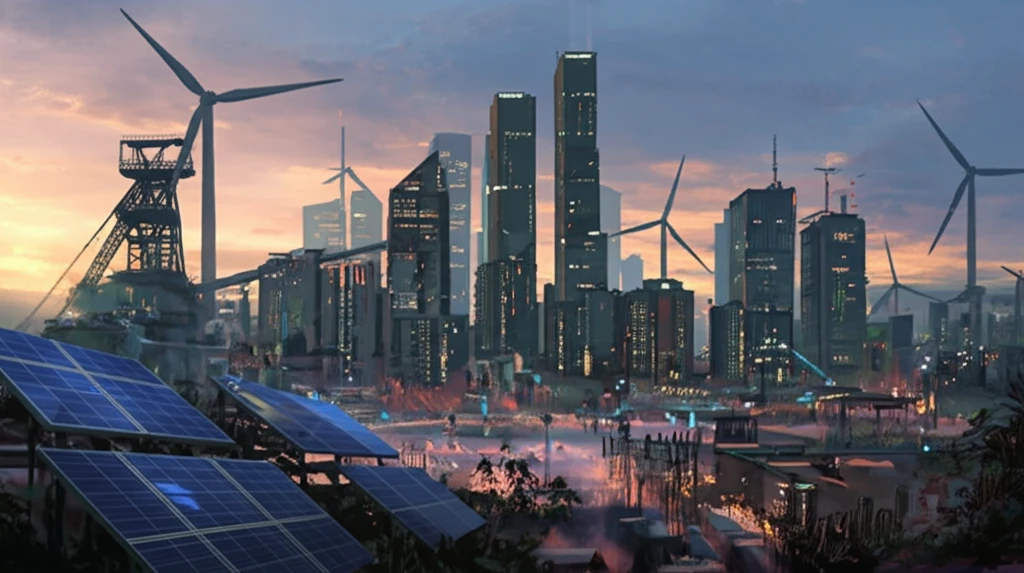
China's sustainable energy future with wind turbines and solar panels against a backdrop of a transitioning cityscape and fading coal mine.

Can China Go Green? Unpacking the Future of Coal and Electrification

"A deep dive into China's energy transition: Balancing coal phase-out and electrification for a sustainable future."


China, the world’s largest energy consumer, stands at a critical juncture in its journey toward decarbonization. The nation’s energy strategy, long reliant on coal, is now being reshaped by the urgent need to address climate change and improve air quality. Two key elements are driving this transformation: greening the power supply and electrifying end-use sectors.

However, this transition is not without its challenges. Concerns linger about the potential pitfalls of rapidly embracing electrification while coal still dominates the power mix. Can China successfully navigate this complex landscape, ensuring that its pursuit of a cleaner energy future doesn't inadvertently exacerbate environmental problems?

Recent research sheds light on this critical question, examining multiple scenarios for high electrification alongside varying timelines for phasing out coal. Using sophisticated climate mitigation models, scientists are uncovering the potential impacts of these pathways on both China's energy system and the global climate.

The Climate Impact of China's Coal Phase-Out: Why Timing Matters

China's sustainable energy future with wind turbines and solar panels against a backdrop of a transitioning cityscape and fading coal mine.

The pace at which China decarbonizes its power sector has significant implications for the global climate. A study highlights that delaying the coal phase-out by just ten years could increase global warming by approximately 0.011°C. This finding underscores the urgency of accelerating the shift away from coal-fired power generation.

But what about the concern that premature electrification, with a still-dominant coal power, might lead to increased emissions? Surprisingly, research suggests that this isn't necessarily the case. At the energy service and sectoral level, there is little evidence of large-scale premature electrification, even with slower coal phase-out scenarios.

This challenges the conventional wisdom that electrification should only begin once the power sector is almost entirely decarbonized. The key takeaway is that early electrification can still drive significant CO2 abatement, provided that power emission intensity decreases substantially. Here's what you need to know:
  • Paris Agreement Goals: Early electrification supports achieving the goals.
  • Climate Mitigation Strategies: Balancing coal phase-out with renewable energy and end-use electrification is key.
  • Energy System Modeling: Models show the potential for large-scale emission reductions.
  • Power Sector Transformation: A rapid shift to renewable energy is crucial.
  • Industrial and Climate Policies: Targeted policies can drive decarbonization.
  • China's Role: China's actions significantly impact global climate goals.
As long as China reduces its power emission intensity to below 150 kgCO2/MWh by 2040, scaling up electrification early can bring enormous gains in CO2 abatement in the medium to long term. This is equivalent to avoiding approximately 0.04°C of global warming.

Policy Implications: Charting a Path Forward

The study offers several key policy recommendations for China's energy transition. Prioritizing and coordinating an effective power sector transition is essential. Given that most emissions come from already electrified sectors, greening the electricity supply yields the most significant near-term emission reductions. Also, policies that accelerate end-use electrification are crucial. These should be informed by end-use application efficiency and local grid emission intensity to ensure significant emission reductions.

About this Article -

This article was crafted using a human-AI hybrid and collaborative approach. AI assisted our team with initial drafting, research insights, identifying key questions, and image generation. Our human editors guided topic selection, defined the angle, structured the content, ensured factual accuracy and relevance, refined the tone, and conducted thorough editing to deliver helpful, high-quality information.See our About page for more information.

This article is based on research published under:

DOI-LINK: https://doi.org/10.48550/arXiv.2312.04332,

Title: Multi-Level Emission Impacts Of Electrification And Coal Pathways In China'S Netzero Transition

Subject: econ.gn q-fin.ec

Authors: Chen Chris Gong, Falko Ueckerdt, Christoph Bertram, Yuxin Yin, David Bantje, Robert Pietzcker, Johanna Hoppe, Robin Hasse, Michaja Pehl, Simón Moreno-Leiva, Jakob Duerrwaechter, Jarusch Muessel, Gunnar Luderer

Published: 07-12-2023

Everything You Need To Know

1

What are the two primary strategies driving China's energy transition towards decarbonization?

The two key elements reshaping China's energy strategy are 'greening the power supply' and 'electrifying end-use sectors'. 'Greening the power supply' involves transitioning away from coal towards more renewable energy sources. 'Electrifying end-use sectors' means increasing the use of electricity in areas like transportation, industry, and buildings, which have historically relied on fossil fuels. Balancing these two approaches is critical for China's decarbonization efforts.

2

How does delaying the phase-out of coal in China impact global warming?

Delaying the 'coal phase-out' in China has significant implications for global warming. Research indicates that a delay of just ten years could increase global warming by approximately 0.011°C. This underscores the urgency of accelerating the shift away from coal-fired power generation. The pace at which China decarbonizes its power sector is crucial for meeting global climate goals.

3

Is there a risk that early electrification could worsen emissions if China's power supply is still heavily reliant on coal?

While it seems counterintuitive, research suggests that early 'electrification' can still drive significant CO2 abatement, even with slower 'coal phase-out' scenarios. At the energy service and sectoral level, there is little evidence of large-scale premature electrification, provided that the power emission intensity decreases substantially. Early electrification can bring enormous gains in CO2 abatement in the medium to long term, provided that power emission intensity decreases substantially.

4

What specific power emission intensity target should China aim for by 2040 to maximize the benefits of early electrification?

To maximize the benefits of early 'electrification', China should reduce its power emission intensity to below 150 kgCO2/MWh by 2040. Achieving this target would lead to significant CO2 abatement, equivalent to avoiding approximately 0.04°C of global warming. This reduction in 'power emission intensity' is crucial for ensuring that electrification leads to net emission reductions.

5

What key policy recommendations are suggested to facilitate China's energy transition, ensuring significant emission reductions?

Several key policy recommendations can facilitate China's energy transition. Prioritizing and coordinating an effective 'power sector transition' is essential, as greening the electricity supply yields the most significant near-term emission reductions. Additionally, policies that accelerate 'end-use electrification' are crucial. These should be informed by end-use application efficiency and local grid emission intensity to ensure significant emission reductions. Policies should focus on the most effective measures to rapidly reduce emissions and support long-term decarbonization.

Newsletter Subscribe

Subscribe to get the latest articles and insights directly in your inbox.