
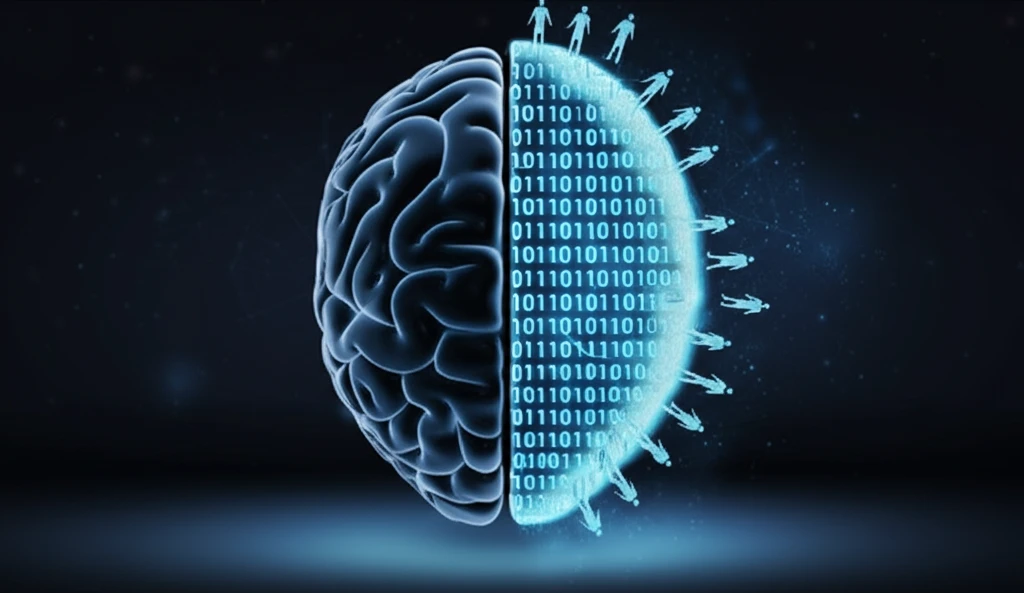
AI Brain vs Human Altruism: A depiction of the conflict between AI's predictive capabilities and the complexities of human behavior.

Can AI Really Understand Us? New Study Questions AI's Ability to Predict Human Behavior

"Groundbreaking research reveals that even the most advanced AI models struggle to accurately predict how humans balance self-interest with the needs of others, raising concerns about AI's role in social decision-making."


Artificial intelligence is rapidly transforming how we live and work, offering powerful new tools for everything from creative writing to medical consultations. As AI systems become more sophisticated, their potential to assist in complex decision-making processes is drawing increasing attention. However, many crucial decisions involve balancing our own self-interest with the interests of others, a complex equation that requires a deep understanding of human nature.

A recent study by Valerio Capraro, Roberto Di Paolo, and Veronica Pizziol sheds light on AI's current capabilities in this critical area. Their research investigates whether today's most advanced AI models can accurately predict how humans behave in situations that require balancing self-interest and the well-being of others. The findings reveal a significant gap between AI predictions and actual human behavior, raising important questions about AI's readiness for high-stakes social decision-making.

This article delves into the details of the study, exploring its methodology, key findings, and the potential implications for AI developers, policymakers, and anyone interested in the future of AI's role in society.

How Accurate is AI in Predicting Human Altruism?

AI Brain vs Human Altruism: A depiction of the conflict between AI's predictive capabilities and the complexities of human behavior.

The researchers focused on a classic economics experiment called the "dictator game." In this game, one person (the dictator) is given a sum of money and decides how much to share with another participant. This simple scenario provides a direct measure of how people weigh their self-interest against their concern for others.

Capraro and his team presented three leading AI chatbots – GPT-4, Google's Bard, and Microsoft's Bing Chat – with experimental instructions from 108 different dictator game experiments conducted across 12 countries. The AI models were then asked to predict how people would behave in each scenario. Here's what they discovered:

  • GPT-4 Showed Qualitative Understanding: Only GPT-4 captured the basic patterns of human behavior, identifying three main groups: those primarily motivated by self-interest, those driven by fairness and aversion to inequality, and those who behaved altruistically.
  • AI Overestimates Altruism: Despite this qualitative understanding, GPT-4 consistently overestimated how generous people would be. Its predictions showed a significantly higher level of altruism than what was observed in the actual human experiments.
  • Bias Towards Idealism: The AI model underestimated self-interested and inequity-averse behaviors, suggesting an overly optimistic view of human nature.
These findings highlight a crucial challenge: while AI can identify broad behavioral patterns, it struggles to accurately predict the nuances of human decision-making, particularly when social factors are involved. The tendency to overestimate altruism could have significant consequences if AI is used to guide decisions in areas like public policy or business strategy.

The Future of AI and Human Understanding

The study's authors suggest that the overestimation of altruism may stem from biases in AI training data or from the "reinforcement learning with human feedback" (RLHF) stage, where AI models are trained to generate human-like language. This process might inadvertently lead AI to adopt an overly positive view of human behavior in an attempt to be "politically correct."

About this Article -

This article was crafted using a human-AI hybrid and collaborative approach. AI assisted our team with initial drafting, research insights, identifying key questions, and image generation. Our human editors guided topic selection, defined the angle, structured the content, ensured factual accuracy and relevance, refined the tone, and conducted thorough editing to deliver helpful, high-quality information.See our About page for more information.

This article is based on research published under:

DOI-LINK: https://doi.org/10.48550/arXiv.2307.12776,

Title: Assessing Large Language Models' Ability To Predict How Humans Balance Self-Interest And The Interest Of Others

Subject: econ.gn cs.ai cs.cy cs.gt q-fin.ec

Authors: Valerio Capraro, Roberto Di Paolo, Veronica Pizziol

Published: 21-07-2023

Everything You Need To Know

1

What were the key findings of the study regarding AI's ability to predict human behavior in the dictator game?

The study, conducted by Valerio Capraro, Roberto Di Paolo, and Veronica Pizziol, used the dictator game to assess how well AI models like GPT-4, Google's Bard, and Microsoft's Bing Chat could predict human behavior. Key findings revealed that GPT-4 showed a qualitative understanding of behavior patterns, identifying groups based on self-interest, fairness, and altruism. However, the AI models, especially GPT-4, consistently overestimated altruism, and underestimated self-interested behavior. This suggests a significant gap in the AI's ability to accurately model the nuances of human decision-making when social factors are involved.

2

How did the study assess the AI models' understanding of human behavior, and what specific experiment was used?

The study evaluated the AI models by having them predict outcomes in the dictator game, a classic economics experiment. In this game, one person (the dictator) decides how to share a sum of money with another participant. The AI models, including GPT-4, Bard, and Bing Chat, were presented with instructions from 108 different dictator game experiments from 12 countries. The AI was then asked to predict how people would behave in each scenario, allowing the researchers to measure the accuracy of the AI's predictions against actual human behavior in situations that involve balancing self-interest against the well-being of others.

3

What are the potential implications of AI overestimating human altruism, as demonstrated in the research?

The overestimation of altruism by AI models, particularly GPT-4, could have significant implications. If AI systems are used to guide decisions in areas like public policy or business strategy, this bias could lead to inaccurate predictions and potentially suboptimal outcomes. For example, in resource allocation or negotiation scenarios, AI might predict more cooperative behavior than actually exists, leading to ineffective strategies. The tendency of AI to overestimate generosity highlights a critical need to improve AI's understanding of human motivations to ensure reliable decision-making support.

4

Why does AI, according to the study, struggle to accurately predict human behavior, and what factors might contribute to this?

According to the study, the challenges AI faces in predicting human behavior stem from several factors. The primary issue is the inability to accurately model the nuanced balance between self-interest and the needs of others, which is fundamental to many human decisions. The research suggests that the overestimation of altruism may result from biases in AI training data or the 'reinforcement learning with human feedback' (RLHF) stage, where AI models are trained to generate human-like language. This process might lead the AI to adopt an overly positive view of human behavior in an attempt to be 'politically correct', thus distorting the model's predictions.

5

How does the study's findings relate to the broader conversation about AI's role in society and its potential impact on decision-making processes?

The study's findings significantly influence the conversation about AI's role in society by highlighting the limitations of current AI models in understanding human behavior, especially in social contexts. As AI systems become increasingly integrated into decision-making processes, from public policy to business strategy, the ability to accurately predict human actions is crucial. The research by Capraro, Di Paolo, and Pizziol raises important questions about the reliability and ethical implications of using AI in high-stakes scenarios, particularly when decisions require an understanding of complex social dynamics. It underscores the need for further research and development to improve AI's ability to model human behavior realistically, accounting for the full spectrum of human motivations, including self-interest and altruism.

Newsletter Subscribe

Subscribe to get the latest articles and insights directly in your inbox.