
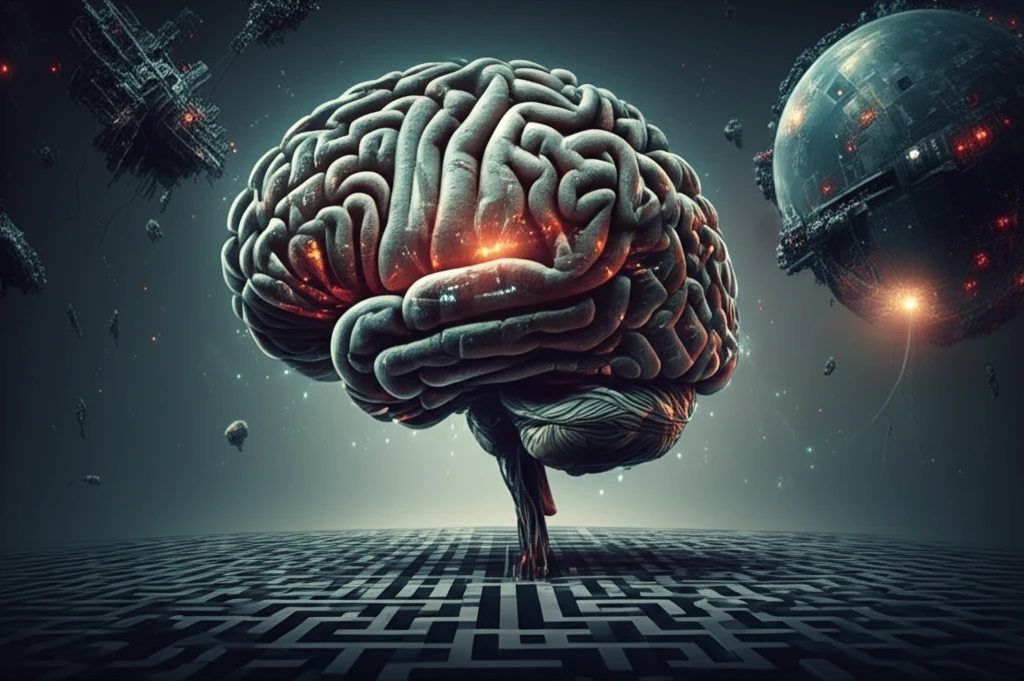
AI agents navigating a brain-shaped maze, representing the complexities of replicating human decision-making.

Can AI Really Think Like Us? New Study Questions How Closely AI Simulates Human Economic Decisions

"Researchers explore the reasoning abilities of AI agents in economic experiments, uncovering surprising limitations and raising questions about the future of AI-driven simulations."


Economic experiments provide a controlled environment for studying human decision-making, offering valuable insights into various economic theories and hypotheses. Gathering enough participants for these experiments is often costly and time-consuming. To combat this issue, researchers are starting to use large language models (LLMs) to simulate human behavior, creating what are known as generative agents. The hope is that these AI agents can accurately mimic human decision-making, drastically reducing the costs associated with traditional experiments.

This approach, known as LLMs-driven multi-agent simulation (MAS), is gaining traction in economics and behavioral science. Generative agents, unlike traditional agents with predefined rules, make decisions using LLMs, allowing for more human-like responses. However, this emerging field faces significant challenges. While some studies have successfully replicated classical economic results using LLMs, others have found inconsistencies between AI simulations and real-world behavior.

A recent study delves into the reasoning abilities of generative agents, examining whether enhancing their reasoning skills can lead to more accurate simulations of human economic decisions. By focusing on the ultimatum game—a classic scenario highlighting the tension between theoretical rationality and actual human behavior—the researchers explore the potential and limitations of using AI to replace human participants in economic experiments.

Why Reasoning Ability Matters: The Ultimatum Game and AI Decision-Making

AI agents navigating a brain-shaped maze, representing the complexities of replicating human decision-making.

The ultimatum game involves two players deciding how to divide a sum of money. The first player proposes a split, and the second player can either accept the offer, in which case the money is divided as proposed, or reject it, in which case neither player receives anything. According to economic theory, the second player should accept any offer, no matter how small, because receiving something is better than receiving nothing. However, human behavior often deviates from this rational model.

In reality, people frequently reject offers they perceive as unfair, even if it means sacrificing their own potential gain. This highlights the role of emotions, fairness, and social norms in decision-making—factors that are difficult to replicate in AI simulations. The study specifically investigates whether improving the reasoning abilities of AI agents can lead to more human-like behavior in this context.

  • The Study Design: The researchers designed a multi-agent simulation to reproduce the results of an actual economic experiment on the ultimatum game. They focused on improving the reasoning ability of generative agents through various prompting methods.
  • Prompting Methods: The study employed different prompting techniques to enhance the reasoning abilities of the AI agents, including few-shot prompting (providing examples of desired outputs) and chain of thoughts (CoT) prompting (guiding agents to explain their reasoning step by step).
  • The Goal: The aim was to see if higher reasoning ability would lead the AI agents to make decisions closer to real human behavior, or if other factors, such as the agents' 'personas,' would be more influential.
The results showed that as the reasoning ability of the AI agents increased, their decisions moved closer to the theoretical solution—always accepting any offer—rather than mirroring the nuanced, often 'irrational,' behavior of human participants. This suggests that while AI can be trained to reason more effectively, it still struggles to incorporate the complex social and emotional factors that drive human economic decisions. Interestingly, the study also found that the 'personas' assigned to the generative agents might play a crucial role in replicating real-world experimental results.

The Future of AI in Economic Simulations: It's All About Being Human

This research highlights both the potential and the limitations of using AI to simulate human behavior in economic experiments. While improving the reasoning abilities of AI agents is crucial, it's equally important to consider the social and emotional factors that influence human decision-making. As LLMs continue to evolve, future research should focus on developing methods to imbue AI agents with more realistic 'personas' and a better understanding of human motivations. By doing so, we can move closer to creating AI simulations that truly replicate the complexities of human economic behavior, unlocking new possibilities for economic research and policy-making.

About this Article -

This article was crafted using a human-AI hybrid and collaborative approach. AI assisted our team with initial drafting, research insights, identifying key questions, and image generation. Our human editors guided topic selection, defined the angle, structured the content, ensured factual accuracy and relevance, refined the tone, and conducted thorough editing to deliver helpful, high-quality information.See our About page for more information.

This article is based on research published under:

DOI-LINK: https://doi.org/10.48550/arXiv.2406.11426,

Title: Can Ai With High Reasoning Ability Replicate Human-Like Decision Making In Economic Experiments?

Subject: cs.gt econ.gn q-fin.ec

Authors: Ayato Kitadai, Sinndy Dayana Rico Lugo, Yudai Tsurusaki, Yusuke Fukasawa, Nariaki Nishino

Published: 17-06-2024

Everything You Need To Know

1

What are generative agents and how do they differ from traditional agents in the context of economic experiments?

Generative agents are AI agents that simulate human behavior within economic experiments. Unlike traditional agents, which operate based on predefined rules, generative agents utilize Large Language Models (LLMs) to make decisions. This allows them to generate more human-like responses, offering a potential for more realistic simulations of economic scenarios. The use of LLMs enables generative agents to consider a wider range of factors and make more nuanced decisions compared to their rule-based counterparts.

2

Why is the ultimatum game a key focus in evaluating the reasoning abilities of AI agents?

The ultimatum game is used because it exposes the gap between theoretical rationality and actual human behavior. In this game, players decide how to divide a sum of money. Economic theory suggests rational players should accept any offer. However, humans often reject offers they perceive as unfair, even if it means they receive nothing. This deviation highlights the impact of emotions, fairness, and social norms, which AI must understand to simulate human decisions accurately. By studying AI's performance in the ultimatum game, researchers can assess how well AI captures these human factors.

3

How do prompting methods, like few-shot prompting and chain of thoughts (CoT) prompting, improve the reasoning abilities of AI agents?

Prompting methods are used to guide and enhance the decision-making of generative agents. Few-shot prompting involves providing the AI with examples of desired outputs, essentially training it with specific instances. Chain of thoughts (CoT) prompting, on the other hand, guides agents to explain their reasoning step-by-step. These methods aim to improve the AI's ability to simulate more human-like reasoning processes by helping them understand the context, make informed decisions, and offer insights into the 'why' behind each action.

4

What are the main challenges in using AI to simulate human behavior in economic experiments, and how can these be addressed?

A major challenge is replicating the complex social and emotional factors that drive human decisions. Current AI, even with advanced reasoning abilities, struggles to fully capture these aspects. The study found that as the reasoning ability of the AI agents increased, their decisions moved closer to the theoretical solution, deviating from the nuanced behavior of human participants. To address this, future research should focus on developing methods to imbue AI agents with more realistic 'personas' and a better understanding of human motivations. This may involve incorporating additional data sources and refining the training processes.

5

What role do 'personas' play in AI simulations of economic behavior, and why are they important for accurate modeling?

The study indicates that the 'personas' assigned to generative agents have a crucial role in replicating real-world experimental results. 'Personas' can represent various psychological traits or attitudes that affect the choices the AI agent makes. By assigning different 'personas' to the AI agents, researchers can explore how these traits influence economic decisions, making the simulations more realistic and insightful. This is essential because human decisions are rarely based solely on rationality; they are often influenced by emotions, biases, and social norms. By incorporating 'personas', the AI simulations can account for these human complexities, leading to more accurate and relevant economic insights.

Newsletter Subscribe

Subscribe to get the latest articles and insights directly in your inbox.