
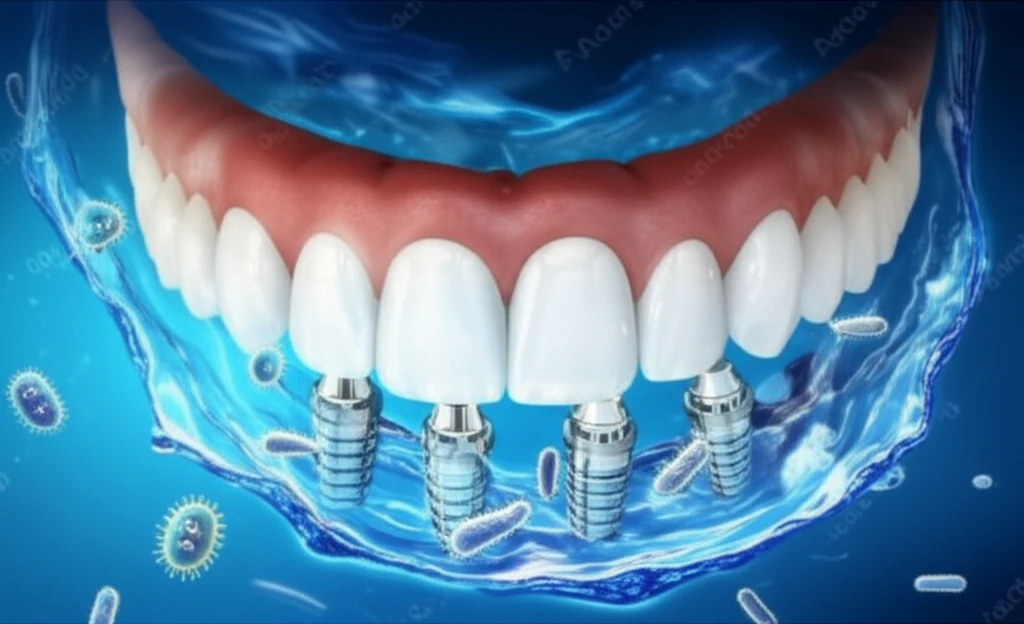
Dental implants protected by delmopinol mouth rinse

Can a Special Mouth Rinse Really Prevent Gum Disease Around Implants?

"New research explores how delmopinol mouth rinse could be a game-changer for maintaining healthy gums and preventing peri-implant diseases."


The number of people affected by peri-implant diseases, which are inflammatory conditions affecting the tissues around dental implants, is rising. Maintaining good oral hygiene and controlling plaque buildup at home are crucial for preventing peri-implant mucositis and peri-implantitis after implant placement.

Peri-implant mucositis is characterized by inflammation of the soft tissues around the implant, with bleeding upon gentle probing being a primary sign. Peri-implantitis, a more advanced stage, involves inflammation and progressive bone loss around the implant. Plaque, a sticky film of bacteria, is a major culprit in these conditions. Managing plaque is key to preventing and controlling peri-implant diseases.

Delmopinol is an ingredient found in some commercially available mouth rinses designed to combat plaque and gingivitis (gum inflammation). It works by disrupting plaque formation and preventing bacteria from sticking to teeth, gums, and implants. While previous studies have explored its benefits for natural teeth, this research investigates its potential for maintaining healthy tissues around dental implants.

Delmopinol: A Potential Shield for Your Implants?

Dental implants protected by delmopinol mouth rinse

A recent study published in the journal Clinical Implant Dentistry and Related Research investigated the effectiveness of a 0.2% delmopinol mouth rinse in preventing peri-implant mucositis and peri-implantitis. Researchers conducted a randomized controlled study using dogs with dental implants to evaluate how delmopinol rinse affected peri-implant tissue health.

Here’s how the study was conducted:

  • Implants were placed in dogs' mandibles after tooth extraction.
  • Dogs were divided into two groups: one received a 0.2% delmopinol mouth rinse, and the other received a placebo rinse.
  • Ligatures (threads) were placed around the implants to induce peri-implant disease.
  • Clinical and radiographic assessments were performed throughout the study to monitor tissue health and bone levels.
  • Micro-CT and histologic analyses were conducted at the end of the study to evaluate bone-to-implant contact.
The results showed that plaque levels were lower in the delmopinol group before ligature placement. Also, the delmopinol group had a significantly smaller ratio of affected implants (those with probing depths ≥4 mm) compared to the placebo group. The test agent also appeared to help prevent bone loss associated with ligature placement, based on computed tomography and histologic analysis.

The Bottom Line: A Promising Tool for Implant Health

The study suggests that a 0.2% delmopinol mouth rinse may help prevent the development of peri-implant disease by controlling plaque. While this research was conducted on animals, the findings indicate that delmopinol could be a valuable addition to your oral hygiene routine if you have dental implants.

It's important to remember that this is just one study, and more research is needed to confirm these results in humans. Also, the ligature model used in the study is a simplified representation of peri-implant disease.

If you're concerned about gum disease around your dental implants, talk to your dentist or dental hygienist. They can assess your individual needs and recommend the best oral hygiene practices, including whether a delmopinol mouth rinse is right for you. Maintaining a strict oral hygiene routine and regular dental check-ups are crucial for long-term implant success.

About this Article -

This article was crafted using a human-AI hybrid and collaborative approach. AI assisted our team with initial drafting, research insights, identifying key questions, and image generation. Our human editors guided topic selection, defined the angle, structured the content, ensured factual accuracy and relevance, refined the tone, and conducted thorough editing to deliver helpful, high-quality information.See our About page for more information.

This article is based on research published under:

DOI-LINK: 10.1111/cid.12692, Alternate LINK

Title: Evaluation Of 0.2% Delmopinol Mouth Rinse For Prevention Of Peri-Implant Mucositis And Peri-Implantitis: A Randomized Controlled Canine Study

Subject: General Dentistry

Journal: Clinical Implant Dentistry and Related Research

Publisher: Wiley

Authors: Liran Levin, Horia Barbu, Sivge Kurgan, Raluca Monica Comăneanu, Daniel Referendaru, Adi Lorean

Published: 2018-11-15

Everything You Need To Know

1

What exactly is peri-implant mucositis, and how does it affect dental implants?

Peri-implant mucositis is an inflammatory condition affecting the soft tissues surrounding a dental implant, primarily indicated by bleeding upon gentle probing. It's the initial stage of peri-implant disease. If left unaddressed, peri-implant mucositis can progress into a more severe condition known as peri-implantitis.

2

Could you explain peri-implantitis and its potential consequences for dental implants?

Peri-implantitis is a more advanced stage of peri-implant disease that develops from untreated peri-implant mucositis. It involves inflammation and progressive bone loss around the dental implant. The presence of peri-implantitis can compromise the long-term stability and success of dental implants.

3

What is delmopinol, and how does it work to protect dental implants?

Delmopinol is an ingredient used in some mouth rinses that aims to combat plaque formation and gingivitis, which is gum inflammation. It functions by disrupting the formation of plaque and preventing bacteria from adhering to the surfaces of teeth, gums, and dental implants. By controlling plaque buildup, delmopinol can help prevent peri-implant mucositis and peri-implantitis.

4

Can you elaborate on the study that explored delmopinol's effects on dental implants?

The study published in *Clinical Implant Dentistry and Related Research* used a controlled experiment on dogs to simulate conditions around dental implants. Ligatures were placed to induce peri-implant disease. One group received a 0.2% delmopinol mouth rinse, while the other received a placebo rinse. The study found that the delmopinol group had lower plaque levels and a smaller ratio of affected implants, suggesting that delmopinol could help prevent bone loss associated with ligature placement. While conducted on animals, these findings suggest potential benefits for humans with dental implants.

5

Besides using mouth rinse, what else can I do to keep my gums healthy around my implants?

Maintaining good oral hygiene is crucial for preventing peri-implant diseases like peri-implant mucositis and peri-implantitis after implant placement. Plaque control is key. Plaque is a sticky film of bacteria that can lead to inflammation and bone loss around dental implants. Using a mouth rinse with delmopinol can be a valuable addition to oral hygiene routines, as it helps to disrupt plaque formation and prevent bacteria from adhering to dental implants and gums.

Newsletter Subscribe

Subscribe to get the latest articles and insights directly in your inbox.