
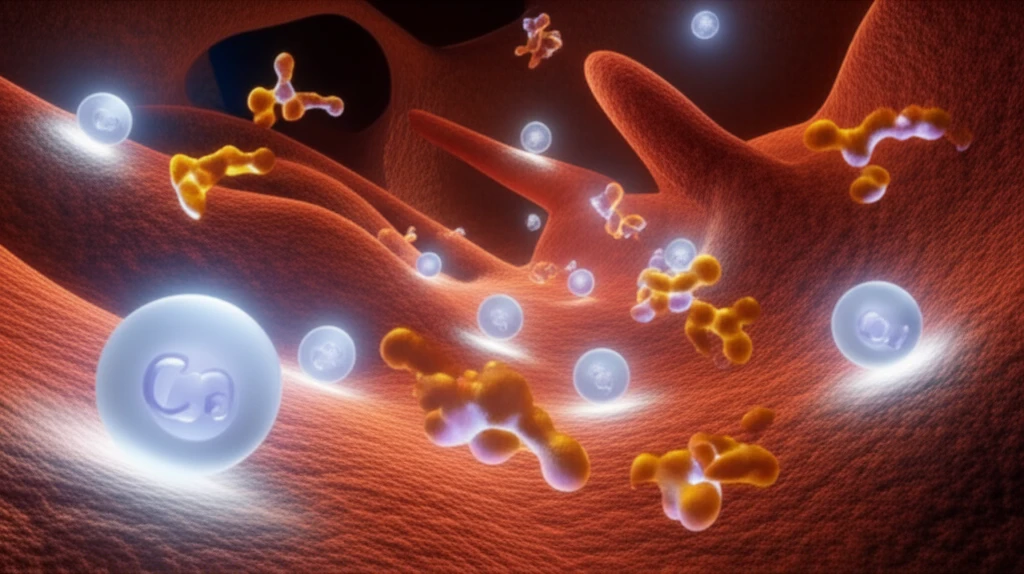
Calcium ions guiding cholesterol molecules within a cell.

Calcium's Hidden Role: How Cellular Calcium Levels Affect Cholesterol Distribution

"New research uncovers the critical link between calcium within cells and cholesterol balance, offering potential insights for treating related health issues."


For years, calcium has been known as a key player in bone health and nerve function. However, emerging research reveals a surprising new role for this essential mineral: managing the distribution of cholesterol within our cells. This discovery sheds light on the intricate mechanisms that maintain cellular health and could pave the way for innovative treatments for cholesterol-related diseases.

Cholesterol, often villainized, is vital for building cell membranes, producing hormones, and synthesizing vitamin D. The body maintains tight control over cholesterol levels and its movement within cells. A disruption in this balance can lead to various health problems. Now, scientists are finding that calcium, specifically the calcium stored in the endoplasmic reticulum (ER) – a network of membranes within cells – plays a crucial, previously unrecognized role in this process.

This article explores the groundbreaking research that links ER calcium levels to the distribution of unesterified cholesterol, the form of cholesterol readily available for cellular functions. We'll delve into how calcium impacts the sterol regulatory element-binding proteins (SREBPs), key regulators of lipid metabolism, and what these findings could mean for understanding and treating metabolic disorders.

The Calcium-Cholesterol Connection: What the Research Shows

Calcium ions guiding cholesterol molecules within a cell.

The study highlights that decreasing ER calcium levels significantly alters the intracellular pool of unesterified cholesterol. This means that when calcium stores in the ER are low, the usual distribution of cholesterol within the cell is disrupted. This is significant because a portion of the intracellular cholesterol becomes inaccessible to the ER's sterol-sensing mechanism when ER calcium status is depleted.

Think of the ER as a central hub that monitors and regulates cholesterol levels. When calcium levels are adequate, the ER can accurately assess cholesterol levels and signal the body to make adjustments as needed. However, when calcium is low, this monitoring system is impaired, leading to a misinterpretation of cholesterol levels.

  • Redistribution of Cholesterol: Lowering ER calcium causes cholesterol to move away from where it's normally sensed.
  • Impaired Sensing Mechanism: Part of the cholesterol becomes hidden from the ER's usual detection process.
  • Impact on SREBPs: This disruption affects the SREBPs, which control how the body makes and uses cholesterol and other fats.
Researchers propose that ER calcium status acts as a critical parameter for establishing the reference point for maintaining cellular cholesterol homeostasis. In simpler terms, the amount of calcium in the ER helps set the standard for how much cholesterol should be present and how it should be distributed. This discovery underscores the importance of maintaining adequate calcium levels for proper cellular function and overall metabolic health.

Implications for Health and Future Research

This research opens new avenues for understanding and potentially treating cholesterol-related disorders. By recognizing the crucial role of calcium in cholesterol management, scientists can explore targeted therapies to restore cellular calcium balance and improve cholesterol metabolism. This could be particularly relevant for conditions like hyperlipidemia (high cholesterol) and other metabolic syndromes.

The study also emphasizes the need for further research into the interplay between calcium signaling and lipid metabolism. Future studies could investigate how different factors, such as diet, lifestyle, and genetics, influence ER calcium levels and cholesterol distribution. Understanding these complex interactions could lead to more personalized and effective approaches to prevent and manage cholesterol-related health issues.

While more research is needed, this discovery marks a significant step forward in our understanding of cellular health. It highlights the interconnectedness of various cellular processes and emphasizes the importance of maintaining a balanced internal environment for optimal well-being. Keeping calcium and cholesterol in check might be more intertwined than previously thought!

About this Article -

This article was crafted using a human-AI hybrid and collaborative approach. AI assisted our team with initial drafting, research insights, identifying key questions, and image generation. Our human editors guided topic selection, defined the angle, structured the content, ensured factual accuracy and relevance, refined the tone, and conducted thorough editing to deliver helpful, high-quality information.See our About page for more information.

This article is based on research published under:

DOI-LINK: 10.1016/j.ceca.2018.11.002, Alternate LINK

Title: Endoplasmic Reticulum Calcium Dictates The Distribution Of Intracellular Unesterified Cholesterol

Subject: Cell Biology

Journal: Cell Calcium

Publisher: Elsevier BV

Authors: Wen-An Wang, Luis B. Agellon, Marek Michalak

Published: 2018-12-01

Everything You Need To Know

1

What is the newly discovered role of Calcium?

The role of Calcium is crucial for overall health and wellness, in addition to its established role in bone health and nerve function. New research reveals its involvement in managing the distribution of Cholesterol within cells, a function vital for cellular health and the prevention of cholesterol-related diseases.

2

Why is Cholesterol important, and how does Calcium affect it?

Cholesterol plays a vital role in building cell membranes, producing hormones, and synthesizing vitamin D. Calcium within the Endoplasmic Reticulum (ER) is key to how the body manages and distributes Cholesterol. When ER Calcium is low, Cholesterol distribution is disrupted, impacting the Sterol Regulatory Element-binding Proteins (SREBPs), which regulate lipid metabolism. This disruption can lead to health issues.

3

What is the Endoplasmic Reticulum (ER)'s role in this process, and how does Calcium influence it?

The Endoplasmic Reticulum (ER) is like a central hub that monitors and regulates Cholesterol levels. Its function relies heavily on adequate Calcium levels. When Calcium levels are low, the ER's ability to accurately assess Cholesterol levels is compromised. This can impair the ER's sterol-sensing mechanism, leading to a misinterpretation of Cholesterol levels and potentially affecting the body's lipid metabolism regulation.

4

What are Sterol Regulatory Element-binding Proteins (SREBPs), and how are they affected?

The Sterol Regulatory Element-binding Proteins (SREBPs) are key regulators of lipid metabolism, including Cholesterol production and usage. Their function is affected when Calcium levels within the ER are low. This disruption can affect how the body manages Cholesterol and other fats, potentially contributing to metabolic disorders.

5

What are the implications of this research for health and potential treatments?

This research suggests potential treatments for Cholesterol-related disorders. Scientists can explore therapies aimed at restoring cellular Calcium balance to improve Cholesterol metabolism. This could have implications for conditions like hyperlipidemia and metabolic syndromes. The implications underscore the importance of maintaining adequate Calcium levels to ensure proper cellular function and overall metabolic health.

Newsletter Subscribe

Subscribe to get the latest articles and insights directly in your inbox.