
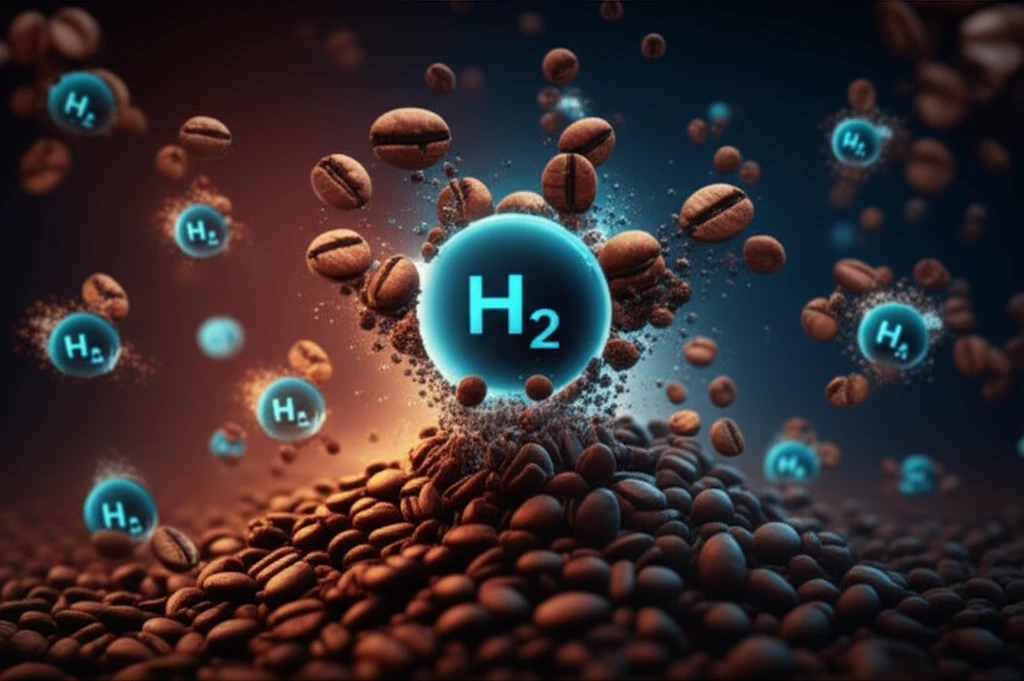
Brewing a Greener Future: Can Coffee Waste Solve Our Hydrogen Needs?

"Exploring the potential of coffee grounds as a sustainable source for hydrogen recovery and fuel production"
In a world increasingly focused on sustainable energy solutions, innovative approaches to resource management are gaining traction. One such approach involves transforming waste products into valuable resources. Hydrogen, a clean and versatile energy carrier, is at the forefront of this movement, and researchers are exploring unconventional sources for its production. Among these sources, coffee grounds—a ubiquitous waste product—are emerging as a promising candidate.
Every day, millions of cups of coffee are consumed worldwide, leaving behind a mountain of coffee grounds. While some of these grounds find their way into compost bins, a significant portion ends up in landfills, contributing to environmental problems. However, recent scientific investigations suggest that these discarded coffee grounds can be repurposed to extract hydrogen, offering a dual benefit of waste reduction and clean energy production.
This article delves into the groundbreaking research exploring the use of coffee grounds as a bioadsorbent for hydrogen recovery. We'll examine the processes involved in transforming coffee waste into activated carbon, a material capable of capturing and releasing hydrogen from gas mixtures. Furthermore, we will discuss the potential implications of this technology for the future of sustainable energy and waste management.
From Waste to Resource: How Coffee Grounds Become Hydrogen Fuel
The core of this innovation lies in converting coffee grounds into activated carbon, a highly porous material with an extensive surface area. This transformation involves a process called chemical activation, where the coffee grounds are treated with chemicals like zinc chloride (ZnCl2) and heated to high temperatures. This process creates a network of pores within the carbon structure, enhancing its ability to adsorb gases, including hydrogen.
- Preparation: Coffee grounds are collected and cleaned to remove impurities.
- Activation: The grounds are chemically treated and heated to create activated carbon.
- Adsorption: The activated carbon is used to capture hydrogen from gas mixtures.
- Desorption: The captured hydrogen is released and collected for use.
A Sustainable Sip: The Future of Coffee-Based Hydrogen
The potential of coffee grounds as a bioadsorbent for hydrogen recovery offers a compelling vision for a more sustainable future. By transforming a waste product into a valuable energy resource, we can reduce our reliance on fossil fuels, mitigate environmental pollution, and create new economic opportunities. While further research and development are needed to optimize this technology and scale it up for industrial applications, the initial findings are promising. Perhaps, one day, our morning cup of coffee will not only energize us but also contribute to powering a cleaner, greener world.