
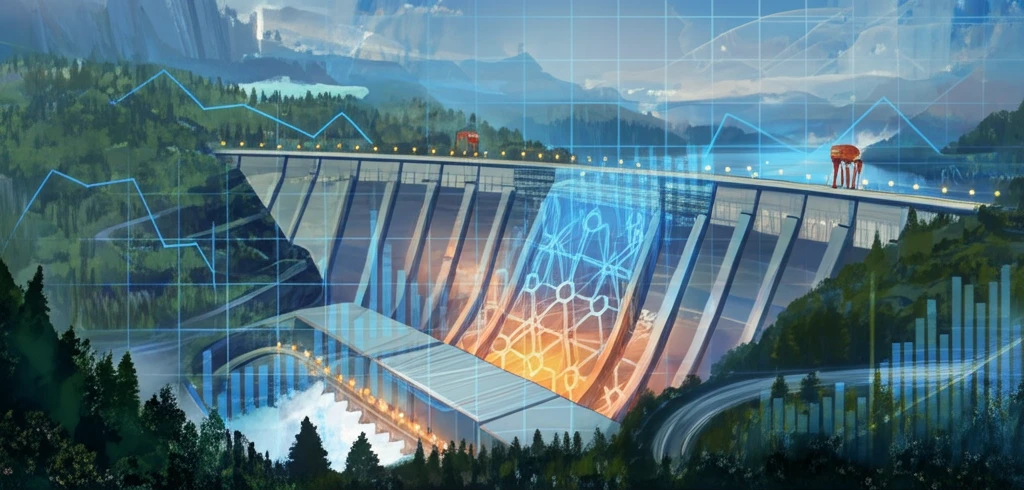
Powering Tomorrow: Unveiling the Dynamics of Hydropower Economics

"A comprehensive look into the evolving landscape of hydropower, from its historical roots in Norway to its pivotal role in the global energy transition."
Hydropower, for many years, has been more than just an energy source; it's been a cornerstone of political and economic strategy, especially in countries like Norway. Historically, Norway's approach to hydropower was characterized by direct political control, especially after 1905 when the parliament restricted foreign and domestic private ownership of waterfalls essential for hydropower development. This led to a system where the public sector dominated electricity production, owning almost 90% of the nation's hydropower capacity. This model, deeply rooted in the nation's history, has significantly shaped its energy landscape.
At the local level, electricity pricing policies focused on average cost pricing for general consumption. Meanwhile, state-owned power stations supplied energy-intensive industries such as aluminum, ferro alloys, and pulp and paper at favorable rates. Greenhouse activities also benefited from this protective agricultural policy. The availability of cheap electricity became a key factor in localizing primary aluminum industries, given the need to import raw materials like aluminum oxide. Although the technology was partly developed in Norway, it soon became international. This strategic approach ensured stable energy prices and supported key sectors of the Norwegian economy.
However, the global energy landscape began to shift in the late 1980s and early 1990s with the deregulation of the electricity industry. The creation of wholesale markets, such as the day-ahead last price auction in England in 1990, initiated a wave of similar deregulation efforts across Europe. This transition wasn't solely about policy; it reflected an underlying economic rationale focused on driving down production costs through competition. As countries worldwide grappled with these changes, Norway, too, found itself at a crossroads, balancing its historical energy policies with the emerging dynamics of a globalized energy market.
Clean Output, Cost Baselines, and National Targets
Hydropower is widely regarded as an attractive alternative to fossil fuels because it does not directly produce carbon dioxide or other atmospheric pollutants while offering a relatively consistent source of power. The sector's economic significance has warranted dedicated academic study, including a second edition of "Hydropower Economics" in Springer's International Series in Operations Research & Management Science. Cost benchmarking has also matured, with the Oak Ridge National Laboratory using parametric "baseline cost models" to generate generalized cost estimates for projects across various hydropower resource categories. National progress is uneven: sources note that statistical data for Ukraine can vary widely, even as Bulgaria's hydropower output approached its 2020 NREAP target of 2.42 GW alongside combined solar PV contributions.
Reservoir Timing and Multi-Objective Modeling
The core economic question in hydropower production is the time pattern of water use in the reservoir, since with enough storage capacity the water used today could alternatively be used tomorrow. Large-scale planning exercises, such as the U.S. Hydropower Vision report, apply economic modeling of the electric sector to explore an array of possible futures for the hydropower industry. At a conceptual level, economics is framed as the study of unlimited wants and limited resources, a tension exemplified by the desire for higher living standards in Mekong River Basin countries. Methodological refinements continue, including multi-objective approaches that use Pareto-front and multicriteria analysis to explore hydropower operating rules that simultaneously improve economic and environmental values.
From Wisconsin 1882 to Systematic Modeling
The world's first hydroelectric power plant began operations in Wisconsin in 1882, marking a significant milestone in the history of energy production. From those early beginnings, analytical treatment of hydropower grew into a formal discipline: the book "Hydropower Economics" examines sustainable alternate energy sources beginning with modeling hydropower and then extending the model to include thermal power and wind power. Analysis also operates at multiple levels of aggregation, with physical trade in electricity considered both between countries and between regions within a country. These foundations continue to structure how the economics of water resources are studied and modeled today.
Navigating the Currents: Key Aspects of Hydropower Today
The deregulation of electricity markets introduced competition and aimed to lower production costs. Norway followed suit, establishing a competitive wholesale market in 1991. However, unlike England, which relied on conventional coal-based thermal units and nuclear plants, Norway depended on over 600 hydropower plants. The operation and management of these plants traditionally fell to engineers. The national grid and electricity regulator (NVE) employed system analysis to coordinate the reservoirs, ensuring demand was met cost-effectively while also monitoring energy balance and planning capacity expansion. It's a complex interplay of natural resources, engineering expertise, and regulatory oversight.
- Price Variability: Consumer prices now fluctuate based on cold winters and dry years.
- Investment Lag: New capacity investments have been slow, reflecting previous over-investment.
- Market Expansion: Existing capacity is efficiently utilized through market mechanisms.
Integrating Hydropower with Wind, Solar, and Climate Scenarios
Recent scholarship has brought the fast-developing field of hydropower economics up to date, with new editions considering developments such as integrating hydropower with wind and solar power systems and providing battery-like storage functions to other countries and markets. Literature reviews survey the current role hydropower plays worldwide, alongside its inherent benefits, the remaining potential, and specific development plans across various regions of the globe. A growing body of research applies integrated assessments of climate change impact to understand hydrologic flow and its consequences for the hydropower economy under various climate scenarios, generating information for water resource management in a changing climate. The work signals a shift toward situating hydropower economics within broader renewable systems and climate adaptation planning.
Economic Strengths Alongside Environmental Costs
On the economic side, hydropower is a demonstrated driver of economic activity, supporting jobs from engineering and construction to operations and maintenance, while offering other economic benefits and providing electricity that helps businesses compete globally. Yet the environmental ledger is more complicated: although hydropower is often termed green energy because its production does not generate harmful emissions, the main environmental problem is the exploitation of hydropower sites as such. The tension between these economic advantages and the site-level environmental impacts of dam and reservoir development sits at the center of debates over new hydropower projects.
Counterfactual Valuation and Cost Comparisons
The economic value of firm hydropower capacity can be estimated by comparing system capacity expansion costs under a scenario with an existing hydropower plant (the actual case) against a scenario without the plant (the counterfactual case). Comparative techniques also extend to project-level decisions, such as using levelized cost comparisons of offgrid and grid connection options in Nepal's hydropower financing context. Analyses of this kind contrast the cost characteristics of hydropower versus thermal generation and consider lifetime examples of each. Together these approaches give planners and financiers a structured basis for weighing hydropower against alternatives.
Looking Ahead: Balancing Sustainability and Economics
Hydropower's journey from a politically directed enterprise to a market-driven sector reflects the broader global energy transition. As nations grapple with climate change and seek sustainable energy solutions, hydropower remains a vital component. Understanding its economic dynamics, environmental impacts, and technological advancements is crucial for policymakers, industry leaders, and consumers alike. The future of hydropower depends on striking a balance between economic efficiency, environmental stewardship, and social responsibility, ensuring a reliable and sustainable energy supply for generations to come. The insights gained from Norway's experience offer valuable lessons for countries worldwide as they navigate their own energy futures.
Decision Support from Cost Analysis to Capital Structure
Economic analysis plays a coordinating role in hydropower planning: it facilitates comparisons between hydropower and other renewable energy sources, ensuring that investments align with national energy goals and environmental commitments. For smaller projects, cost analysis and economic risk assessment can be carried out in a relatively straightforward manner, providing decision makers and stakeholders a handy tool for micro hydropower development, particularly around construction costs. Integrated studies of factors affecting project performance use a combined approach to examine profitability and capital structure, though authors acknowledge such analyses may not account for all potential aspects, with expert opinion singling out significant constraints on viability. The result is an evolving toolkit that supports both macro-level energy policy and micro-level project finance decisions.
Hydropower's Role in Low-Carbon Power Systems
Hydroelectric plants today represent the most prevalent form of electricity generation from renewable sources, giving the technology a strong base for future growth. As a renewable and clean generation technology, hydropower should continue to play an important role in future low-carbon power systems and in the global energy transition to clean electricity. At the industry level, trends in the U.S. hydropower turbine supply chain offer a glimpse into the scope and vitality of the market while signaling emerging directions in hydropower development. Combined with its value in integrating intermittent renewables, these factors point to hydropower remaining a fixture of energy planning.
From Coordinated Systems to Deregulated Markets
The modern institutional context for hydropower economics traces back to the restructuring of electricity markets. The Norwegian state organisation responsible for coordinating the hydropower electricity system, known as "Samkjøringen," contacted the author of "Hydropower Economics" in 1990 about the advanced plan for deregulating the electricity system, separating generation and transmission. That contact frames a systemic challenge that persists across markets: as coordination bodies give way to market-based arrangements, questions of who manages water resources and ensures system reliability become more complex.
Projects, Communities, and Real-World Trade-offs
Real-world hydropower development is illustrated by case studies of U.S. non-powered dam (NPD) projects commissioned or in development or construction over the past ten years, showing the concrete, on-the-ground dimension of hydropower economics. Yet the human and environmental ledger is mixed: hydropower's social and environmental impacts may be problematic, though the local and atmospheric pollution generated by a typical hydropower plant is still dwarfed by a comparably-sized coal plant. In Albania, for instance, coal along with oil is the other primary energy source against which hydropower's relative cleanliness is measured. These case studies and comparisons highlight the trade-offs communities and governments navigate when pursuing new hydropower capacity.