
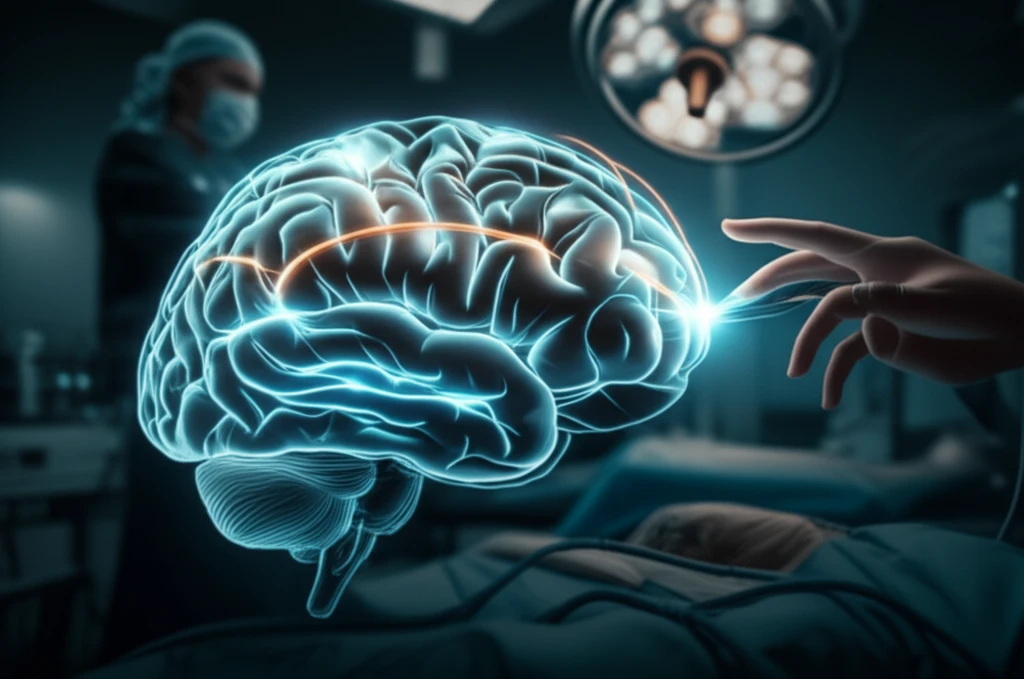
Intricate pathways of the brain illuminated during epilepsy surgery with innovative brain mapping technology.

Brain Mapping Breakthrough: Minimizing Risks in Epilepsy Surgery

"Innovative neurophysiological monitoring refines surgical precision for congenital hemiparesis patients, promising safer outcomes and better functionality."


Epilepsy surgery presents a significant opportunity for individuals with drug-resistant seizures, especially those with congenital hemiparesis. However, the challenge lies in accurately targeting the seizure-causing areas while preserving essential brain functions. Traditional methods of brain mapping can be limiting, particularly in patients with developmental delays or cognitive impairments, underscoring the need for innovative approaches.

A recent study introduces a groundbreaking intraoperative neurophysiological monitoring (IONM) technique that refines the precision of epilepsy surgery. This method focuses on mapping corticospinal projections—the pathways that control movement—to minimize the risk of post-operative deficits. By employing a comprehensive approach to brain mapping, surgeons can make more informed decisions, improving patient outcomes and quality of life.

This article will delve into the specifics of this pioneering IONM technique, illustrating its application in a 34-year-old patient with congenital hemiparesis and intractable epilepsy. We'll explore how this method not only aids in surgical decision-making but also offers a promising alternative to conventional preoperative assessments.

Innovative Brain Mapping: A Step-by-Step Guide

Intricate pathways of the brain illuminated during epilepsy surgery with innovative brain mapping technology.

The core of this new technique lies in its ability to map corticospinal projections in real-time during surgery. Unlike conventional methods, this IONM approach uses transcranial stimulation (TCS) to record compound muscle action potentials (CMAPs) from bilateral limb muscles simultaneously. This provides a comprehensive view of motor pathways, accounting for any atypical arrangements due to congenital conditions.

The procedure unfolds in a carefully orchestrated sequence:

  • Pre-Craniotomy TCS: Stimulating electrodes are placed strategically on the scalp (Cz, C3, and C4) to activate motor pathways.
  • Bilateral CMAP Recording: Muscle responses are recorded from both sides of the body, revealing how each hemisphere contributes to motor function.
  • Direct Cortical Stimulation (DCS): After opening the skull, surgeons use a monopolar electrode to directly stimulate the brain, further refining the map of motor areas.
  • Integration and Resection: By combining TCS and DCS data, surgeons can precisely identify and preserve eloquent cortex while resecting the epileptogenic zone.
In the case study, this technique enabled surgeons to identify bilateral corticospinal projections to the patient's paretic limb. This crucial insight allowed for a tailored resection, avoiding damage to critical motor areas and resulting in a seizure-free outcome without new functional deficits.

The Future of Safer Epilepsy Surgery

This innovative IONM technique represents a significant advancement in epilepsy surgery, particularly for patients with congenital hemiparesis. Its ability to map motor pathways in real-time, accounting for individual variations, minimizes the risk of post-operative deficits and maximizes the potential for successful seizure control.

Moreover, this method holds promise as a replacement for conventional preoperative assessments like functional MRI and transcranial magnetic stimulation, especially in young patients who may struggle with cooperation and participation. The simplicity and patient-independent nature of IONM make it a valuable tool for surgical planning and decision-making.

As research continues, this technique could become a standard of care, offering safer and more effective epilepsy surgery for a wider range of patients. The ability to predict functional outcomes and preserve quality of life will undoubtedly transform the landscape of epilepsy treatment.

About this Article -

This article was crafted using a human-AI hybrid and collaborative approach. AI assisted our team with initial drafting, research insights, identifying key questions, and image generation. Our human editors guided topic selection, defined the angle, structured the content, ensured factual accuracy and relevance, refined the tone, and conducted thorough editing to deliver helpful, high-quality information.See our About page for more information.

This article is based on research published under:

DOI-LINK: 10.1016/j.wneu.2017.08.071, Alternate LINK

Title: Pattern Of Corticospinal Projections Defined By Brain Mapping During Resective Epilepsy Surgery In A Patient With Congenital Hemiparesis And Intractable Epilepsy

Subject: Neurology (clinical)

Journal: World Neurosurgery

Publisher: Elsevier BV

Authors: Chen-Ya Yang, Hsin-Hung Chen, Chien Chen, Jan-Wei Chiu, Chen-Liang Chou, Tsui-Fen Yang

Published: 2017-11-01

Everything You Need To Know

1

What is the Intraoperative Neurophysiological Monitoring (IONM) technique?

The innovative Intraoperative Neurophysiological Monitoring (IONM) technique is a groundbreaking method used during epilepsy surgery to precisely map the brain's motor pathways. Specifically, it maps the corticospinal projections which are the neural pathways controlling movement. This allows surgeons to identify and protect critical motor areas during the resection of the epileptogenic zone, ultimately aiming to minimize the risk of post-operative deficits. The process involves techniques like transcranial stimulation (TCS) and direct cortical stimulation (DCS).

2

How does congenital hemiparesis affect epilepsy surgery, and how does the IONM technique help?

Congenital hemiparesis is a condition characterized by weakness on one side of the body, often present from birth due to brain injury or malformation. In the context of epilepsy surgery, this condition presents a unique challenge. Patients with congenital hemiparesis may have atypical brain organization, making it more difficult to map the motor pathways using traditional methods. The IONM technique addresses this by providing a real-time, comprehensive view of motor pathways. This ensures that surgeons can accurately target the seizure-causing areas without damaging critical motor functions, leading to safer outcomes and better functionality for these patients.

3

Why is the use of Intraoperative Neurophysiological Monitoring (IONM) important in epilepsy surgery?

The use of Intraoperative Neurophysiological Monitoring (IONM) in epilepsy surgery is important because it enhances surgical precision. Traditional brain mapping methods can be limited, especially in patients with developmental delays or cognitive impairments. IONM provides a detailed, real-time map of the motor pathways, particularly the corticospinal projections. By using techniques like transcranial stimulation (TCS) and direct cortical stimulation (DCS), surgeons can make more informed decisions, leading to a reduction in post-operative deficits. This results in a higher quality of life and improved functional outcomes for the patient.

4

What are the key steps involved in the IONM technique?

The key steps of the Intraoperative Neurophysiological Monitoring (IONM) technique include: 1. Pre-Craniotomy TCS: Stimulating electrodes are strategically placed to activate motor pathways. 2. Bilateral CMAP Recording: Muscle responses are recorded from both sides of the body. 3. Direct Cortical Stimulation (DCS): Surgeons use a monopolar electrode to directly stimulate the brain. 4. Integration and Resection: Combining TCS and DCS data, surgeons identify and preserve the eloquent cortex while resecting the epileptogenic zone. These steps provide a comprehensive, real-time map of the motor pathways, allowing for precise surgical targeting while minimizing risks.

5

What are the implications of this new IONM technique for patients undergoing epilepsy surgery?

The implications of this innovative Intraoperative Neurophysiological Monitoring (IONM) technique are significant, particularly for patients with conditions like congenital hemiparesis. By accurately mapping the corticospinal projections and identifying eloquent cortex in real-time, surgeons can minimize the risk of post-operative deficits such as paralysis or weakness. This leads to better seizure control and improved functional outcomes. The advanced precision offered by the IONM approach allows for safer surgery and opens possibilities for more patients with drug-resistant seizures to benefit from surgical interventions, ultimately enhancing their quality of life.

Newsletter Subscribe

Subscribe to get the latest articles and insights directly in your inbox.