
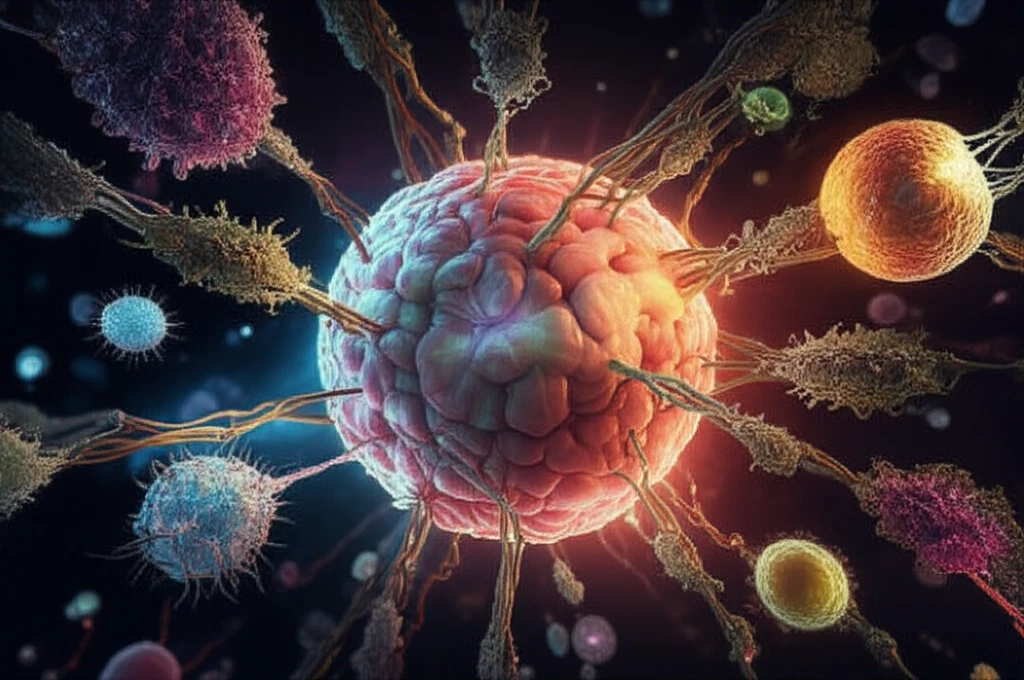
Nanoparticles attacking a brain tumor cell.

Brain Cancer Breakthroughs: How Nanotechnology & Immune Modulation Could Change Everything

"Innovative approaches combining magnetic hyperthermia and immune checkpoint inhibitors show promise in glioblastoma and breast cancer brain metastases treatment."


Brain cancer remains one of the most challenging and devastating diseases to treat. Glioblastoma, the most common primary brain malignancy in adults, is notoriously aggressive, with a median survival rate of only around one year. Breast cancer, particularly the triple-negative subtype (TNBC) and HER2-positive cancers, often metastasizes to the brain, resulting in similarly poor outcomes.

Traditional treatments have had limited success, underscoring the urgent need for innovative strategies that can effectively target these cancers while protecting the delicate brain environment. Recent research is focusing on two primary avenues: manipulating the tumor microenvironment (TME) to stimulate an immune response and understanding how cancer cells breach the blood-brain barrier (BBB) to establish metastases.

This article will delve into the findings of several studies presented at the NEURO-ONCOLOGY conference. We'll explore how researchers are using nanotechnology to generate localized hyperthermia and stimulate an immune response against glioblastoma. We'll also examine how specific molecules, like MLK4 and S1P3, play critical roles in metastasis initiation and blood-brain barrier permeability, respectively, potentially paving the way for new therapeutic interventions.

Harnessing Heat: Magnetic Hyperthermia for Glioblastoma Treatment

Nanoparticles attacking a brain tumor cell.

One promising approach involves using magnetic hyperthermia to induce localized heating within the tumor, triggering an immune response. Researchers at UCL Cancer Institute are exploring this strategy, combining superparamagnetic iron-oxide nanoparticles (SPIONs) with an alternating magnetic field (AMF) to generate heat in-situ. The idea is to essentially 'vaccinate' the tumor, making it more visible to the immune system.

Here's how the approach works:

  • SPION Injection: SPIONs are injected directly into the glioblastoma tumor.
  • AMF Activation: An alternating magnetic field is applied, causing the SPIONs to generate heat.
  • Heat-Shock Response: The localized heat induces a heat-shock protein response, signaling cellular stress and death.
  • Immune Activation: This process is designed to attract immune cells to the tumor, priming them to attack the cancer cells.
Initial results are encouraging. Studies using the GL261 glioblastoma model in mice showed that SPIONs remained within the tumor after injection and effectively generated heat when exposed to AMF. Importantly, the treatment led to a localized heat-shock protein response and an influx of activated cytotoxic T-cells, suggesting that the approach can indeed stimulate an anti-tumor immune response. While the treatment also increased regulatory T-cells (which can suppress the immune response), further research into combining this approach with immune checkpoint inhibitors (drugs that block the activity of regulatory T-cells) may enhance its effectiveness.

The Road Ahead: Refining Therapies and Targeting Metastasis

These studies represent important steps forward in the fight against brain cancer. While significant challenges remain, the innovative approaches being explored, from nanotechnology-driven immune stimulation to targeted inhibition of key metastasis-promoting molecules, offer a glimmer of hope for improving outcomes for patients with these devastating diseases.

Further research is needed to optimize these therapies and translate them into effective clinical treatments. This includes:

<ul> <li>Further research is needed to optimize these therapies and translate them into effective clinical treatments. This includes:</li> <li><b>Combinatorial Strategies:</b> Combining magnetic hyperthermia with immune checkpoint inhibitors or other therapies to enhance the anti-tumor immune response.</li> <li><b>Targeted Drug Delivery:</b> Developing strategies to effectively deliver therapeutic agents across the blood-brain barrier.</li> <li><b>Personalized Medicine:</b> Tailoring treatment approaches based on the individual characteristics of the tumor and the patient's immune system.</li> </ul>

About this Article -

This article was crafted using a human-AI hybrid and collaborative approach. AI assisted our team with initial drafting, research insights, identifying key questions, and image generation. Our human editors guided topic selection, defined the angle, structured the content, ensured factual accuracy and relevance, refined the tone, and conducted thorough editing to deliver helpful, high-quality information.See our About page for more information.

Everything You Need To Know

1

What are the main challenges in treating brain cancer?

Glioblastoma is the most common and aggressive primary brain malignancy in adults, with a poor prognosis and a median survival of about one year. Breast cancer, particularly the triple-negative subtype (TNBC) and HER2-positive cancers, often spreads to the brain, leading to similarly poor outcomes. Traditional treatments have been limited in their effectiveness, highlighting the need for new strategies that can target these cancers while protecting the delicate brain environment.

2

How does magnetic hyperthermia work?

Magnetic hyperthermia uses superparamagnetic iron-oxide nanoparticles (SPIONs) injected into the tumor, which then generate heat when exposed to an alternating magnetic field (AMF). This localized heating triggers a heat-shock protein response, signaling cellular stress and death. The approach is designed to attract immune cells to the tumor, stimulating an anti-tumor immune response. Early studies showed that SPIONs stayed within the tumor and generated heat, leading to a heat-shock protein response and an influx of activated cytotoxic T-cells in a GL261 glioblastoma model in mice.

3

What is the process of using magnetic hyperthermia for cancer treatment?

SPIONs are injected directly into the glioblastoma tumor. When exposed to an alternating magnetic field (AMF), they generate heat. This heat induces a heat-shock protein response, which signals cellular stress and death. This process is designed to attract immune cells to the tumor, priming them to attack the cancer cells, ultimately creating an immune response.

4

Why are immune checkpoint inhibitors important in this context?

Immune checkpoint inhibitors are drugs that block the activity of regulatory T-cells. Regulatory T-cells can suppress the immune response. Combining magnetic hyperthermia with immune checkpoint inhibitors could enhance the effectiveness of the treatment by preventing the suppression of the immune response, therefore enabling the immune system to work more effectively against the cancer.

5

What are the key takeaways regarding innovative approaches to treating brain cancer?

The research explores innovative strategies for treating brain cancer. These include magnetic hyperthermia using SPIONs and AMF to generate heat within tumors, and understanding the role of molecules like MLK4 and S1P3 in metastasis and blood-brain barrier permeability. The significance of these strategies lies in their potential to improve outcomes for patients with glioblastoma and breast cancer brain metastases, which are currently difficult to treat with limited options.

Newsletter Subscribe

Subscribe to get the latest articles and insights directly in your inbox.