
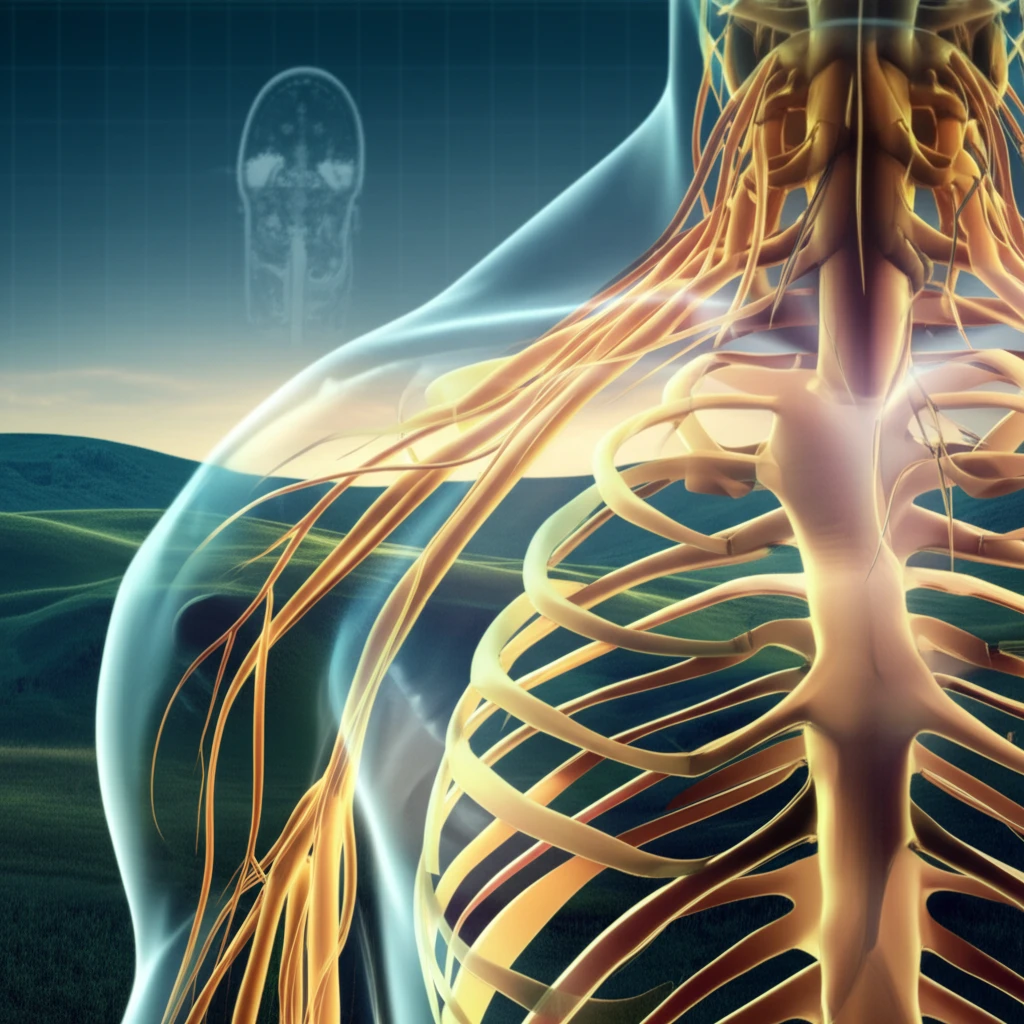
Brachial Plexus Injuries: Can MRI Scans Accurately Detect Nerve Damage?

"A close look at the effectiveness of 1.5T MRI in diagnosing root avulsions after traumatic injuries."
Traumatic brachial plexus injuries, which affect up to 1% of adults involved in serious road accidents, can have devastating consequences. These injuries involve damage to the network of nerves that control movement and sensation in the arm and hand. Effective treatment and recovery depend heavily on accurately diagnosing whether the nerve roots have been avulsed, or torn away, from the spinal cord.
Distinguishing between pre-ganglionic injuries (root avulsions) and post-ganglionic injuries (ruptures or attenuations) is crucial because each type requires a different surgical approach and has a different prognosis. Post-ganglionic injuries, where the nerve is still attached to the spinal cord, can often be repaired or grafted, offering a more favorable outcome. Root avulsions, on the other hand, typically require nerve transfers from other areas of the body, as re-implantation of the avulsed root remains uncertain.
Magnetic resonance imaging (MRI) has become increasingly popular for evaluating brachial plexus injuries due to its ability to provide detailed images of soft tissues. However, the accuracy of MRI in detecting root avulsions has been a topic of debate. This article explores the diagnostic accuracy of 1.5T MRI in detecting root avulsions in adults with traumatic brachial plexus injuries, shedding light on the reliability and limitations of this imaging technique.
What is the Role of MRI in Diagnosing Brachial Plexus Injuries?
Currently, the most reliable method for identifying root avulsions involves surgical exploration of the supraclavicular brachial plexus, where surgeons directly visualize the nerves. Given the invasive nature and uncertain outcomes of exploratory surgery, doctors often rely on pre-operative imaging and neurophysiological tests to inform their surgical decisions. MRI is valued for its multi-planar capabilities and superior soft-tissue contrast, allowing doctors to visualize the nerve roots and surrounding structures in detail.
- Study Design: A retrospective cohort study was conducted, evaluating MRI scans performed on a consecutive series of adult males with non-penetrating traumatic brachial plexus injuries.
- Participants: The study included patients managed at a single institution between January 2008 and July 2016.
- Index Test: MRI of the brachial plexus was performed using a 1.5 Tesla scanner (Siemens Avanto). Specific sequences included sagittal T1-weighted and T2-weighted turbo-spin echo, axial T2 turbo-spin echo (TSE), coronal short-tau inversion recovery (STIR), and constructive interference steady state (CISS).
- Reference Standard: Operative exploration of the supraclavicular brachial plexus was used as the reference standard for diagnosing root avulsions. Avulsion was defined based on the absence of nerve roots in the foramina or the ease with which neural structures could be pulled away during exploration.
- Data Analysis: Statistical methods were used to assess the diagnostic accuracy of MRI, including sensitivity, specificity, positive predictive value, and negative predictive value.
Key Takeaways and Future Directions
The study highlights the importance of improving diagnostic imaging techniques for brachial plexus injuries. While MRI is a valuable tool, its modest diagnostic accuracy underscores the need for continued research and development in this area. Future studies could explore the use of advanced MRI techniques, such as diffusion tensor imaging and hyperpolarization methods, to enhance the accuracy of root avulsion detection. Additionally, the study recommends that patients with brachial plexus injuries be promptly referred to specialist centers to facilitate high-quality prospective research and improve patient outcomes.