
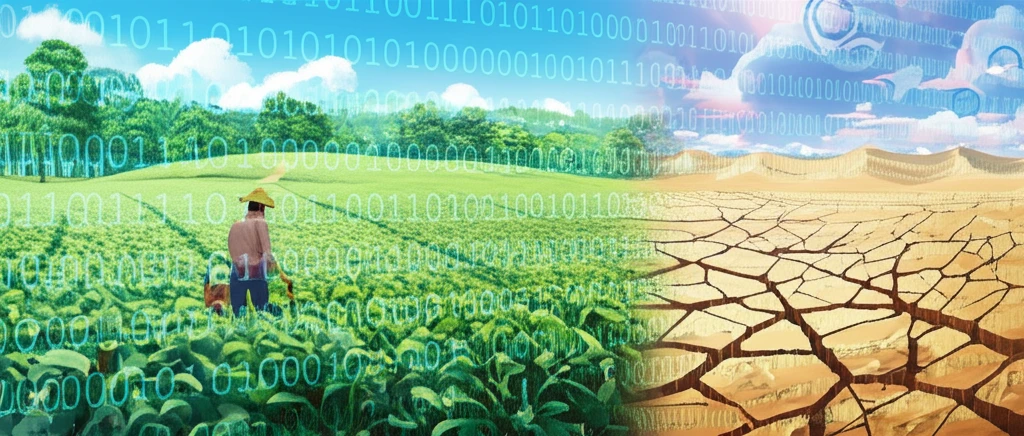
A split landscape showcasing the transformative impact of sustainable farming practices, blending lush fields with arid terrain.

Boosting Farm Productivity: Can This Simple Strategy Save Agriculture?

"Unlock the secrets to improving agricultural productivity with insights from a groundbreaking study on soil conservation and farmer efficiency."


In an era defined by climate challenges and increasing global food demand, improving agricultural productivity has become more critical than ever. Traditional approaches often fall short, particularly for smallholder farmers in developing countries who face unique obstacles. But what if a simple, yet powerful strategy could revolutionize how we approach agriculture, turning struggling farms into models of efficiency and sustainability?

A recent study published in December 2023, by Centorrino, Pérez-Urdiales, Bravo-Ureta, and Wall, offers a beacon of hope. The researchers tackle the complexities of evaluating agricultural programs, particularly those aimed at promoting soil conservation, using a sophisticated method that accounts for the real-world challenges farmers face. This approach, known as the Binary Endogenous Treatment in Stochastic Frontier Models, promises to provide a more accurate assessment of program effectiveness and unlock new pathways to agricultural success.

This article explores the key insights from this study, translating complex economic models into practical understanding for anyone interested in the future of farming. We'll uncover how accounting for hidden factors can reveal the true impact of interventions, offering valuable lessons for policymakers, agricultural organizations, and farmers themselves.

The Hidden Problem: Why Traditional Methods Fall Short?

A split landscape showcasing the transformative impact of sustainable farming practices, blending lush fields with arid terrain.

Traditional methods of evaluating agricultural programs often overlook a critical issue: endogeneity. This fancy term simply means that farmers who participate in soil conservation programs may already be different from those who don't. Perhaps they have more degraded land, are more open to new ideas, or face different economic pressures. Ignoring these pre-existing differences can skew the results, making it difficult to determine whether the program is truly effective.

Imagine a program designed to help farmers adopt new technologies. If the farmers who choose to participate are already more skilled or have better resources, it might seem like the program is working wonders. However, the reality might be that these farmers would have thrived regardless. This is where the Stochastic Frontier Analysis (SFA) comes in, offering a way to measure technical efficiency (TE).

  • Endogeneity Bias: The core issue SFA addresses by accounting for self-selection and other factors influencing participation in agricultural programs.
  • Traditional SFA Shortcomings: Previous models have limitations in dealing with endogenous variables, leading to inaccurate evaluations.
  • Binary Endogenous Treatment: The innovative model developed in the study allows the production frontier and inefficiency to depend on an endogenous binary treatment.
Using data from a soil conservation program in El Salvador, the researchers demonstrated the importance of controlling for endogeneity. When they applied standard methods, the program appeared to have little impact. However, when they accounted for the hidden factors influencing participation, the results revealed that the program significantly improved technical efficiency. This highlights the critical need to look beyond the surface and consider the underlying dynamics at play.

A Path Forward: The Future of Agricultural Innovation

By adopting a more nuanced and comprehensive approach, policymakers and agricultural organizations can make better decisions, allocate resources more effectively, and ultimately, empower smallholder farmers to thrive. The future of agriculture depends on our ability to understand the complexities of farming systems and develop solutions that are both sustainable and equitable. And it all starts with asking the right questions and embracing innovative methods of analysis.

About this Article -

This article was crafted using a human-AI hybrid and collaborative approach. AI assisted our team with initial drafting, research insights, identifying key questions, and image generation. Our human editors guided topic selection, defined the angle, structured the content, ensured factual accuracy and relevance, refined the tone, and conducted thorough editing to deliver helpful, high-quality information.See our About page for more information.

This article is based on research published under:

DOI-LINK: 10.1002/jae.3020,

Title: Binary Endogenous Treatment In Stochastic Frontier Models With An Application To Soil Conservation In El Salvador

Subject: econ.em stat.ap

Authors: Samuele Centorrino, Maria Pérez-Urdiales, Boris Bravo-Ureta, Alan J. Wall

Published: 21-12-2023

Everything You Need To Know

1

What is the key problem with how agricultural programs are usually evaluated?

Traditional evaluations of agricultural programs often fail to account for 'endogeneity'. This means that farmers who choose to participate in programs, like those promoting soil conservation, may already differ significantly from those who don't. These pre-existing differences can skew the results and make it hard to accurately determine if the program is genuinely effective. Ignoring such factors gives biased results.

2

How does the Binary Endogenous Treatment in Stochastic Frontier Models improve agricultural program evaluation?

The Binary Endogenous Treatment in Stochastic Frontier Models addresses endogeneity by acknowledging and accounting for the self-selection of farmers into programs. This approach allows the production frontier and inefficiency to depend on an endogenous binary treatment. By doing so, it provides a more accurate assessment of a program's true impact on technical efficiency, which helps in understanding whether the program truly improves farm productivity.

3

What is 'technical efficiency' (TE) in the context of farming, and why is it important?

Technical efficiency (TE) in farming refers to how well farmers convert inputs (like seeds, fertilizer, and labor) into outputs (crops). Measuring TE is crucial because it indicates how productively a farm is operating. Improving TE means farmers can produce more with the same resources, boosting overall agricultural productivity and sustainability. Methods like Stochastic Frontier Analysis (SFA) help to measure and improve TE by identifying inefficiencies.

4

Can you explain how a soil conservation program was evaluated in El Salvador, and what the results showed?

In El Salvador, researchers evaluated a soil conservation program using both traditional methods and the Binary Endogenous Treatment in Stochastic Frontier Models. The traditional methods suggested the program had little impact. However, when they accounted for endogeneity using the newer model, the results showed that the program significantly improved technical efficiency. This demonstrates the importance of accounting for hidden factors influencing participation to accurately assess a program's effectiveness.

5

What are the implications of using innovative methods like Stochastic Frontier Analysis (SFA) for agricultural policy and the future of farming?

Using innovative methods like Stochastic Frontier Analysis (SFA) has significant implications for agricultural policy. By providing a more accurate assessment of program effectiveness, policymakers can make better-informed decisions about resource allocation and program design. This can lead to more effective support for smallholder farmers, improved agricultural productivity, and more sustainable farming practices. Embracing these advanced analytical techniques is essential for addressing the complex challenges facing agriculture and ensuring food security in the future.

Newsletter Subscribe

Subscribe to get the latest articles and insights directly in your inbox.