
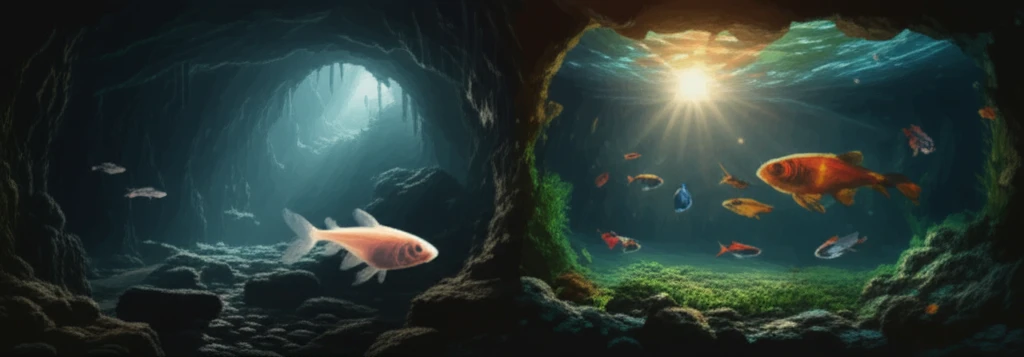
Cavefish and Surface Fish: A Tale of Two Worlds

Blind Luck? Unraveling the Secrets of Cavefish Evolution

"How ecological speciation drives unique adaptations in Astyanax cavefish."


In the diverse tapestry of life, evolution often crafts unique adaptations to specific environments. Ecological speciation, where populations diverge due to different habitats, showcases nature's ingenuity. Cave environments, characterized by perpetual darkness and limited resources, present extreme selective pressures, making them ideal laboratories for studying this process.

The Astyanax mexicanus, or Mexican tetra, offers a compelling case study. This fish has surface-dwelling and cave-dwelling populations, with the latter exhibiting remarkable adaptations like blindness and reduced pigmentation. What's particularly fascinating is that these distinct populations can still interbreed, allowing scientists to explore the genetic basis of their differences.

Recent research delves into the genomic consequences of ecological speciation in Astyanax cavefish. By analyzing hybrids between cave and surface fish, scientists have uncovered intriguing patterns of allelic transmission and epistatic interactions, shedding light on the genetic mechanisms driving their divergence.

Unmasking Transmission Ratio Distortion

Cavefish and Surface Fish: A Tale of Two Worlds

One of the key findings of the study is the observation of transmission ratio distortion (TRD) in hybrid offspring. TRD occurs when the frequency of certain alleles deviates significantly from Mendelian expectations. In other words, some alleles are inherited more or less often than predicted.

Researchers discovered that TRD in Astyanax hybrids is not a random occurrence. Instead, it appears to be influenced by genomic incompatibilities between cave and surface fish. This suggests that specific combinations of alleles from the two populations may not function optimally together, leading to selective pressures during sperm development.

Here are the main takeaways regarding transmission ratio distortion:
  • TRD primarily affects male germline cells rather than female or zygotic stages.
  • Genomes of the old lineage cave fish are mismatched with that of the new lineage surface fish.
  • Transmission bias occurs at a stage prior to full maturation of the sperm.
To confirm these observations, scientists analyzed the allelic content of sperm DNA and compared it to that of control diploid DNA from fin clips. The results revealed that males that were inter-lineage hybrids showed more significant differences between gametic and zygotic DNA than those that were non-hybrids, confirming the impact of hybridization on TRD.

The Big Picture: Implications for Speciation

This research contributes significantly to our understanding of the genetic mechanisms underlying ecological speciation. By revealing the role of transmission ratio distortion and epistatic interactions in Astyanax cavefish, it highlights the complex interplay between natural selection and reproductive isolation.

The findings support the hypothesis that ecological divergence can lead to the evolution of reproductive barriers as a byproduct of adaptation. As cave and surface fish adapt to their respective environments, their genomes become increasingly incompatible, ultimately contributing to speciation.

Ultimately, this study underscores the importance of considering both direct selective pressures and indirect genetic effects when investigating the origins of biodiversity. The Astyanax cavefish, with its remarkable adaptations and complex genetic interactions, remains a valuable model for unraveling the mysteries of evolution.

About this Article -

This article was crafted using a human-AI hybrid and collaborative approach. AI assisted our team with initial drafting, research insights, identifying key questions, and image generation. Our human editors guided topic selection, defined the angle, structured the content, ensured factual accuracy and relevance, refined the tone, and conducted thorough editing to deliver helpful, high-quality information.See our About page for more information.

This article is based on research published under:

DOI-LINK: 10.1371/journal.pone.0079903, Alternate LINK

Title: Genomic Consequences Of Ecological Speciation In Astyanax Cavefish

Subject: Multidisciplinary

Journal: PLoS ONE

Publisher: Public Library of Science (PLoS)

Authors: Richard Borowsky, Dana Cohen

Published: 2013-11-19

Everything You Need To Know

1

What is the significance of Astyanax mexicanus in the context of ecological speciation?

Astyanax mexicanus, also known as the Mexican tetra, provides a compelling example of ecological speciation. This species has surface-dwelling and cave-dwelling populations. The cave-dwelling populations have adapted to their environment in a unique way, developing blindness and reduced pigmentation. This divergence is driven by different selective pressures in the two habitats. The fact that these populations can still interbreed allows researchers to study the genetic basis of their differences.

2

What is ecological speciation and how does it relate to the adaptations seen in Astyanax cavefish?

Ecological speciation is a process where populations diverge into separate species due to different environmental conditions. In the case of Astyanax cavefish, the extreme conditions of cave environments, characterized by perpetual darkness and limited resources, have driven unique adaptations like blindness and reduced pigmentation. This process showcases how natural selection can lead to significant changes in a relatively short period, creating distinct populations adapted to specific niches.

3

What is Transmission Ratio Distortion (TRD) and how does it manifest in the study of Astyanax cavefish?

Transmission Ratio Distortion (TRD) is a phenomenon where the frequency of certain alleles in offspring deviates from Mendelian expectations. In the context of Astyanax cavefish, TRD occurs in hybrid offspring between cave and surface fish. This distortion arises because of genomic incompatibilities between the cave and surface fish. Specific combinations of alleles from the two populations may not function optimally together, leading to selective pressures during sperm development. The research indicates that TRD primarily affects male germline cells and is influenced by mismatches between the genomes of the old lineage cave fish and the new lineage surface fish.

4

How does epistasis contribute to the unique adaptations observed in Astyanax cavefish?

Epistasis refers to the interaction between different genes, where the effect of one gene is dependent on the presence of one or more modifier genes. In the study of Astyanax cavefish, epistatic interactions play a significant role in shaping the traits that distinguish cave-dwelling fish from surface-dwelling fish. These interactions highlight the complex genetic architecture underlying adaptation, showing how multiple genes can work together to produce a specific trait. For instance, the loss of sight in cavefish may involve multiple genes, where the effect of one gene is modulated by others.

5

What is the broader significance of the research on Astyanax cavefish for understanding the process of speciation?

The research on Astyanax cavefish provides valuable insights into how ecological speciation works. By examining TRD and epistatic interactions, scientists are getting a better understanding of the genetic mechanisms driving the divergence of populations. The findings help explain how reproductive isolation and natural selection work together to create new species adapted to specific environments, showing the complexity of evolution.

Newsletter Subscribe

Subscribe to get the latest articles and insights directly in your inbox.