
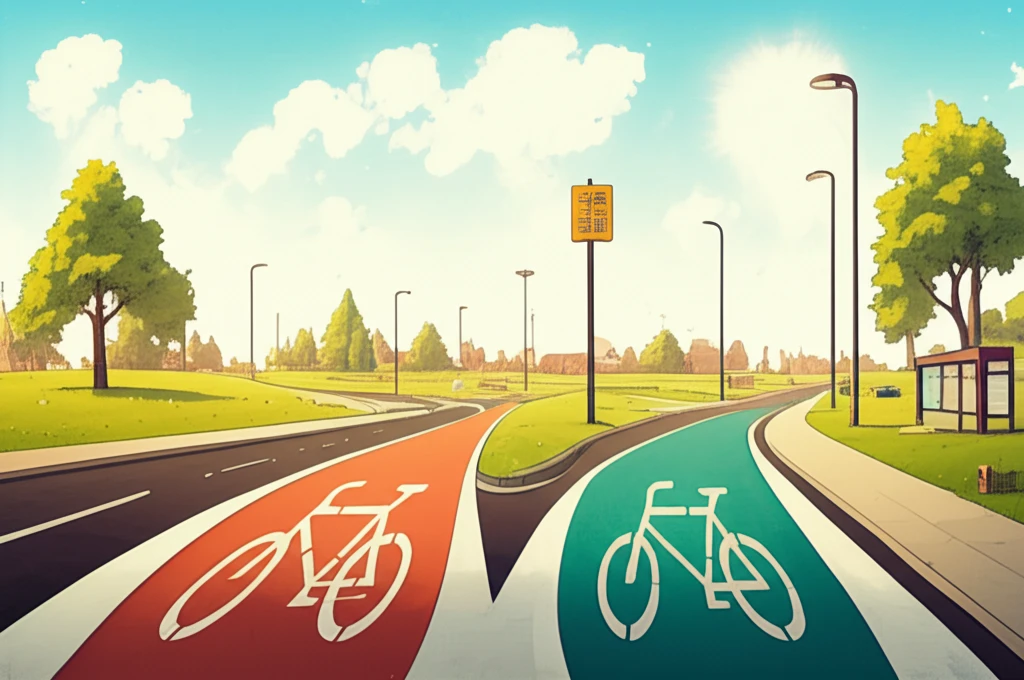
Bike-Friendly Cities: How Connected Infrastructure Boosts Home Values & Community

"Uncover the hidden economic benefits of interconnected bike paths and local amenities, transforming neighborhoods into desirable, thriving communities."
In today's urban planning, there's a growing emphasis on creating vibrant, walkable communities that prioritize the health and well-being of their residents. A key component of this vision is the development of interconnected active transportation networks, with a particular focus on bike facilities. Cities across the nation are expanding their bike lane networks, and residents are increasingly recognizing the value of these amenities.
But what impact do bike facilities have on the local economy and property values? As active transportation infrastructure gains traction, it's crucial to understand how homeowners perceive these features and how they complement existing community assets. This exploration delves into the economic impact of interconnected active transportation infrastructure, examining how bike facilities and their connections to local amenities can boost property values and enhance community appeal.
Planners are looking at ways to connect bike networks to existing infrastructure. Given the importance of local governance in these choices, understanding the impact on nearby homeowners is essential for evaluating competing projects and targeting investments to areas with the greatest potential benefits.
Injuries Rise Where Infrastructure Falls Short
Data from New York City shows that bike injuries are increasing most in areas with the worst cycling infrastructure, underscoring a direct link between infrastructure quality and rider safety. Streetsblog analysis further reveals that the best protected bike lanes still concentrate in the whitest neighborhoods, raising serious equity concerns about who benefits from investment. This pattern is not unique to New York—advocates in the U.S., Canada, and Australia note that low population density is routinely used as a counter-argument against expanding bike infrastructure, even in dense urban cores where cycling could thrive.
Complete Streets and the Myth of One-Size-Fits-All Standards
A complete streets approach—designing roadways to accommodate cyclists, pedestrians, and transit users alongside cars—is widely recognized as best practice in bike infrastructure planning. This philosophy aligns with Frederick Law Olmsted's historic vision of public spaces designed for equitable access and livable communities. However, rigid adherence to standards such as the conventional 12-foot lane width can limit flexibility; research shows that context-sensitive design, rather than blanket rules, better serves urban planners and infrastructure developers.
A Gap in the Historical Record
The provided source material for this subsection does not contain factual content directly relevant to the history of bike infrastructure development. While cycling advocacy has deep roots—from early 20th-century bicycle boom movements to the protected-lane revolution of the 2010s—no specific milestones or foundational discoveries can be cited from the sources supplied. Future research should draw on dedicated historical and urban-planning literature to fill this gap.
The Capitalization of Connectivity
Research conducted in Franklin County, Ohio, provides valuable insights into how interconnected active transportation infrastructure affects property values. The study, titled "Capitalization of interconnected active transportation infrastructure," investigated the impact of connections between local amenities and bike facilities on single-family home prices. The results reveal that proximity to bike facilities generally leads to positive capitalization, particularly with on-road facilities.
- On-Road Facilities: Proximity to on-road bike facilities generally increases home values.
- Bus Stop Connections: On-road bike facilities connected to bus stops can decrease property values.
- Open Space Connections: On-road bike facilities connected to local open spaces boost property values.
- Non-Road Facilities: Connectivity with public spaces for non-road facilities increases home value.
Green Infrastructure ROI Becomes Clearer
New research is increasingly linking parks, trails, and bike infrastructure to measurable public health, quality-of-life, and economic benefits. The National Association of Realtors reports that the return on investment for green infrastructure is becoming much clearer, though outcomes depend on a number of best practices in design and placement. PeopleForBikes continues to highlight the best places to bike in the U.S., signaling growing institutional interest in benchmarking cycling-friendly communities.
Economic Impact Studies Refute Critics
A common criticism of new bike lanes is that they harm adjacent businesses by making car access less convenient, but research from Portland State University's Transportation Research and Education Center directly refutes this claim. The study finds that bike lanes can provide a positive economic impact for cities rather than the drag critics predict. Rider experience also tells the story: as one cyclist documented, routes with solid bike infrastructure dramatically improve the safety and enjoyment of urban cycling compared to routes without.
Federal Policy Shifts Favor Bike Infrastructure
The $1.2 trillion federal infrastructure bill signed in late 2021 includes a 60 percent increase in federal funding for transportation alternatives and language encouraging complete streets policies. Smart Cities Dive reports that this represents a significant policy shift toward climate-friendly transportation, including dedicated investment in bike infrastructure. The cycling surge seen in many cities during and after the pandemic appears to be here to stay, according to reporting supported by these policy changes.
Planning for a Bike-Friendly Future
Creating bike-friendly communities is more than just building bike lanes; it's about strategically connecting people to the places they want to go. By understanding the nuances of how residents perceive and value these connections, planners can make informed decisions that lead to increased property values, healthier lifestyles, and more vibrant, thriving communities.
The Politics Behind 'Independent' Infrastructure Reviews
The validity of expert assessments of bike infrastructure trials has come under scrutiny. An analysis of a so-called independent expert report on a pop-up bike infrastructure trial found it to be neither independent nor expert in its methodology, describing it as a privately commissioned piece of political advocacy containing egregious errors. This underscores how debates over bike infrastructure are often shaped as much by political framing as by data quality, making transparent and comprehensive evaluation all the more critical.
Winter Cycling Proves Year-Round Infrastructure Is Possible
Oulu, Finland demonstrates that dedicated cycling infrastructure can support high ridership even in harsh winter climates, challenging the assumption that cold-weather cities cannot be bike-friendly. More than half of all trips to universities and schools in Oulu are made by bike over the course of a year, sustained by well-maintained winter cycling paths. The city's experience suggests that year-round cycling viability depends less on weather than on infrastructure investment and maintenance.
Infrastructure Systems Demand Integrated Management
The broader infrastructure landscape—including bike networks—increasingly demands sophisticated asset management approaches as systems grow in complexity. ASCE's Journal of Infrastructure Systems addresses how interconnected infrastructure challenges require systems-level thinking that goes beyond individual projects. Managing bike infrastructure as part of a larger transportation and urban systems portfolio is essential for maximizing long-term community value.
Shared Micromobility Advances the Car-Free Vision
Lime, the world's largest shared electric vehicle company, is building toward a future where transportation is shared, affordable, and car-free through e-scooter and e-bike services. Their mission directly connects to broader sustainability goals tracked by institutions like Times Higher Education through sustainability impact rankings. The real-world impact of these services is felt most directly by individuals who gain affordable, accessible transportation options that complement larger bike infrastructure networks.