
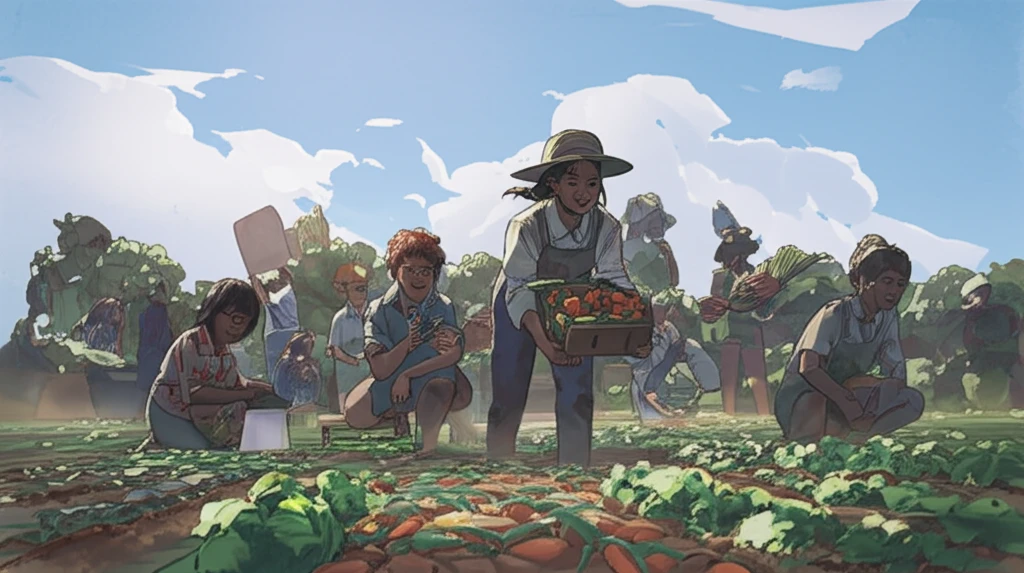
Community Supported Agriculture harvest with diverse people.

Beyond the Grocery Store: Unlocking the Power of Community-Supported Agriculture

"Discover how CSA programs are reshaping our relationship with food, fostering sustainability, and building stronger communities – and how you can get involved."


In a world increasingly focused on sustainable living and knowing where our food comes from, Community Supported Agriculture (CSA) is gaining significant traction. CSAs represent a direct partnership between consumers and local farmers, offering a unique alternative to traditional grocery shopping.

But what exactly is a CSA, and why should you consider joining one? At its core, a CSA is a commitment. Consumers, often called members, purchase a 'share' of a farm's harvest in advance. This upfront payment provides farmers with crucial capital at the start of the growing season, ensuring financial stability. In return, members receive a regular supply of fresh, locally grown produce throughout the season.

This article dives into the world of CSAs, exploring how they function, the benefits they offer to both consumers and farmers, and the key factors that influence whether someone chooses to participate. We'll break down the research, simplify the concepts, and help you decide if joining a CSA is the right step for you.

The CSA Advantage: Fresh Food, Stronger Communities, and a Sustainable Future

Community Supported Agriculture harvest with diverse people.

CSAs offer a multitude of benefits that extend far beyond simply acquiring groceries:

Here's a breakdown:

  • Access to Fresh, Local Produce: Enjoy seasonal fruits and vegetables picked at their peak ripeness, often far fresher than what's available in supermarkets.
  • Supporting Local Farmers: Your investment directly supports local farms and their sustainable practices, helping them thrive in a competitive market.
  • Building Community: CSAs often foster a sense of community through farm events, volunteer opportunities, and direct interaction with the farmers who grow your food.
  • Environmental Benefits: CSAs typically promote sustainable farming methods, reducing reliance on pesticides and long-distance transportation, thus lowering your carbon footprint.
  • Learning Opportunities: Many CSAs offer educational programs, workshops, and farm tours, providing insights into agriculture and where your food comes from.
However, it's crucial to acknowledge that CSAs aren't without their challenges. Commitment is key, as members share in both the bounty and the risks of farming. Unforeseen circumstances like weather or pests can impact harvests, meaning the quantity and variety of produce can fluctuate. It’s important to consider how factors in our lives and surroundings can affect how we see CSAs.

Making the CSA Choice: Is It Right for You?

Ultimately, deciding whether to participate in a CSA involves weighing the advantages against the commitment and potential challenges. By understanding the dynamics at play – the socio-cultural influences, the personal values, and the balance of gains and losses – you can make an informed choice that aligns with your lifestyle and supports a more sustainable food system. Take the time to research local CSAs, connect with farmers, and explore the options available to see if this unique approach to food is the right fit for you.

About this Article -

This article was crafted using a human-AI hybrid and collaborative approach. AI assisted our team with initial drafting, research insights, identifying key questions, and image generation. Our human editors guided topic selection, defined the angle, structured the content, ensured factual accuracy and relevance, refined the tone, and conducted thorough editing to deliver helpful, high-quality information.See our About page for more information.

This article is based on research published under:

DOI-LINK: https://doi.org/10.48550/arXiv.2312.17529,

Title: Theorizing The Socio-Cultural Dynamics Of Consumer Decision-Making For Participation In Community-Supported Agriculture

Subject: econ.th

Authors: Sota Takagi, Yusuke Numazawa, Kentaro Katsube, Wataru Omukai, Miki Saijo, Takumi Ohashi

Published: 29-12-2023

Everything You Need To Know

1

What exactly is Community Supported Agriculture (CSA), and how does it work?

Community Supported Agriculture (CSA) is a direct partnership between consumers and local farmers. Members purchase a 'share' of a farm's harvest in advance, providing farmers with crucial capital at the start of the growing season. In return, members receive a regular supply of fresh, locally grown produce throughout the season. This system bypasses traditional grocery stores, fostering a closer relationship between consumers and their food source. While the definition focuses on the economic exchange, it's important to remember the social aspect of CSAs, where community building and educational opportunities often take place. This symbiotic relationship ensures that the farmer has upfront capital for farming, and you get fresh produce.

2

What are the primary benefits of joining a Community Supported Agriculture (CSA) program?

CSAs offer numerous advantages, including access to fresh, local produce picked at its peak ripeness. By participating in CSA you are directly supporting local farmers and promoting sustainable farming practices, which helps them thrive against larger commercial competition. CSAs also foster a sense of community through farm events, volunteer opportunities, and direct interaction with farmers. Environmentally, CSAs reduce reliance on pesticides and long-distance transportation, lowering your carbon footprint. In addition, educational programs, workshops, and farm tours are often part of the CSA experience, offering insights into agriculture and food origins. The combined effect of these benefits creates a multi-dimensional value for both the member and the community as a whole.

3

What are some of the challenges or potential drawbacks of participating in a Community Supported Agriculture (CSA)?

One significant challenge is the commitment required, as members share in both the bounty and the risks of farming. Unforeseen circumstances like weather or pests can impact harvests, meaning the quantity and variety of produce can fluctuate. This can be a drawback for those seeking a guaranteed selection of specific items. Unlike a grocery store, one cannot simply choose to not participate in the risk. It is important to note that these risks can lead to a greater appreciation for the work that goes into producing food, and the inherent unpredictability of agriculture.

4

How do Community Supported Agriculture (CSA) programs contribute to sustainability and environmental health?

Community Supported Agriculture (CSA) programs promote sustainable farming methods, reducing reliance on pesticides and long-distance transportation, thereby lowering the carbon footprint associated with food production. By supporting local farms, CSAs encourage practices that prioritize soil health, biodiversity, and water conservation. These practices contrast sharply with industrial agriculture, which often relies on monoculture farming and synthetic inputs that degrade ecosystems. As a result, CSAs can create a more resilient and environmentally friendly food system.

5

Besides receiving produce, what other opportunities might Community Supported Agriculture (CSA) members have to engage with their local farm and community?

Beyond receiving fresh produce, Community Supported Agriculture (CSA) members often have opportunities to engage with their local farm through farm events, volunteer activities, and direct interactions with the farmers. Many CSAs offer educational programs, workshops, and farm tours, providing insights into agriculture and where your food comes from. These experiences create a stronger connection between consumers and their food source, fostering a deeper understanding of sustainable farming practices and the importance of local agriculture. Moreover, this kind of engagement can build a more vibrant and resilient community around the farm.

Newsletter Subscribe

Subscribe to get the latest articles and insights directly in your inbox.