
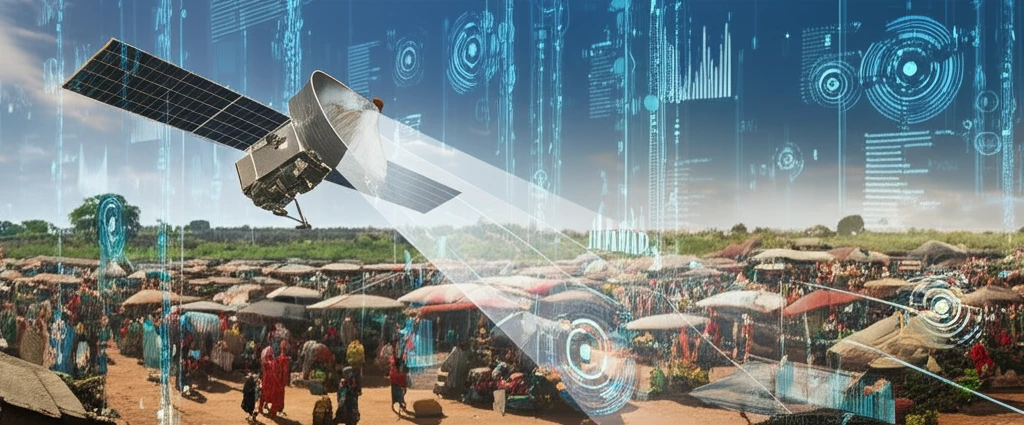
Beyond the Farm: How Satellites Are Revolutionizing Rural Economic Monitoring

"Discover how high-frequency satellite imagery is unlocking real-time insights into remote rural economies, offering a game-changing approach to poverty reduction and targeted assistance."
For years, understanding the economic pulse of remote rural communities has been a major challenge. Traditional methods, relying on infrequent surveys and on-the-ground assessments, often fall short due to cost, accessibility, and the ever-changing nature of these regions. But what if we could tap into a source of data that's always watching, providing consistent, real-time insights, regardless of location or ground conditions? That's the promise of satellite imagery, and it's rapidly changing how we perceive and support rural economies.
Imagine a world where policymakers can identify emerging economic challenges in real-time, humanitarian organizations can deliver targeted aid with unprecedented efficiency, and researchers can gain a deeper understanding of the intricate factors that shape rural livelihoods. This isn't science fiction; it's the reality being unlocked by high-frequency satellite imagery. By monitoring periodic markets – the lifeblood of many rural economies – we can now construct detailed, up-to-weekly measures of economic activity, capturing seasonal patterns, and responding to local weather and conflict.
This article delves into the groundbreaking research that's making this revolution possible. We'll explore how scientists are using satellite data to detect marketplaces without pre-existing maps, track their activity levels, and correlate these findings with other measures of economic well-being. Get ready to discover how satellite imagery is paving the way for a more responsive and effective approach to rural development.
Why Traditional Economic Monitoring Fails Rural Communities
The fight against extreme poverty has made significant strides, but stubborn pockets remain, particularly in remote and fragile regions. These areas often lack the infrastructure and resources for effective economic monitoring, creating a major obstacle to further progress. Traditional methods struggle because:
- Remoteness and Fragility: Field data collection is costly and often impossible in conflict zones or areas with limited infrastructure.
- Data Gaps: Accurate and timely data is lacking, hindering effective responses to critical events like natural disasters or epidemics.
- Inconsistent Records: Maintaining consistent administrative records is difficult, leading to unreliable data for policymakers and researchers.
- Scalability Issues: Household surveys are expensive to scale and infrequently collected, providing only a snapshot of economic conditions.
The Future of Rural Economic Monitoring is in the Sky
Satellite imagery offers a powerful new tool for understanding and supporting rural economies. By providing real-time, consistent, and scalable data, it overcomes the limitations of traditional methods and opens up a new era of evidence-based decision-making. As technology advances and data analysis techniques become more sophisticated, the potential for satellite imagery to drive positive change in rural communities will only continue to grow. The ability to monitor even the most remote economies has massive implications for both global intervention efforts and improving research accuracy in our understanding of globalized markets.