
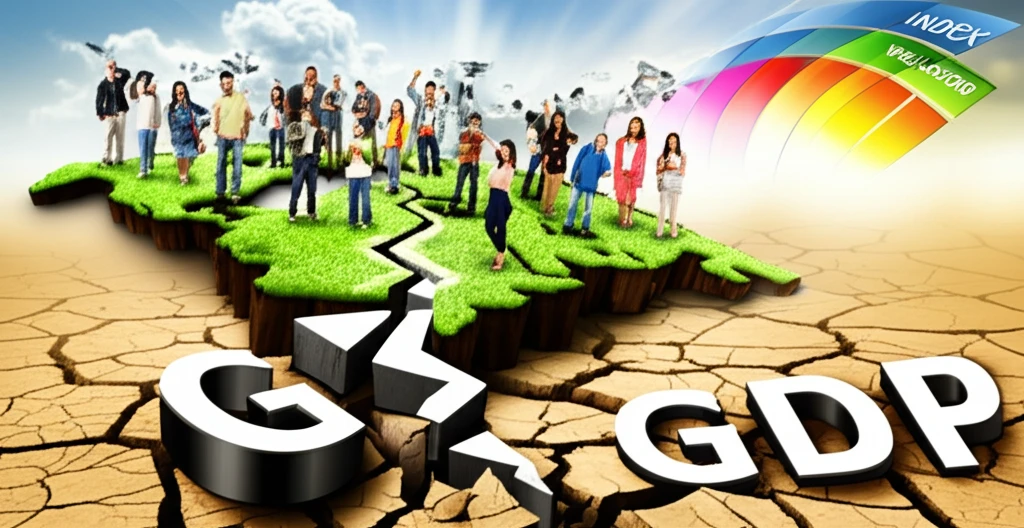
Sustainable Development Illustration

Beyond GDP: Why Our Obsession with Economic Growth is Unsustainable

"Is GDP truly a measure of progress? Discover alternative ways to measure a nation's well-being and build a sustainable future."


In today's world, it's common to hear leaders and experts talk about "sustainable development." However, these words often don't lead to real action. Take Albania, for example, where progress is almost always measured by the growth of its Gross Domestic Product (GDP). But relying only on economic indicators like GDP can be misleading. Since the mid-20th century, people have questioned whether GDP truly reflects a society's well-being.

GDP doesn't account for important things like people's happiness or the environment. This article explores new ways to measure sustainable development. It looks at happiness indexes and ecological footprints to get a more complete picture of progress. This approach considers quality of life, environmental sustainability, and economic development, which is especially important for countries like Albania.

Consider this: On the day a new highway opened between Tirana and Durres, researchers counted the gas stations built on the old road. They found 42 gas stations in just 38 kilometers, some costing over a hundred thousand euros. Their article was titled "Money for Nothing!" because many of these ventures were unsustainable. This illustrates how focusing solely on GDP can hide the real picture.

The Problem with GDP: A Flawed Measure of Progress

Sustainable Development Illustration

Using only economic measures of progress is not enough. We need to pay attention to sustainable development to understand both where we are now and what our future holds. Sustainability should be a top priority because it is closely tied to a free society. If we don't value sustainability in our financial, natural, and social systems, future generations won't be able to live freely. Stability is essential for solving social problems.

Jon Derbach, author of "An Agent for a Sustainable America," calls sustainable development one of the most important ideas of the 20th century, along with democracy, human rights, free markets, collective security, and fighting poverty. UN Secretary-General Ban Ki-moon has called sustainable development "the imperative of the twenty-first century."

  • GDP Doesn't Reflect Well-being: GDP focuses on economic output but ignores social and environmental factors that contribute to people's quality of life.
  • GDP Can Mask Unsustainable Practices: GDP can increase even when resources are being depleted or the environment is being damaged.
  • GDP Doesn't Capture Inequality: GDP growth can hide the fact that wealth is concentrated in the hands of a few, while many struggle to make ends meet.
GDP measures everything, "except that which makes life worthwhile," Robert Kennedy said in 1968. GDP does not measure the health of our children, the quality of their education, or the joy of their play. It does not include the beauty of our poetry or the strength of our marriages, the intelligence of our public debate, or the integrity of our public officials. It measures neither our wit nor our courage, neither our wisdom nor our learning, neither our compassion nor our devotion to our country.

The Path Forward: Measuring What Matters

It's time to move beyond GDP as the sole measure of progress and embrace a more comprehensive approach that considers well-being and sustainability. By adopting a well-being index and focusing on what truly matters, we can create a more just, equitable, and sustainable future for all.

About this Article -

This article was crafted using a human-AI hybrid and collaborative approach. AI assisted our team with initial drafting, research insights, identifying key questions, and image generation. Our human editors guided topic selection, defined the angle, structured the content, ensured factual accuracy and relevance, refined the tone, and conducted thorough editing to deliver helpful, high-quality information.See our About page for more information.

Everything You Need To Know

1

Why is relying solely on Gross Domestic Product (GDP) as a measure of progress potentially misleading, using Albania as an example?

Relying solely on Gross Domestic Product (GDP) can be misleading because it doesn't account for all aspects of a nation's well-being. While GDP focuses on economic output, it often ignores crucial elements like environmental sustainability and social happiness. The example of Albania illustrates this. The construction of the highway and the subsequent proliferation of gas stations may have contributed positively to GDP, but the article implies that this growth may have been built on unsustainable practices, potentially harming the environment or representing an inefficient use of resources. This shows that GDP growth doesn't necessarily equate to genuine progress or improved quality of life. A well-being index would provide a more holistic view of progress.

2

What are the key shortcomings of GDP as a measure of a nation's advancement, and what aspects of societal well-being does it fail to capture?

GDP has several key shortcomings. Firstly, it doesn't reflect the well-being of a society. GDP focuses on economic output, neglecting social and environmental factors that determine the quality of life. Secondly, GDP can mask unsustainable practices, where resources are depleted, or the environment is damaged, all while GDP increases. Thirdly, GDP doesn't capture income inequality, which allows GDP growth to hide wealth concentration in the hands of a few while many struggle. In essence, GDP fails to measure crucial elements such as happiness, health of children, quality of education, beauty in art, or the strength of societal bonds. Robert Kennedy's quote highlights these limitations, suggesting that GDP measures everything except the things that make life truly worthwhile.

3

In what ways does the article suggest measuring progress beyond Gross Domestic Product (GDP), and why is this shift considered important?

The article suggests measuring progress beyond Gross Domestic Product (GDP) by embracing a more holistic approach. This involves considering a well-being index and focusing on factors that truly matter, like quality of life and environmental sustainability. This shift is crucial because it allows for a more accurate assessment of a nation's advancement, moving beyond simply economic measures. The article implies that this approach leads to a more just, equitable, and sustainable future for all. Focusing on sustainable development, according to the article, is essential for maintaining a free society and ensuring future generations can live freely, which is vital for solving social problems.

4

How does the concept of sustainable development relate to the limitations of Gross Domestic Product (GDP), and why is sustainable development emphasized in the context of the 21st century?

Sustainable development is directly related to the limitations of Gross Domestic Product (GDP) because it addresses the aspects that GDP ignores: environmental impact, social well-being, and long-term resource management. GDP can increase even when unsustainable practices are in place, potentially harming the environment or depleting resources. Sustainable development, on the other hand, prioritizes economic development alongside environmental protection and social equity, providing a more complete picture of progress. Sustainable development is emphasized in the context of the 21st century because it is seen as the imperative of the century. It ensures a focus on sustainability in financial, natural, and social systems, guaranteeing future generations can live freely. This is a crucial step to solving social problems and building a better future.

5

What are the different areas that the article mentions GDP doesn't account for?

The article points out that GDP fails to account for several crucial aspects of societal well-being. It does not measure people's happiness. It does not include the health of our children, the quality of their education, or the joy of their play. Furthermore, GDP does not capture the beauty of our poetry or the strength of our marriages. The intelligence of public debate and the integrity of public officials also are not included. Ultimately, it measures neither our wit nor our courage, neither our wisdom nor our learning, neither our compassion nor our devotion to our country. These examples highlight the narrow scope of GDP and illustrate why a more comprehensive approach to measuring progress is needed.

Newsletter Subscribe

Subscribe to get the latest articles and insights directly in your inbox.