
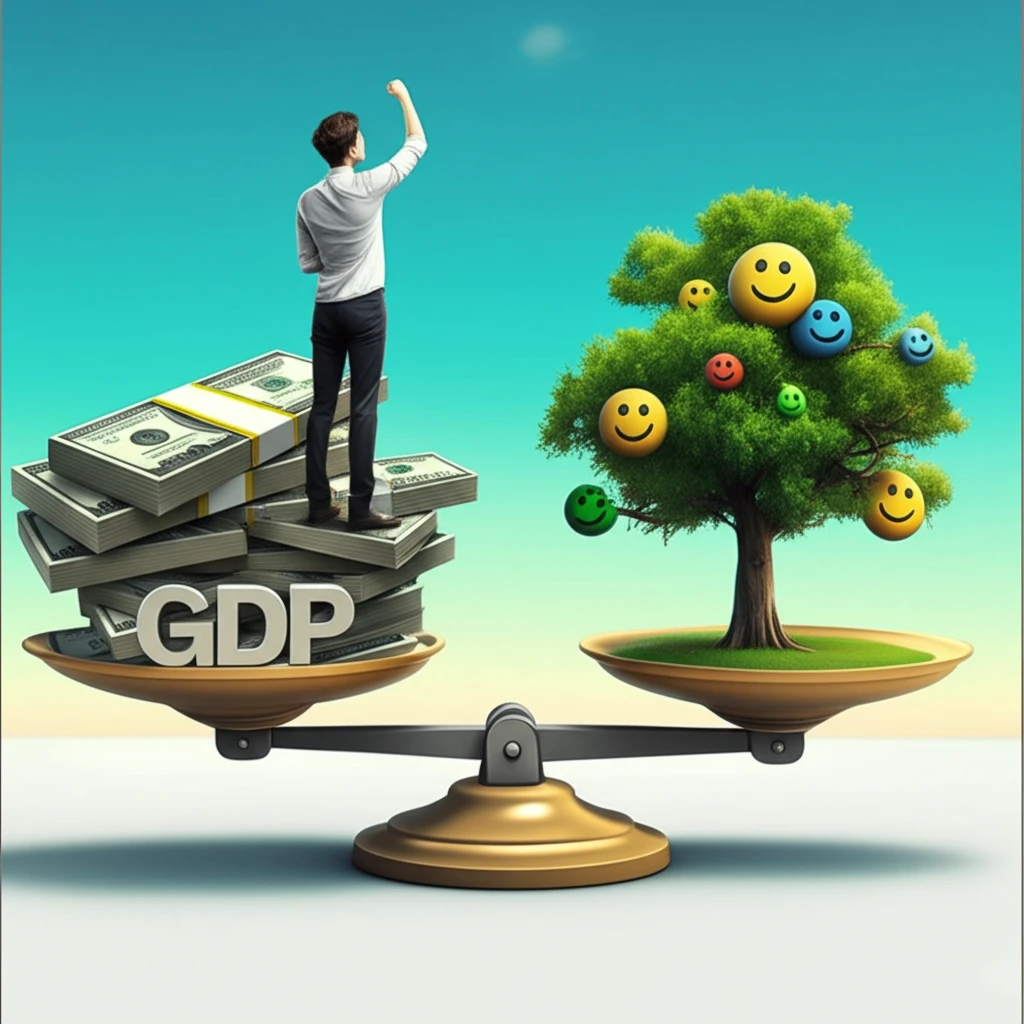
Beyond GDP: Why Measuring Happiness and Sustainability Matters More Than Economic Growth

"Uncover the limitations of GDP as a measure of societal progress and explore alternative approaches that prioritize well-being and environmental sustainability."
In today's world, it's common to hear leaders and experts talk about 'sustainable development' as the key to a better future. However, these words often don't lead to real action. This is especially true in places like Albania, where progress is mainly judged by how much the economy grows, measured by GDP (Gross Domestic Product). But is this the best way to measure how well a society is doing?
For many years, people have questioned whether GDP alone is a good measure of progress. It mainly looks at economic factors, ignoring things like people's happiness and well-being. In this article, we'll explore why we need to look beyond just GDP and consider other ways to measure progress, including happiness and environmental sustainability. This is especially important for countries like Albania, where a more complete picture of progress is needed.
Let's start with a simple example. Imagine a new highway is built between two cities. While this might boost the economy and increase GDP, it could also lead to problems like gas stations on the old road going out of business. This shows how focusing only on economic growth can hide the full story and why we need to consider the bigger picture of sustainable development.
Tracking Global Progress Toward the 2030 Agenda
The 2030 Agenda for Sustainable Development, adopted by all United Nations Member States in 2015, provides a shared blueprint for peace and prosperity for people and the planet. The Sustainable Development Report 2026 visualizes and tracks countries' performance across 108 trend indicators through its SDG Index, Dashboards, and Data Explorer, offering a current statistical picture of progress. The Sustainable Development Index (SDI) takes a complementary lens by measuring the ecological efficiency of human development and recognizing that development must be achieved within planetary boundaries. Open data sources such as the World Bank's World Development Indicators provide free, internationally comparable statistics on global development and the fight against poverty. Taken together, these tools show that measuring progress now extends well beyond economic output alone.
The SDG Framework and Verification Standards
The standard approach to sustainability rests on the 17 UN Sustainable Development Goals (SDGs), framed as a universal call to action to end poverty and inequality, protect the planet, and ensure that all people enjoy health, justice, and prosperity. International bodies such as UNDP and WHO Europe reinforce the same framing, emphasizing that it is critical that no one is left behind, while ISO links its standards directly to the SDGs. On the methodological side, organizations such as Verra provide market-based verification mechanisms, including the Sustainable Development Verified Impact Standard, for assessing whether projects deliver credible sustainability outcomes. The very breadth of the framework also points to its limits, as harmonizing diverse indicators, standards, and verification bodies remains an ongoing practical challenge.
From Stockholm to the 2030 Agenda
The modern concept of sustainable development was famously defined as development that meets the needs of the present without compromising the ability of future generations to meet their own needs, a formulation central to the work of the International Institute for Sustainable Development. The IISD traces this history through milestones from the 1972 Stockholm conference to Stockholm+50, showing how the idea evolved over half a century. In 2015, the international community set the SDGs as part of the UN 2030 Agenda for Sustainable Development, pledging to eradicate poverty, find sustainable solutions, and ensure everyone's human rights. The resulting 'Transforming our World' resolution is a historic document that lays out the 17 SDGs to mobilize global efforts to end poverty, foster peace, safeguard the rights and dignity of all people, and protect the planet.
The Problem with Focusing Only on GDP
Using only economic measures like GDP to judge progress has been criticized for a long time. These measures don't consider important things like people's happiness or the health of the environment. If we don't value sustainability, future generations may not be able to live freely. Lack of stability limits our ability to solve social problems.
- GDP Doesn't Account for Environmental Damage: Economic growth can come at the expense of natural resources and environmental health.
- Ignores Social Well-being: GDP doesn't reflect the happiness, health, or education levels of a population.
- Can Mask Inequality: GDP growth can hide the fact that wealth is not evenly distributed.
- Short-Term Focus: GDP often prioritizes immediate gains over long-term sustainability.
Review Platforms, Frontier Science, and Reporting
The High-level Political Forum on Sustainable Development (HLPF) serves as the central United Nations platform for the follow-up and review of the 2030 Agenda and its 17 SDGs. Alongside it, the Sustainable Development Report series complements official SDG indicators and voluntary country-led review processes with its own SDG Index and Dashboards. In the research community, venues such as Nature's sustainability channel and the journal Energy for Sustainable Development publish frontier work, including recent studies on the catalytic deconstruction of plastics in which plastic additives can deactivate catalysts and hinder recycling. Together, these reviews and journals track both the scientific frontier and the institutional machinery that keeps the SDGs under continuous assessment.
Critiques of the Sustainable Development Concept
Critics from the Planetary Project contend that the term 'sustainable development' is itself problematic, pointing to an internal logical contradiction and to what they see as the narrowness of the concept. They also criticize a provocative tendency to confine global problems to the environmental context rather than addressing broader structural issues. The Global Footprint Network, for its part, acknowledges the limitations and criticisms of its ecological footprint methodology, noting that criticism drives the scientific process and can stem from misunderstandings, new insights, or genuine flaws in the methodology. Taken together, these sources illustrate that sustainable development remains a contested concept whose measurement tools and core assumptions continue to be questioned.
Economic Growth vs. Sustainable Development
Economic development refers to the process by which a country's economic health and quality of life improve, encompassing a number of structural changes. Sustainable development, by contrast, conditions that progress on ecological limits and intergenerational equity, a distinction at the heart of the debate over whether GDP should remain the primary yardstick of national success. Development practitioners describe 'what sustains development' as one of the most fundamental and contested questions in development practice, given the competing priorities of governments, agencies, researchers, and civil society. Comparison platforms such as Versus make such trade-offs tangible by allowing users to compare anything side-by-side with specifications, filters, and clear data visualizations, underscoring how readily these choices can be quantified.
Moving Towards a More Sustainable Future
It's time to look beyond GDP as the only way to measure how well a country is doing. We need to adopt measures that consider both the well-being of people and the health of the planet. One such measure is the Happy Planet Index (HPI), which combines well-being and environmental impact. By embracing these alternative measures, we can create a more sustainable and equitable future for all, ensuring a better quality of life for generations to come.
A Universal Call for Action for People and Planet
The United Nations frames the SDGs as 'Time for Global Action for People and Planet,' a call addressed to all countries, whether poor, rich, or middle-income, to promote prosperity while protecting the planet. This dual mandate is echoed in emerging research on diagnosing the developmental sustainability of complex social systems such as teams, organizations, communities, and cities by assessing quality of life, wellbeing, happiness, and proactive engagement of participants. The authors note that the last decade has seen regional and global communities transition through unprecedented economic change, deepening the need to understand sustainable community development in relation to both complex economic phenomena and psychological processes. The convergence of UN policy framing and academic methodology points toward a definition of progress that integrates economic, environmental, and human wellbeing dimensions.
Sustainability in Unexpected Frontiers
Sustainability innovation is reaching into unexpected sectors, as illustrated by the amusement ride industry, where manufacturers such as LIMEIQI are focusing on sustainable and eco-friendly attractions. Industry content tracks both current trends in sustainable amusement rides and future trends in eco-friendly amusement attractions, suggesting that energy efficiency, materials choice, and a lower environmental footprint are becoming design priorities even in leisure infrastructure. As more sectors apply sustainability principles, the emerging frontier appears to be less about discovering new goals and more about translating established standards of environmental performance into every corner of the economy. This points to a broader pattern in which sustainable practices migrate from core industries into peripheral ones.
Beyond Any Single Metric
Beyond specific indicators and indexes, the broader challenge is systemic, because sustainability, wellbeing, and economic growth are entangled in ways that no single measurement framework fully captures. Shifting away from GDP-centered measures raises difficult questions about data comparability, political incentives, and whose wellbeing counts, and these questions remain far from settled. A more realistic path forward appears to be a plural approach that treats economic output as one measure among many rather than the default definition of progress.
Auditing Policies for Real-World Change
Real-world impact ultimately depends on whether commitments translate into organizational practice, and one concrete mechanism is the audit of sustainable development policies within businesses. Case studies show how auditing such policies has driven meaningful change in two prominent organizations, illustrating the power of structured review to move companies from stated intentions to verified action. This human-scale focus complements macro-level statistics by connecting sustainability targets to the everyday decisions of firms and the people who work within them.