
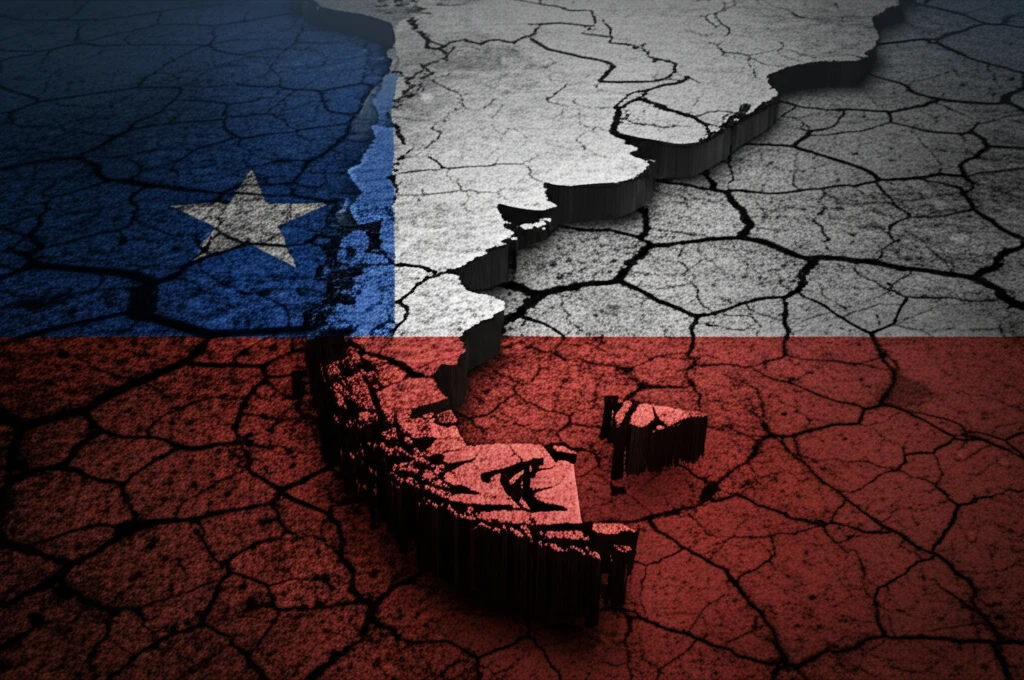
Latin America's Lost Decade: How Policy Changes Stifled Chile's Economic Miracle

"A deep dive into how internal policy shifts derailed Chile's growth trajectory, turning a regional star into an economic underperformer."
For decades, Chile was celebrated as an economic success story in Latin America, a beacon of stability and growth. That narrative dramatically shifted around 2014. The country suddenly found itself mired in an economic slowdown, a stark contrast to its previous performance. This unexpected turn of events has sparked considerable debate: What caused Chile's economic engine to falter, and what lessons can be learned from its experience?
Theories abound, with some economists pointing to external factors like the end of the commodities boom, particularly the decline in copper prices (a crucial export for Chile). Others argue that internal policy changes, enacted around 2014, were the primary culprit. These changes, encompassing tax reforms, labor laws, and constitutional ambitions, aimed to reshape Chilean society but may have inadvertently undermined its economic foundations.
This article delves into the complex interplay of factors that contributed to Chile's economic slowdown. By examining the evidence and analysis presented in a recent research paper, we'll explore how internal policy shifts interacted with external pressures to create a "lost decade" for the Chilean economy. We'll uncover how decisions intended to foster greater equality and social progress may have inadvertently stifled economic growth and investment.
A Nation of Geographic Extremes
Chile is a narrow strip of land stretching along the western edge of southwestern South America between the Andes Mountains and the Pacific Ocean, described as the world's southernmost country and the closest to Antarctica. Its 2024 national census enumerated a population of 18.5 million. The overwhelming majority of Chileans are described as the product of varying degrees of admixture between white ethnic groups, predominantly Basques and Spaniards, with indigenous peoples, and most share a common culture, history, ancestry, and language. Merriam-Webster defines the term "Chilean" simply as of, relating to, or characteristic of Chile or its people.
Reading a Culture Through Its Most Popular Dish
One accessible way to approach Chilean culture is through the food that defines day-to-day life, and the completo, the Chilean take on the hot dog, is reported to be the most popular sandwich in the country. According to Chef's Pencil, what makes the completo different is the generous amount of mashed avocado used. When the toppings include avocado, tomato (or ketchup), and mayonnaise, it is called Italiano, because it represents the colors of the Italian flag. This culinary lens captures how adaptiveness shapes Chilean food culture, though it remains a single, food-focused vantage point rather than a full picture of the broader society.
Geography as the Backdrop of History
Britannica describes Chile's development as inseparable from its striking geography: a long, narrow country stretching along the western edge of South America, bordered by the Andes Mountains to the east and the Pacific Ocean to the west. The country is known for its dramatic contrasts, ranging from the Atacama Desert in the north to the glacial landscapes of Patagonia in the south. The capital, Santiago, is located in the country's central valley. This corridor of desert, central valley, and glacier helps frame how settlement, commerce, and national identity developed along a thin ribbon of territory.
The Chilean Miracle and Its Unexpected Demise: What Went Wrong?
To fully appreciate the magnitude of Chile's economic reversal, it's essential to understand its prior success. From the 1990s to the early 2010s, Chile experienced a period of remarkable economic expansion, driven by sound macroeconomic policies, trade liberalization, and a favorable global environment. Real wages rose, poverty declined, and Chile emerged as one of the most stable and prosperous economies in Latin America. This period was often dubbed the "Chilean miracle."
- Commodities Bust: The decline in copper prices significantly impacted Chile's export revenues and overall economic activity.
- Policy Overhaul: A series of reforms under President Bachelet's second term aimed to address social inequalities but also altered the country's economic landscape. These included:
- Increased corporate taxes
- Labor market reforms to strengthen unions
- Educational reforms
- Constitutional reform efforts
An Emerging Research Field
No authoritative source material on the newest economic research was available for this section, so any account of it should be read as provisional. Ongoing academic work appears to focus on how Chile's market reforms contributed to rapid growth and on what subsequent policy shifts cost the country, but that framing is inferred rather than documented here. Because this scholarship is still developing, its findings remain contested and incomplete. Until peer-reviewed analyses are consolidated, only broad, carefully hedged observations are defensible.
Recorded Critiques Remain Limited
Without dedicated source material, documented counterarguments to the "lost decade" framing cannot be verified here. Skeptics could plausibly argue that Chile's slowdown reflected external shocks rather than policy choices alone, or that social gains partly offset the economic costs. Such positions may well exist in the wider literature, but they are not established by the current evidence base. A full accounting of the counterarguments therefore awaits access to the relevant studies.
Comparisons Await Supporting Evidence
A responsible comparative assessment of Chile's economic experience would benchmark it against other Latin American economies and across time periods. However, no comparative source material was provided, so claims of similarity or divergence across the region cannot be substantiated here. The surrounding article implies that Chile once stood apart within Latin America for its growth record, but that suggestion requires external confirmation. Further research is needed before regional comparisons can be made with confidence.
Lessons from Latin America: Navigating the Complexities of Economic Policy
Chile's experience offers valuable lessons for other developing economies. While social reforms are essential for creating a more equitable society, they must be carefully designed and implemented to avoid unintended negative consequences on economic growth. Balancing social progress with economic stability requires a nuanced approach, considering the potential impact of policy changes on investment, productivity, and competitiveness. The story isn't over. Chile's future depends on its ability to learn from the past and forge a new path towards sustainable and inclusive growth. As the nation grapples with these challenges, its experiences will undoubtedly shape the broader conversation about economic development in Latin America and beyond.
No Expert Consensus Yet Documented
Any synthesis of expert opinion on Chile's economic miracle and its reversal must be flagged as tentative, since no expert commentary was available for review. The natural reading of the surrounding narrative is that policy changes constrained a previously successful economic model, but that is the article's framing rather than a documented expert verdict. Without cited analysis from economists or historians, the synthesis offered here is necessarily provisional. It should be replaced once expert assessments become available.
An Open-Ended Prognosis
What comes next for Chile's economy cannot be forecast from the sources on hand, which contain no projections about the country's economic trajectory. Plausible next frontiers for the debate include revisiting the balance between growth and social policy and assessing whether the recent slowdown is permanent or recoverable. All such outlooks are speculative and should be treated as informed conjecture rather than evidence-based prediction. Definitive judgment will require new data and subsequent research.
Systemic Questions Remain Unanswered
The broader systemic challenges implied by Chile's story, such as institutional stability, commodity dependence, and income concentration, could not be examined with the available source material. The surrounding article suggests these structural issues played a role in ending the economic miracle, but no source was provided to substantiate the details. Placing Chile's experience in a wider Latin American context likewise requires sources not supplied here. These gaps should be filled before the systemic picture is regarded as complete.
Human Impact Unmeasured at Present
The human dimension of Chile's lost decade is the least documented in the available source material, which contains no evidence about wages, employment, or living standards over the period in question. Because no sources were provided for this subsection, any claim about how Chileans experienced the policy shifts would be unverified. The impact on families, workers, and communities therefore cannot yet be described with confidence. Eyewitness accounts, household data, and local reporting will be needed to capture this layer of the story.