
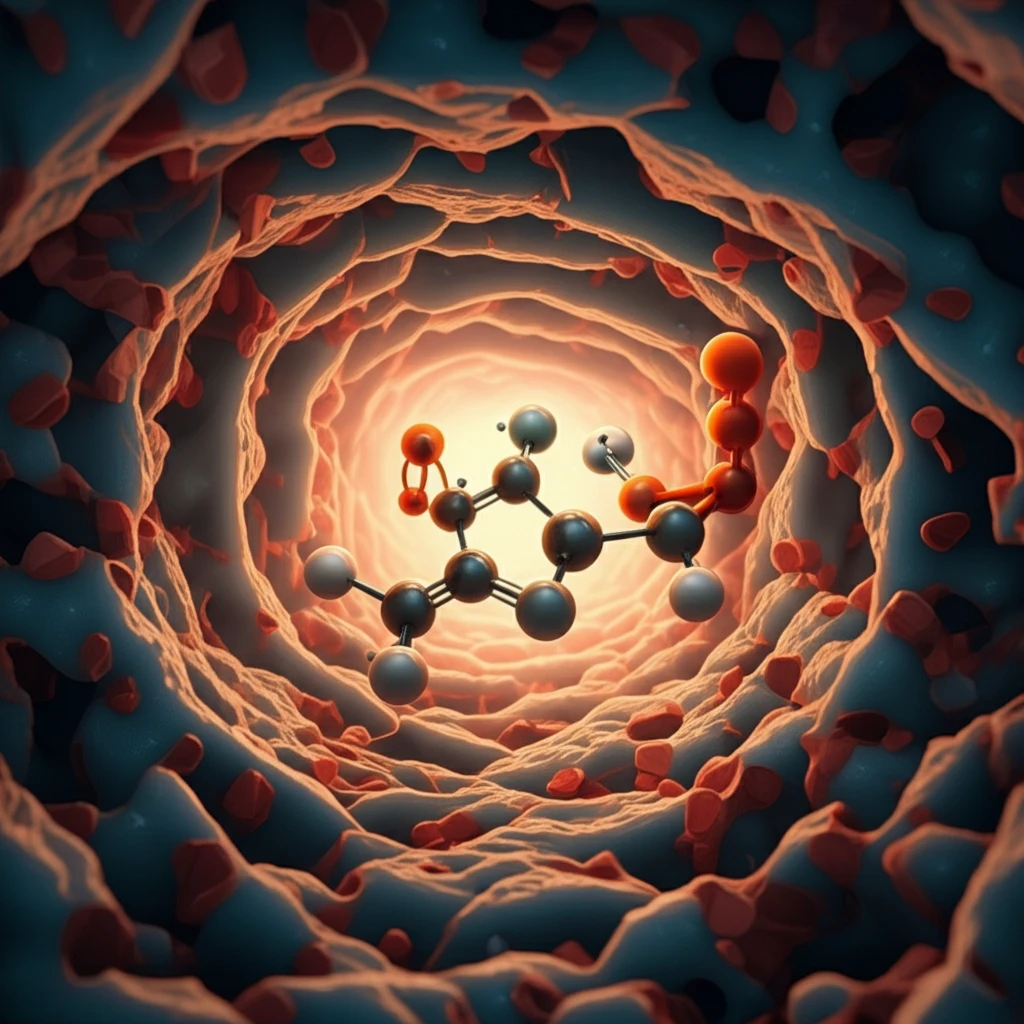
Benzene to Phenol: Unlocking High-Performance Selective Oxidation with Iron-Containing Zeolites

"Scientists uncover the mechanism behind efficient benzene hydroxylation using Fe zeolites, paving the way for industrial applications and sustainable chemical processes."
The direct conversion of benzene to phenol represents a highly sought-after process with considerable economic potential. This transformation is crucial in producing a wide range of products, including plastics, resins, and pharmaceuticals. Iron-containing zeolites (Fe zeolites) have emerged as promising catalysts for this reaction, showcasing an exceptional combination of high activity and selectivity.
Despite their initial success, Fe zeolites have faced challenges related to catalyst deactivation, limiting their long-term industrial applications. Catalyst deactivation refers to the gradual loss of catalytic activity over time, which can result from various factors such as the formation of byproducts or structural changes in the catalyst. Overcoming this deactivation issue is crucial for the widespread adoption of Fe zeolite catalysts in benzene hydroxylation and other oxidation reactions.
Recent research has shed light on the nature of the active site in Fe zeolites, an unusually reactive Fe(IV)=O species. This breakthrough has opened new avenues for understanding the reaction mechanism and designing more robust and efficient catalysts. Now, scientists are diving deep into how this active site interacts with benzene, aiming to unlock the secrets to high activity, selectivity, and catalyst longevity. By understanding the relationship between the active site and catalyst deactivation, more effective strategies can be developed.
The Benzene-to-Phenol Challenge
Direct hydroxylation of benzene to phenol represents a significant chemical transformation, with Fe-zeolite catalysts showing substantial promise. Studies have examined Fe-Beta catalysts with iron content ranging from 0.045 to 2.0 wt.% for benzene-to-phenol conversion using N2O as an oxidant. The apparent rate of benzene hydroxylation on Fe-ZSM-5 has been measured at 19 times greater than that of phenol hydroxylation, demonstrating strong selectivity for the desired product. Research has identified approximately 340 μmol gcat–1 of Fe(II) centers accessible under reaction conditions in these catalytic systems.
N2O-Based Oxidation and Catalyst Limitations
The most established method for direct benzene hydroxylation uses nitrous oxide (N2O) as an oxidizing agent in the gas phase with Fe-zeolite catalysts. However, practical limitations exist with current Fe-zeolite catalysts that mechanistic insights may help resolve. Hierarchical Fe/ZSM-5 catalysts have been developed that show strongly improved lifetime in selective hydroxylation, suggesting that addressing diffusion constraints can enhance performance. Density functional theory computations using B3LYP functionals have been employed to understand the mechanistic pathway of direct benzene hydroxylation over Fe-ZSM-5.
Foundations of Fe-Zeolite Catalysis
Fe/ZSM-5 zeolites have attracted considerable research attention due to their high activity and stability in direct benzene hydroxylation. The use of hydrogen peroxide (H2O2) as an alternative oxidant to N2O has also been explored, with Fe-containing zeolites demonstrating selective phenol production. Studies have synthesized Fe(X)L-MYZ and Fe(X)L-YZ catalysts for benzene oxidation with H2O2, establishing that iron-containing zeolites can effectively catalyze this transformation.
How Does the Active Site Regenerate During Benzene Hydroxylation?
To fully understand the catalytic mechanism, researchers employed advanced spectroscopic techniques to probe the reaction between the active Fe(IV)=O site (denoted as α-O) and benzene. These techniques provide detailed insights into the electronic and geometric structures of the active site, as well as the changes that occur during the reaction.
- Mössbauer Spectroscopy: Quantitatively tracks iron species during the reaction, showing regeneration of Fe(II).
- X-ray Absorption Spectroscopy (XAS): Provides electronic and structural information, confirming changes in the iron center's coordination.
- Nuclear Resonance Vibrational Spectroscopy (NRVS): Selectively probes vibrations of iron sites, revealing changes in bonding.
Recent Advances in Catalytic Performance
Recent research demonstrates that both Fe-ZSM-5 and Fe-Beta zeolites generate Fe(II) active sites capable of decomposing N2O to produce surface atomic oxygen species. These active sites are responsible for the selective oxidation of benzene to phenol. In 2024, studies enhanced benzene oxidation using an Fe1/PMA catalyst under ambient conditions, representing progress toward sustainable catalytic processes. This work provides new insights into molecular-level catalytic mechanisms for benzene-to-phenol conversion.
Challenges in Understanding Active Sites
Research findings suggest that the UV-vis spectral behavior of iron complexes in zeolites is not significantly affected by the presence or absence of mesoporosity. This observation complicates efforts to characterize active sites using spectroscopic techniques alone. The difficulty in distinguishing different iron species in zeolite frameworks remains a challenge for optimizing catalytic performance. These findings indicate that direct spectroscopic evidence of active site behavior may be limited in providing clear guidance for catalyst design.
Hierarchical Zeolite Improvements
Hierarchical Fe/ZSM-5 zeolite catalysts have been developed through one-step synthesis methods, achieving strongly improved lifetime in selective hydroxylation of benzene to phenol. These hierarchical structures address diffusion limitations present in conventional microporous zeolites. The improved performance suggests that engineered pore structures can significantly enhance catalytic efficiency. This approach represents a meaningful advancement over traditional Fe-zeolite formulations.
Future Impact
This research provides critical insights into the design of highly active and selective oxidation catalysts. The understanding of the reaction mechanism, combined with strategies to minimize catalyst deactivation, could lead to the development of more efficient and sustainable chemical processes. The ability to directly convert benzene to phenol with high selectivity opens new avenues for industrial applications, potentially reducing reliance on less environmentally friendly methods.
Key Takeaways from the Research
The body of research on iron-containing zeolites for benzene-to-phenol conversion reveals a field progressing from fundamental understanding toward practical application. The identification of Fe(II) active sites and their role in N2O decomposition has been a central finding across multiple studies. While conventional Fe-zeolite catalysts show promise, challenges remain in scaling these systems for industrial implementation.
Expanding Zeolite Frameworks
Fe-BEA (beta) zeolite catalysts have demonstrated comparable catalytic performance to Fe-MFI (ZSM-5) catalysts in selective benzene hydroxylation with N2O. This finding suggests that alternative zeolite frameworks may offer viable pathways for improving catalytic efficiency. Future research may explore additional framework topologies beyond ZSM-5 and Beta structures. The exploration of diverse zeolite compositions could unlock new performance characteristics for this important transformation.
The Persistent Challenge of Arene Hydroxylation
Hydroxylation of arenes through activation of aromatic Csp2–H bonds has attracted great attention for decades but remains a huge challenge in synthetic chemistry. The selectivity problem—avoiding over-oxidation to catechol or other byproducts—continues to drive research into new catalytic systems. Vanadium-containing all-silica zeolites represent one alternative approach to this enduring problem. Despite decades of effort, achieving high selectivity with practical oxidants under mild conditions remains elusive.
Translating Research to Practice
The development of efficient benzene-to-phenol conversion technologies holds potential significance for chemical manufacturing, as phenol is an important industrial chemical used in numerous applications. Progress in this field requires sustained collaboration between academic researchers exploring fundamental mechanisms and engineers developing scalable processes. The challenge of moving from laboratory demonstrations to viable industrial processes remains a key hurdle for the field.