
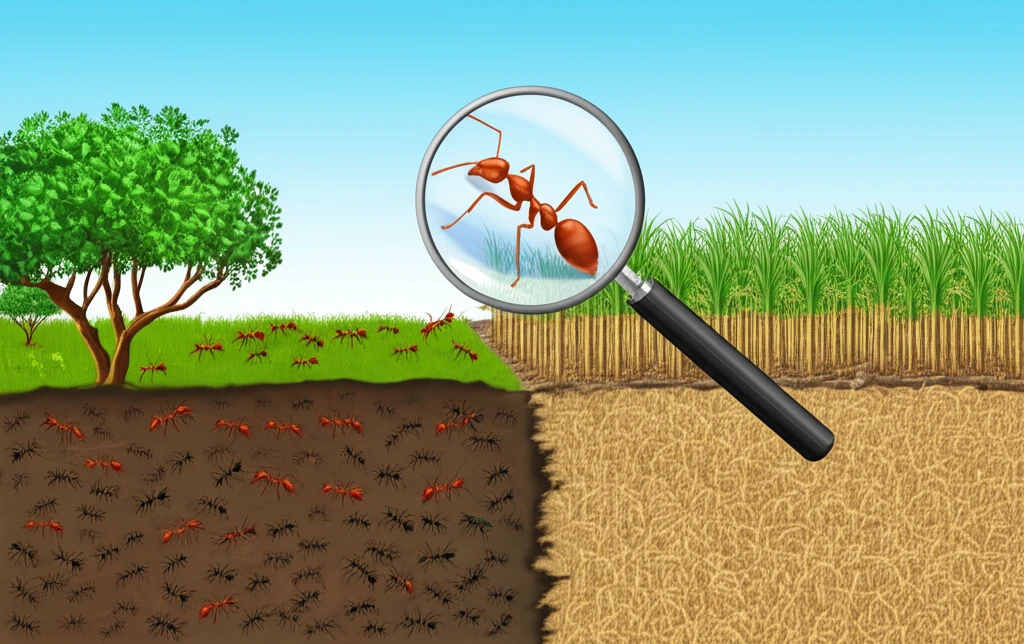
Backyard Biodiversity: How Land Use Choices Affect Ant Communities and What You Can Do

"Uncover the Hidden World of Ants and How Your Land Management Impacts These Tiny Ecosystem Engineers"
Our world is facing a biodiversity crisis, with land-use change identified as a primary culprit. As urban sprawl and agricultural expansion continue, it's essential to understand how our choices impact the delicate balance of ecosystems. While the plight of larger animals often grabs headlines, it's the often-overlooked creatures like ants that can tell us a great deal about the health of our environment.
Ants, often considered the unsung heroes of our ecosystems, play crucial roles in soil aeration, seed dispersal, and nutrient cycling. They're also highly sensitive to environmental changes, making them excellent bio-indicators. By studying ant communities, scientists can gain valuable insights into the effects of different land management practices and restoration efforts.
A recent study published in Austral Ecology delved into the intricate relationship between land use, restoration, and ant biodiversity in the Cerrado region of Brazil, a global biodiversity hotspot. This research highlights how different land management choices—from agriculture to conservation—shape ant communities and offers valuable lessons for promoting biodiversity in various landscapes, including your own backyard.
Measuring Backyard Biodiversity
Biodiversity measures the variety of life in a habitat or ecosystem, and greater biodiversity means a habitat can support more living things and is healthier and more resilient. Biodiversity loss in terrestrial environments associated with human activities has been appreciated as a major issue for some years now. In grasslands, different types of land use can alter ant community composition and overall ant abundance.
Surveying What Lives in Your Backyard
A common approach is to survey a backyard and count what lives there, such as the number of tree types, using larger circles to represent bigger trees and smaller circles for smaller trees. Species can be identified using the SEEK app or a field guide. Ecologists may also make home visits to teach homeowners how to improve their backyard biodiversity.
From Backyard Surveys to Land-Use Science
Research on ant communities across a land use gradient in grasslands examines how different land uses affect ant composition and abundance, either by altering available food sources or by disturbing nesting sites. Climate change is emerging as the greatest environmental challenge of the twenty-first century, induced by natural and anthropogenic reasons. Biodiversity loss in terrestrial environments from human activities has been recognized as a major issue for years.
The Cerrado Experiment: A Microcosm of Land-Use Impact
The researchers focused on the Cerrado, a vast tropical savanna in Brazil, which has faced rapid transformation due to agricultural expansion. They examined ant communities in various land-use types, including sugarcane plantations, cattle pastures, eucalyptus and pine plantations, and restored areas, comparing them to native Cerrado ecosystems. By analyzing ant species richness, functional composition, and their relationship with vegetation attributes, the study revealed the profound impacts of land management practices.
- Agriculture: Intensive farming, especially sugarcane, severely reduces ant diversity.
- Pastoralism: Cattle pastures, if managed carefully, can maintain some level of ant biodiversity.
- Silviculture: Pine and eucalyptus plantations have varying impacts depending on their age and management practices.
- Restoration: Current restoration efforts focused on tree cover have not fully restored native ant communities.
Niche Structure and Arboreal Ant Diversity
Recent research analyzed the niche structure of tropical rainforest ant communities across five sites on three continents, focusing on the two key niche dimensions of diet and foraging time. Studies of arboreal ant communities in tropical forest trees found that most of the explained variation in ant species richness and turnover was due to the joint influences of environmental and spatial factors on tree species richness and turnover.
Interlinked Factors Limit Simple Explanations
Land use can affect ant communities either indirectly, by altering available food sources, or directly, by disturbing nesting sites. In arboreal ant studies, most of the explained variation in ant species richness and turnover was due to the joint influences of environmental and spatial factors on tree species richness and turnover, meaning these factors do not act in isolation.
Comparing Ant Communities Across Continents
Rainforest ant communities were compared across five sites on three continents to analyze their niche structure along the dimensions of diet and foraging time. On a smaller scale, grassland studies compare how different types of land use alter ant community composition and overall abundance.
Small Changes, Big Impact: Promoting Biodiversity in Your Own Space
The lessons from the Cerrado study extend far beyond Brazil. They offer practical guidance for anyone seeking to promote biodiversity in their own environment. Whether you have a sprawling backyard or a small urban garden, your land management choices can make a difference. By understanding the needs of local ecosystems, we can create habitats that support a diverse range of species, starting with the often-overlooked ant communities.
A Healthier Backyard Through Better Land Use
Greater biodiversity means a habitat can support more living things and is healthier and more resilient. Because land use affects ant communities both directly through nesting-site disturbance and indirectly through food sources, the choices people make about managing land matter for ant biodiversity in backyards and beyond.
Citizen Science and Expert Guidance
Homeowners can use apps such as SEEK or a field guide to identify species in their yards, and ecologists can make home visits to advise on improving backyard biodiversity. Such tools make it possible for individuals to monitor and support ant communities and other backyard life.
Climate Change as the Overarching Challenge
Climate change is emerging as the greatest environmental challenge of the twenty-first century, induced by natural and anthropogenic reasons. While biodiversity loss in terrestrial environments linked to human activities has been recognized for years, climate change adds further pressure on habitats and the ant communities within them.
What Homeowners Can Do
Backyard biodiversity begins with a simple question: do you know what is living in your backyard? By identifying how many types of trees and other species are present, and taking steps guided by ecologists and field guides, homeowners can help their habitats support more living things and become healthier and more resilient.