
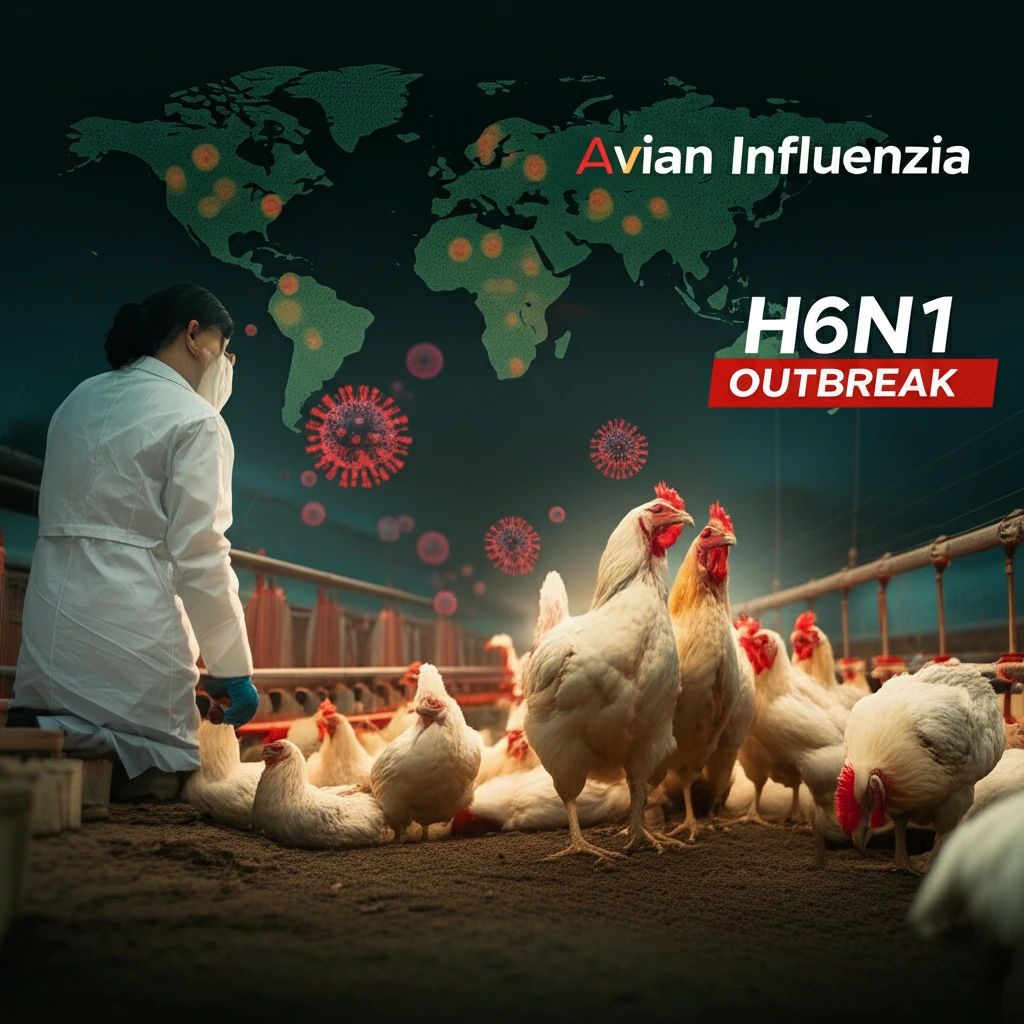
Illustration depicting the spread of H6N1 avian influenza on a poultry farm and its implications for public health.

Avian Influenza: A Growing Threat to Poultry and Public Health

"Understanding the Risks and Implications of the H6N1 Outbreak"


Avian influenza, commonly known as bird flu, has emerged as a significant concern for both the poultry industry and public health. Recent outbreaks, including the one caused by the H6N1 virus, have highlighted the devastating impact these diseases can have on commercial poultry farms and the potential risks they pose to humans.

The H6N1 strain, in particular, has been the subject of recent study due to its increasing prevalence and the severity of its effects. Understanding the nature of this virus, its spread, and its impact is crucial for developing effective prevention and control strategies. The purpose is to help readers understand the risks, the science, and the steps that should be taken to mitigate potential harm.

This article delves into the details of the H6N1 outbreak, focusing on the disease's reproduction, impact on commercial layers, and the implications for public health. We'll also discuss the current research and findings, with the intent of providing a comprehensive overview of this pressing issue.

The Impact of Avian Influenza H6N1 on Poultry Farms

Illustration depicting the spread of H6N1 avian influenza on a poultry farm and its implications for public health.

The H6N1 virus has caused significant problems in commercial poultry farms, resulting in high mortality rates and substantial economic losses. Outbreaks are often associated with severe drops in egg production, which can have a substantial effect on the poultry industry. Affected flocks often see a decrease in egg production and, in some cases, even mortality.

The spread of the virus also has the potential to disrupt the poultry supply chain, which can lead to shortages and market fluctuations. Additionally, the presence of avian influenza can create trade restrictions, affecting international poultry commerce. These combined effects underscore the importance of rapid detection, containment, and control measures.

  • Reduced Egg Production: Farms often experience a sharp decline in egg production, which leads to economic losses.
  • Increased Mortality Rates: The virus can lead to high mortality rates among affected birds, further impacting farm productivity.
  • Trade Restrictions: Outbreaks can cause restrictions on poultry trade, leading to market instability.
  • Supply Chain Disruptions: Outbreaks can disrupt poultry supply chains, causing shortages and price increases.
Detailed research on the H6N1 virus suggests that it is not only a threat to poultry but also has implications for human health. There is a risk of mutation, which could lead to increased virulence and the ability to infect humans. Ongoing monitoring and proactive measures are important to mitigate potential public health risks.

Conclusion

The recent outbreaks of avian influenza, especially the H6N1 virus, highlight the need for constant vigilance and preparedness in both the poultry industry and public health sectors. By understanding the characteristics of the virus, implementing effective control measures, and promoting research, we can minimize the economic and health risks associated with these diseases. The ongoing research efforts are important to improve our understanding and our capacity to handle any new outbreaks of avian influenza.

About this Article -

This article was crafted using a human-AI hybrid and collaborative approach. AI assisted our team with initial drafting, research insights, identifying key questions, and image generation. Our human editors guided topic selection, defined the angle, structured the content, ensured factual accuracy and relevance, refined the tone, and conducted thorough editing to deliver helpful, high-quality information.See our About page for more information.

This article is based on research published under:

DOI-LINK: 10.1080/03079457.2018.1551612, Alternate LINK

Title: An Avian Influenza Virus H6N1 Outbreak In Commercial Layers: Case Report And Reproduction Of The Disease

Subject: General Immunology and Microbiology

Journal: Avian Pathology

Publisher: Informa UK Limited

Authors: W. J. M. Landman, E. A. Germeraad, M. J. Kense

Published: 2018-12-20

Everything You Need To Know

1

What makes the H6N1 strain of avian influenza a significant concern for poultry farms?

The H6N1 strain is particularly concerning because of its increasing prevalence and the severity of its effects on poultry. It leads to high mortality rates and substantial economic losses due to reduced egg production. Furthermore, outbreaks of H6N1 can disrupt the poultry supply chain, create trade restrictions, and introduce market fluctuations. Continuous monitoring and proactive control measures are therefore critical to minimize these impacts. Notably, while the text highlights the economic and supply chain consequences, it does not elaborate on the specific biological mechanisms through which H6N1 causes mortality or reduces egg production, which would provide a more complete understanding.

2

How does the H6N1 virus affect egg production on commercial poultry farms?

The H6N1 virus often causes a sharp decline in egg production on affected poultry farms, leading to significant economic losses. This reduction in egg production, coupled with increased mortality rates among the birds, substantially impacts farm productivity and profitability. The disruption to egg production is a key economic consequence of H6N1 outbreaks. However, the text does not explain the physiological reasons behind the drop in egg production. Understanding how the virus impairs the reproductive systems of hens would provide a more complete picture of its impact.

3

What are the potential risks of the H6N1 virus to human health?

The H6N1 virus carries a risk of mutation, potentially leading to increased virulence and the ability to infect humans. Ongoing monitoring and proactive measures are important to mitigate potential public health risks. While it's clear that mutation is a concern, the text does not specify what types of mutations are most worrisome (e.g., changes in receptor binding) or what measures are being taken to monitor for these mutations. Providing more detail on these aspects would enhance the answer.

4

What measures are being implemented to control and prevent future outbreaks of avian influenza, specifically the H6N1 strain?

To control and prevent future outbreaks of the H6N1 virus, it's important to understand the characteristics of the virus, implement effective control measures, and promote continuous research. Rapid detection, containment, and control measures are crucial in minimizing economic and health risks. Also, ongoing research efforts are important to improve our understanding and our capacity to handle any new outbreaks of avian influenza. However, the specific control measures are not detailed. For example, it would be useful to know if vaccines are available for H6N1, what biosecurity protocols are recommended for poultry farms, and what surveillance systems are in place to detect outbreaks early.

5

What are the broader implications of avian influenza outbreaks, like the H6N1 virus, beyond the immediate impact on poultry farms?

Beyond the immediate impact on poultry farms, outbreaks of avian influenza, such as the H6N1 virus, have several broader implications, including potential public health risks due to possible mutations and the ability to infect humans. Outbreaks can cause trade restrictions, which affect international poultry commerce and can lead to market instability. Supply chain disruptions, which cause shortages and price increases, can also result from such outbreaks. The text touches on these broader impacts but doesn't delve into the social and political ramifications. For instance, it doesn't discuss how governments and international organizations collaborate to manage outbreaks, or how public fear and misinformation can complicate response efforts.

Newsletter Subscribe

Subscribe to get the latest articles and insights directly in your inbox.