
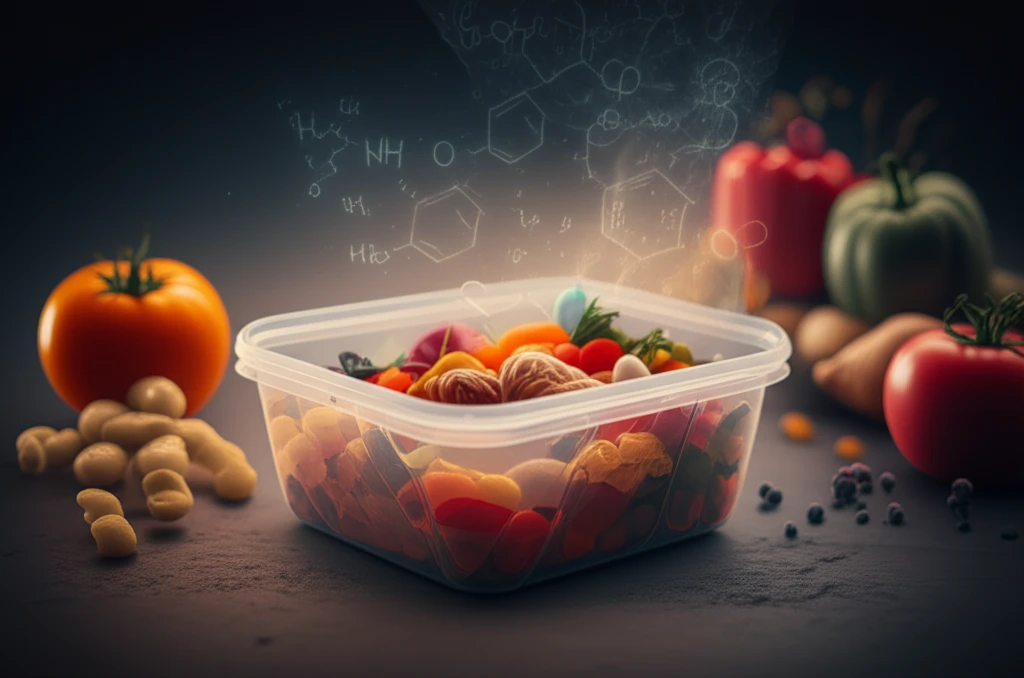
Illustration of chemicals migrating from a plastic food container into food.

Are Your Food Containers Safe? Unveiling Hidden Chemicals in Plastic

"New research reveals that even 'qualified' plastic food containers can leach unlisted chemicals into your food. Discover the potential risks and what you can do to protect yourself."


Plastic food contact materials (FCMs) have become indispensable in our daily routines, offering convenience in food storage and transportation. We rely on these containers to keep our food fresh and protected, often assuming they meet stringent safety standards.

However, a recent study published in PLOS ONE challenges this assumption. Researchers discovered that even FCMs that pass standard compliance tests can leach unexpected chemical substances into food. These 'unlisted' migrants, not included in regulatory lists, raise concerns about potential health implications.

This article delves into the findings of this research, exploring the types of chemicals found, the potential risks they pose, and what consumers can do to make informed choices about the plastic containers they use.

The Hidden Chemical Cocktail in Your Food Containers

Illustration of chemicals migrating from a plastic food container into food.

The study, conducted by researchers at the Nanjing Institute of Supervision & Testing on Product Quality, analyzed 120 plastic FCM products that had already passed qualification tests. Using Gas Chromatography-Mass Spectrometry (GC-MS), a technique that identifies different substances within a sample, they screened for chemical migrants.

The results were surprising. Nearly 100 different compounds were identified, but only 13% were included in the permitted list of Commission Regulation EU No 10/2011, a European standard for plastic food packaging. This means that the vast majority of chemicals leaching from these containers are not subject to specific safety evaluations.

  • Diverse Chemical Categories: The identified compounds were classified into 11 categories based on their chemical structure, including alkanes, amides, esters, alcohols, and phenols.
  • Material-Specific Migrants: Different types of plastic exhibited preferences for different chemical migrants. For example, alkane and phenolic substances were found in almost all FCM products, while some chemicals were unique to specific materials like polypropylene (PP) or melamine-formaldehyde (MF).
  • Low Toxicity... Mostly: While most identified compounds were of low toxicity, several were flagged as potential risk factors in previous studies or included on hazardous substance lists.
Four chemicals of particular concern were Bis(2-ethylhexyl) adipate (DEHA), Bis(2-ethylhexyl) phthalate (DEHP), stearamide, and 2,4-di-tert-butylphenol (2,4-DTBP). While the levels of DEHA and DEHP were below the Specific Migration Limits (SML) set by regulations, 2,4-DTBP was found widely, especially in BOPP/LDPE materials, reaching levels up to 45.568 mg/kg.

What Does This Mean for You? Navigating the World of Plastic Food Containers

The study highlights that plastic FCMs are not as 'inert' as commonly believed. Even when qualified under current regulations, they can release a variety of unlisted chemicals into food.

While the detected levels of some concerning chemicals were within regulatory limits, the presence of a complex mixture of unassessed substances raises questions about potential long-term health effects. More research is needed to fully understand the risks associated with these unlisted migrants.

Consumers can take proactive steps to minimize potential exposure. Consider using alternative food storage options like glass or stainless steel whenever possible. When using plastic containers, avoid heating food in them, as heat can accelerate the migration of chemicals. Stay informed about the latest research and choose products with clear labeling and safety certifications.

About this Article -

This article was crafted using a human-AI hybrid and collaborative approach. AI assisted our team with initial drafting, research insights, identifying key questions, and image generation. Our human editors guided topic selection, defined the angle, structured the content, ensured factual accuracy and relevance, refined the tone, and conducted thorough editing to deliver helpful, high-quality information.See our About page for more information.

This article is based on research published under:

DOI-LINK: 10.1371/journal.pone.0208467, Alternate LINK

Title: Detection And Quantification Analysis Of Chemical Migrants In Plastic Food Contact Products

Subject: Multidisciplinary

Journal: PLOS ONE

Publisher: Public Library of Science (PLoS)

Authors: Shasha Qian, Hanxu Ji, Xiaoxiao Wu, Ning Li, Yang Yang, Jiangtao Bu, Xiaoming Zhang, Ling Qiao, Henglin Yu, Ning Xu, Chi Zhang

Published: 2018-12-05

Everything You Need To Know

1

What are Plastic Food Contact Materials (FCMs) and what do they do?

Plastic Food Contact Materials (FCMs) are used to store and transport food, and are believed to keep it fresh and protected. However, research shows that even FCMs that meet current safety standards can release unexpected, unlisted chemicals into your food. These chemicals, which are not always on regulatory lists, pose potential health risks.

2

How did the researchers determine what chemicals were leaching from the plastic containers, and what did they find?

The study used Gas Chromatography-Mass Spectrometry (GC-MS) to identify chemicals that leach from plastic Food Contact Materials (FCMs). This technique found nearly 100 different compounds. Most of these chemicals were not on permitted lists, raising concerns because they weren't specifically evaluated for safety. The chemicals were grouped into 11 categories, including alkanes, amides, esters, alcohols, and phenols. Some chemicals were specific to certain plastics, like polypropylene (PP) or melamine-formaldehyde (MF). While most compounds were of low toxicity, some were potential risk factors.

3

Which specific chemicals were found to be of concern and why?

The study identified several chemicals of concern, including Bis(2-ethylhexyl) adipate (DEHA), Bis(2-ethylhexyl) phthalate (DEHP), stearamide, and 2,4-di-tert-butylphenol (2,4-DTBP). The levels of DEHA and DEHP were below the Specific Migration Limits (SML). However, 2,4-DTBP was found widely, especially in BOPP/LDPE materials, sometimes reaching high levels. This is significant because these chemicals can migrate into food, potentially affecting health, and the fact that many aren't regulated means their impact isn't fully understood.

4

What does the study's findings mean for the safety of plastic food containers?

The study shows that plastic Food Contact Materials (FCMs) are not completely inert. Even FCMs that have passed qualification tests can release chemicals into food. This means consumers may be exposed to chemicals that haven't been specifically evaluated for safety. These unexpected chemicals can potentially pose risks to health.

5

What are the major implications of these findings for consumers?

The implications are that consumers should be aware that plastic containers can leach chemicals. While the study did not give specific recommendations, understanding that many chemicals found in food containers are not listed and haven't been evaluated for safety is important. Consumers need to be informed to make choices about what they use to store and transport food to protect themselves and their families.

Newsletter Subscribe

Subscribe to get the latest articles and insights directly in your inbox.