
Ancient Globalization: How Nebuchadnezzar's Babylon Shaped the World

"Uncover the surprising stories of foreigners in ancient Babylon and their lasting impact on culture and society."
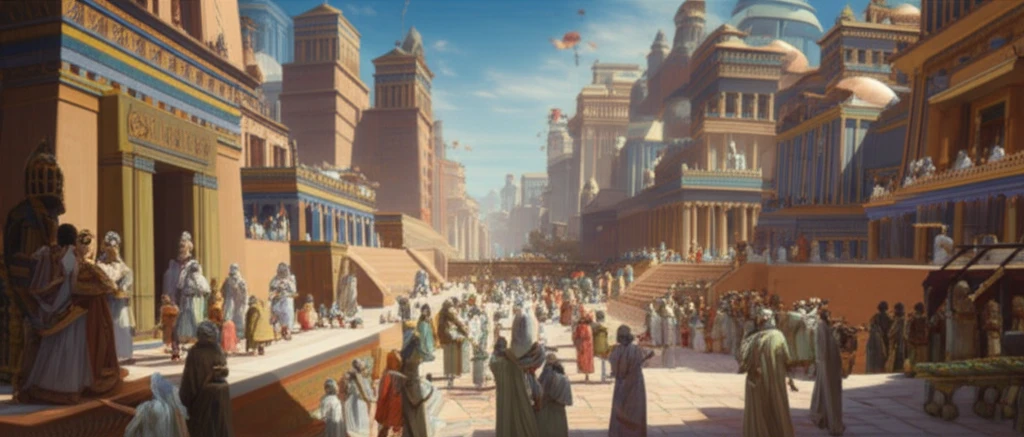
Imagine ancient Babylon not just as a city of towering ziggurats and hanging gardens, but as a vibrant hub teeming with people from across the known world. During the reign of Nebuchadnezzar II (605-562 B.C.E.), Babylon drew in individuals from the Levant, Egypt, Anatolia, and the Jazira, creating a unique melting pot of cultures and skills. These weren't just casual visitors; they were prisoners of war, diplomats, laborers, and skilled artisans who left their mark on the city and its empire.
Ran Zadok's study, "People from Countries West and North of Babylonia in Babylon during the Reign of Nebuchadnezzar," delves into the lives and roles of these foreigners. By examining cuneiform texts and royal archives, Zadok uncovers a complex picture of how these diverse groups were integrated into Babylonian society, contributing to its military, economy, and culture. This article explores the key findings of Zadok's research, revealing how Nebuchadnezzar's Babylon was a surprisingly globalized world.
Prepare to discover the stories behind the names etched in clay tablets – the Urartian, Scythian, Phoenician, and Arabian people who found themselves in Babylon. This is more than just an academic study; it’s a glimpse into the human drama of an ancient empire, showcasing how the movement of people shaped the course of history.
Nebuchadnezzar's Enduring Legacy
Nebuchadnezzar II is widely regarded as the greatest king of the Neo-Babylonian Empire, ruling for an unprecedented 43 years—the longest reign of any monarch in the dynasty. His military campaigns in the Levant and extensive construction projects in Babylon left an indelible mark on ancient history. The Neo-Babylonian Empire itself, established following the fall of Assyria in 612–609 BCE, represented the final native Mesopotamian polity before Persian conquest. Nebuchadnezzar's legacy endures through both his architectural achievements and his significant role in Jewish historical tradition.
Methodological Considerations
Scholars studying Nebuchadnezzar's Babylon must navigate fragmentary archaeological evidence and texts written from vastly different cultural perspectives. Babylonian royal inscriptions tend toward self-glorification, while biblical accounts reflect theological rather than historical priorities. Classical Greek sources, filtered through centuries of transmission, introduce their own distortions. Contemporary research increasingly relies on interdisciplinary approaches combining archaeology, epigraphy, and comparative analysis to construct a more balanced picture.
The Rise of Babylon's Greatest King
Nebuchadnezzar II ascended to power around 605 BCE as the second king of the Chaldean dynasty, inheriting an empire forged by his father Nabopolassar's conquest of Assyria. Britannica identifies him as Babylon's greatest ruler, renowned equally for military prowess and architectural ambition. His reign saw the flourishing of Babylonian culture, religion, and arts, with the city becoming a center of ancient civilization. Historical milestones include the destruction of Jerusalem in 587 BCE and the construction of the legendary Hanging Gardens, though the latter's existence remains debated among scholars.
Who Were These Foreigners in Babylon?
Zadok's research identifies six primary categories of foreigners residing in Babylon during Nebuchadnezzar II's rule. Each group had a distinct role and status within the empire:
- Prisoners of War: The largest category, these individuals were captured during Nebuchadnezzar’s military campaigns to the west and northwest. They were a constant reminder of Babylon’s military might and provided a source of forced labor.
- Hostages: Important figures, including foreign rulers, princes, and courtiers, were held as hostages to ensure the loyalty of their homelands. Their presence in Babylon served as a political tool, demonstrating Babylonian dominance.
- Deserters: Individuals who abandoned their armies or homelands, seeking refuge in Babylon. These deserters often came from neighboring regions like Lydia and Media, adding to the city's diverse population.
- Diplomatic Envoys: Representatives from neighboring kingdoms like Lydia, Cilicia, and Yawan (Ionia), these envoys facilitated communication and trade between Babylon and other regions.
- Immigrants: Individuals who chose to settle in Babylon, often bringing valuable skills and expertise. Assyrians, for example, continued to migrate to Babylonia even after the fall of their empire.
- Mercenaries (?): Foreign soldiers who fought for the Babylonian army, though evidence for Greek mercenaries during this period is limited.
Contemporary Scholarship
Recent research continues to refine our understanding of Nebuchadnezzar's reign and its broader implications. Archaeological excavations at Babylon have revealed the scale of his building programs, while new epigraphic discoveries provide insight into administrative practices. Scholars increasingly examine how the Neo-Babylonian Empire facilitated cultural exchange across the ancient Near East, challenging narratives that focus solely on military conquest.
Military Setbacks and Their Consequences
Despite his eventual triumphs, Nebuchadnezzar's early reign was marked by significant military failures. Academic sources document a disastrous attempted invasion of Egypt in approximately 601 BCE that resulted in heavy Babylonian losses. This failure emboldened vassal states in the Levant, including Judah under King Jehoiakim, to rebel against Babylonian authority. The subsequent siege and destruction of Jerusalem in 587 BCE, while militarily successful, must be understood partly as a response to these earlier embarrassments and the need to reassert imperial control.
Babylon in Comparative Perspective
Comparing Nebuchadnezzar's Babylon to other ancient empires reveals both common patterns and distinctive features. Like many empire-builders, he employed a combination of military force and cultural patronage to legitimize his rule. His approach to governing diverse populations—balancing coercion with religious tolerance—parallels strategies employed by later Hellenistic and Roman rulers. However, the Neo-Babylonian Empire's relatively brief duration compared to Assyrian or Persian hegemonies raises questions about the sustainability of his particular model of imperial power.
The Lasting Legacy of a Globalized Babylon
Nebuchadnezzar's Babylon was more than just a powerful empire; it was a crucible where cultures collided and new ideas were born. The presence of foreigners influenced Babylonian architecture, warfare, and administration. While many of these individuals assimilated into Babylonian society over time, their initial contributions left an indelible mark on the city. By studying these diverse groups, we gain a richer understanding of the complexities of the ancient world and the enduring impact of cultural exchange.
Scholarly Reassessment
Recent scholarly work has complicated traditional narratives about Nebuchadnezzar, drawing on newly discovered Babylonian texts that present a more nuanced portrait. Research published in peer-reviewed journals examines the building activities of both Nabopolassar and his son, revealing how architectural projects served political and religious purposes. New inscriptions from ancient Kish present Nebuchadnezzar as a pious temple restorer rather than merely a destructive conqueror, suggesting that biblical and Babylonian sources reflect competing historical narratives rather than objective truth.
Unanswered Questions
Significant gaps remain in our understanding of Nebuchadnezzar's Babylon and its global connections. The precise mechanisms of cultural transmission between Babylon and distant civilizations require further investigation. Ongoing excavations at Babylon and surrounding sites promise new insights into urban planning, trade networks, and daily life. Future research may also clarify the extent to which Babylonian innovations in astronomy, mathematics, and law influenced later Greek and Roman thought.
Imperial Architecture and Power
Nebuchadnezzar II's approach to governance transformed the Neo-Babylonian Empire from a regional power into a dominant force in the ancient Near East. His government structure balanced centralized authority with pragmatic accommodation of local traditions, a system that proved effective during his lifetime. The restoration of ziggurats and temples dedicated to Marduk served both religious and economic functions, fostering prosperity through enhanced trade routes and agricultural development. However, this system's dependence on strong personal rule may explain its rapid decline after Nebuchadnezzar's death in 562 BCE.
Babylon's Living Legacy
The city Nebuchadnezzar built on the Euphrates grew from a small port town into one of Mesopotamia's most prosperous urban centers. Today, the ruins of Babylon lie roughly 50 miles south of Baghdad in modern Iraq, a reminder of Iraq's deep historical roots. His palace complexes, visible in aerial photographs, attest to the scale of royal ambition in the ancient world. Nebuchadnezzar's reign established Babylon not merely as a political capital but as a cultural touchstone whose influence persisted long after the empire's fall to Persian forces.