
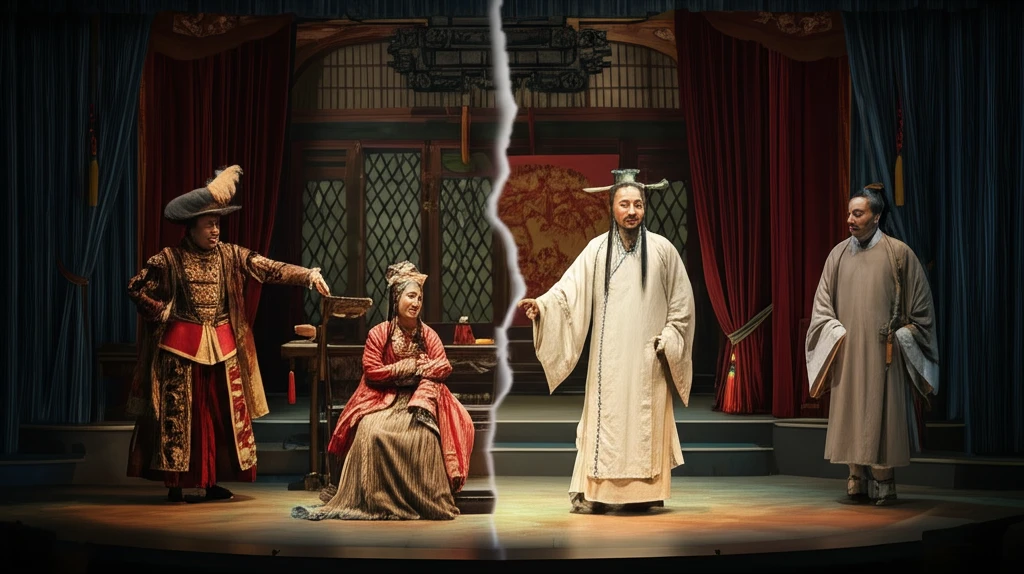
Worlds Collide on Stage: Unearthing the Echoes Between Shakespeare and Tang Xianzu

"Explore the surprising parallels and fascinating differences between the dramatic landscapes of Elizabethan England and Ming Dynasty China in 1616."
The year 1616 marks a pivotal moment in literary history: the year both William Shakespeare and Tang Xianzu, two towering figures of English and Chinese drama, passed away. Though separated by vast geographical and cultural distances, these playwrights crafted works that continue to resonate with audiences worldwide. The recent surge of publications commemorating the 400th anniversary of Shakespeare's death highlights the enduring fascination with his legacy. However, amidst this celebration, it's crucial to consider the simultaneous existence and comparable impact of Tang Xianzu, a playwright who similarly captured the essence of his era.
A new collection of essays, "1616: Shakespeare and Tang Xianzu's China," edited by Tian Yuan Tan, Paul Edmondson, and Shih-Pe Wang, embarks on a fascinating comparative journey. Rather than forcing simplistic parallels, the editors propose using Shakespeare and Tang Xianzu as "visible markers" to illuminate the distinct yet interconnected theatrical worlds of China and England around 1616. This approach seeks to move beyond a homogeneous view of globalization, emphasizing the unique particularities and differences that ultimately reveal complementary and overlapping synergies.
This exploration is particularly vital given the historical imbalance in Western awareness of Tang Xianzu's significance. As Wilt Idema points out in his foreword, translations of Chinese plays into Western languages were significantly delayed. This collection, stemming from a collaborative conference format, pairs scholars from both traditions to examine various facets of their work, offering a rich background for students and researchers alike to explore contextual resonances and dissonances.
Two Pillars of World Drama
Shakespeare and Tang Xianzu are regarded as representatives of two distinct source traditions of world drama, influential across both print and stage as well as national and international cultural spheres. The moniker 'Shakespeare of the East' has been applied to Tang Xianzu in Chinese academic circles since at least 1985, though some scholars have opposed the nickname as reflecting a lack of cultural confidence. Shakespeare's presence in China has interacted deeply with Chinese cultural tradition, while Tang's international stage presence demonstrates a double-sided cultural exchange. In 2015, Chinese President Xi Jinping officially recognized Tang Xianzu as contemporary of Shakespeare, noting both died in 1616.
Comparative Scholarship and Cultural Politics
Comparative studies of Tang Xianzu and Shakespeare have been conducted in both Chinese and non-Chinese scholarly realms for decades, with the association between their works widely acknowledged. During a 2015 state visit to the UK, PRC President Xi Jinping pronounced Tang 'the Shakespeare of the East,' further elevating the comparison to a diplomatic level. Cultural memory surrounding both playwrights is actively constructed through embodied and political performances, positioning them as 'national poets' of their respective civilizations. However, what initially triggered scholarly comparison between the two remains debated among researchers.
Origins of a Cross-Cultural Dialogue
The comparison between Tang Xianzu and Shakespeare draws on their historical contemporaneity—both died in 1616—creating a natural bridge for scholarly inquiry. While no single foundational discovery launched the field, comparative interest grew organically as Chinese and Western scholars recognized parallels in their dramatic output. The relationship between the two playwrights remains a subject of evolving interpretation rather than settled consensus.
A Tale of Two Theatres: Unveiling the Shared and Divergent Worlds of Shakespeare and Tang Xianzu
The essays in "1616: Shakespeare and Tang Xianzu's China" explore a wide array of themes, providing invaluable context for understanding both playwrights. The collection deliberately avoids forcing direct comparisons, instead focusing on illuminating the unique social, political, and cultural landscapes that shaped their dramatic creations. This approach allows for a more nuanced understanding of each playwright's individual genius and the distinct theatrical traditions they represent.
- Geographies of Influence: Essays delve into the playwrights' relationship with specific locales, examining how their environments shaped their work and the themes they explored.
- The State and the Theatre: This pairing examines the role of government and censorship in shaping the creative process, revealing the constraints and opportunities faced by playwrights in both England and China.
- Circulation of Dramatic Texts: This explores the material culture of published play texts, shedding light on the impact of business decisions and printing practices on the dissemination and reception of plays.
New Interdisciplinary Approaches
A 2026 publication by The Commercial Press, 'A Comparative Study of Dramatic Rhetoric in Tang Xianzu and Shakespeare,' synthesizes previous research and applies theoretical frameworks from Rhetoric, Rhetorical Psychology, Cognitive Linguistics, and Dramatic Aesthetics. The joint UK-China commemoration of the 400th anniversary of both playwrights' deaths pushed cross-cultural research depth, breadth, and enthusiasm to unprecedented levels. Recent scholars have proposed an intercultural model of ecological poetics by placing Shakespearean theatre in dialogue with Tang's Kunqu opera, noting Shakespeare's emphasis on elemental disruption versus Tang's metaphysical approach to emotion and season. One article imagines a time-space crossover where Shakespeare reads The Peony Pavilion and Tang reads Romeo and Juliet, suggesting they might become companions on the path of dramatic writing.
Persistent Skepticism and Methodological Gaps
Despite growing scholarly attention, meaningful comparative analysis between Tang Xianzu and Shakespeare faces inherent challenges rooted in vastly different theatrical traditions, languages, and cultural contexts. The direct comparison of their works and legacies remains contested, with some arguing that the parallel obscures as much as it reveals about each playwright's unique contributions. The field continues to grapple with how to avoid reductive equivalences while still identifying genuine points of connection.
Divergent Legacies in Dramatic Traditions
Shakespeare's works encompass a more diverse range of types, including comedy, tragedy, and works like 'The Tempest,' whereas Tang Xianzu's dramatic output, while celebrated, operates within a narrower generic scope. The status of drama in China historically cannot be compared with that in the West, and Shakespeare's position in English literature is roughly equivalent to that of Li Bai and Du Fu in China rather than to any single Chinese playwright. The Folger Shakespeare Library has explored the intersection of Chinese and Shakespeare studies through scholars like Wei Feng and Alexa Alice Joubin. Some scholars note that Tang Xianzu certainly does not hold a comparable status to Shakespeare within his own literary tradition.
A Lasting Legacy: Why Exploring Shakespeare and Tang Xianzu Matters Today
"1616: Shakespeare and Tang Xianzu's China" offers a valuable resource for anyone interested in exploring the rich tapestry of dramatic history. By juxtaposing these two theatrical giants, the collection encourages a more nuanced understanding of cultural exchange and the enduring power of storytelling. Ultimately, the book invites us to move beyond traditional Western-centric perspectives and embrace a global view of literary and theatrical achievement. It serves as both a foundational text and a springboard for future investigations, promising to inspire new avenues of inquiry and appreciation for these two remarkable playwrights.
Bridging Traditions Through Scholarship
The comparison of Tang Xianzu and Shakespeare reveals both the promise and the complexity of cross-cultural literary analysis. As scholars continue to refine their methodological approaches, the dialogue between these two dramatic traditions offers valuable insights into universal themes of love, mortality, and human ambition. Expert commentary from translators and comparatists underscores the difficulty—and the reward—of rendering both playwrights across cultural and linguistic boundaries.
Theater as a Bridge for Global Cultural Dialogue
In 2015, President Xi Jinping proposed that China and Britain jointly commemorate the legacies of both literary masters to promote people-to-people exchanges and deepen mutual understanding. Over the past decade, theater has become an increasingly vital bridge for global cultural dialogue between the two nations. Future research frontiers may include interdisciplinary approaches combining ecological poetics, cognitive linguistics, and performance studies. The ongoing collaboration between Chinese and international scholars suggests that the Tang-Shakespeare comparison will remain a dynamic field of inquiry.
World Drama and Cultural Influence
Shakespeare and Tang Xianzu represent two foundational source traditions of world drama, influential in terms of both print and stage across national and international cultural spheres. Shakespeare's presence in China has interacted with Chinese cultural tradition in complex ways, while Tang's presence on the international stage reveals a double-sided cultural exchange. The challenge lies in understanding how each playwright functions within both their native literary tradition and the broader canon of world drama. These systemic dynamics continue to shape how comparative scholarship approaches the relationship between the two figures.
Beyond the Academy
The Tang Xianzu and Shakespeare comparison extends beyond academic discourse into popular culture, education, and international diplomacy. The shared commemoration by China and the UK demonstrates how literary heritage can foster cross-cultural understanding at the governmental and public levels. As translators continue to render both playwrights' works for new audiences, the human dimension of this scholarly endeavor—bridging languages, cultures, and centuries—remains central to its enduring appeal.