
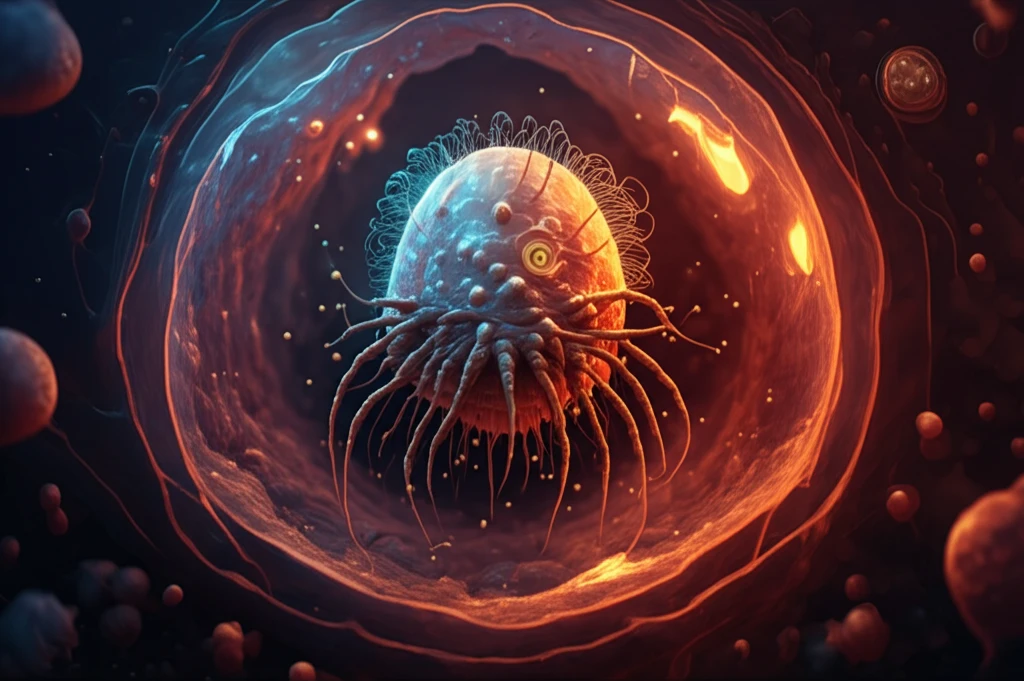
Microscopic view of Calyptospora paranaidji parasite inside fish liver tissue.

Amazon River Mystery: A New Fish Parasite Species Discovered

"Scientists Identify Calyptospora paranaidji, a Unique Apicomplexan Parasite Affecting Peacock Bass in the Tocantins River"


The Amazon rainforest, a realm of unparalleled biodiversity, continuously unveils nature's hidden secrets. Among these recent discoveries is a new species of parasite, adding another layer of complexity to the intricate web of life in this tropical ecosystem. This newly identified parasite belongs to the genus Calyptospora, a group known for infecting aquatic organisms. This particular species was found within the hepatic tissue of the peacock bass (Cichla piquiti) in the Tocantins River, a major Amazon tributary.

The discovery, led by Dr. Edilson Matos and colleagues, not only expands our understanding of parasitic biodiversity but also highlights the importance of ongoing research in under-explored regions. Apicomplexan parasites, like Calyptospora, are significant due to their complex life cycles and potential impact on host populations. Understanding their diversity and distribution is crucial for maintaining the health and balance of aquatic ecosystems.

This article will explore the characteristics of Calyptospora paranaidji, its evolutionary relationships, and the broader implications of its existence within the Amazonian ecosystem. By examining the research methods and findings, we can gain a greater appreciation for the hidden world of parasites and their role in shaping the environment.

AI Search Multiple angles on this topic

Parasites Are a Natural Part of Fish Life

Parasites occur naturally in fish populations, and experts note they are as common in fish as insects are in fruits and vegetables. As 'The Risky Players Ruling Fisheries' explains, fish serve as the best source of animal protein, healthy fats, and nutrients, which makes understanding their parasites important for fisheries and consumers alike. New discoveries in the Amazon basin, such as the recent finding of a new fish parasite species in wild freshwater stingrays, show how much of this parasitic diversity remains to be catalogued.

Morphology Meets Molecular Phylogenetics

Researchers typically classify fish parasites using a combination of morphological description, biochemical analysis, and molecular methods. For example, the description of the apicomplexan parasite Calyptospora paranaidji n. sp. combined a detailed taxonomic summary with phylogenetic analysis based on genetic distances, recording differences of 1.5% from C. serrasalmi and 1.9% from C. funduli. While such molecular comparisons are powerful, their reliability depends on which reference sequences are available, and morphological traits alone can be inconclusive among closely related species.

From Eimeria funduli to the Genus Calyptospora

The genus Calyptospora, a group of parasitic protozoa in the phylum Apicomplexa, was created in 1984 for the species Eimeria funduli because of morphological differences in the sporocyst that suggested it warranted its own genus and family. This foundational classification paved the way for later discoveries such as Calyptospora paranaidji, a new species found parasitizing the hepatic tissue of the peacock bass Cichla piquiti from a reservoir in the Brazilian Amazon region.

Unveiling Calyptospora paranaidji: Morphology and Phylogeny

Microscopic view of Calyptospora paranaidji parasite inside fish liver tissue.

The research team meticulously analyzed specimens of Cichla piquiti, a commercially valuable fish native to the Tocantins-Araguaia basin. Over a period of two years (2016-2017), they collected and examined 32 specimens, noting the prevalence of infection across different months. The fish were captured from the reservoir of the Estreito hydroelectric dam, a significant alteration to the natural riverine environment. Upon examination, nearly half (47%) of the fish were found to be infected with coccidian oocysts, leading to the identification of a new species within the Calyptospora genus.

The identification process involved a comprehensive approach:

  • Microscopic Analysis: Fresh tissue samples were examined using light field microscopy and differential interference contrast (DIC) to determine the oocysts' morphology.
  • Histological Studies: Liver fragments were fixed, sectioned, and stained to reveal the parasite's structure and its interaction with the host tissue.
  • Electron Microscopy: Scanning electron microscopy (SEM) provided detailed views of the sporocysts' surface features.
  • Molecular Analysis: DNA was extracted, and a fragment of the 18S rRNA gene was sequenced to determine the parasite's phylogenetic relationship to other coccidians.
AI Search Multiple angles on this topic

New Parasite Species From Amazon Stingrays

A study of wild freshwater stingrays from the Amazon basin has revealed a new species of fish parasite, adding to the known diversity of cestode parasites from the Acanthobothrium genus already recorded from other freshwater stingray species. Research in the same region has also produced Calyptospora paranaidji n. sp., an apicomplexan parasite described from the liver tissue of Cichla piquiti. Findings such as these have been reported in peer-reviewed venues including the journal Science Advances.

Separating Parasite Myth From Reality

The most famous Amazon parasite story, the candiru, illustrates how legend can outpace fact: the myth claims the tiny fish can swim up a person's urethra during an impromptu bathroom stop, but the terrifying legend is false. In reality the candiru is a small parasitic fish found where the Amazon River meets the sea, and while it is rare for it to enter the human body in dangerous ways, such events are not representative of its normal behavior. The candiru reportedly tracks fish the same way it supposedly hunts humans, underscoring that accurate parasite knowledge requires careful observation rather than folklore.

Comparing Cestodes and Apicomplexans

Amazon fish parasites span very different groups: the newly reported Acanthobothrium cestodes (tapeworms) are recovered from freshwater stingrays, while Calyptospora species are apicomplexan protozoans found inside liver tissue of fish such as Cichla piquiti. The formal taxonomy of Calyptospora paranaidji places it in Phylum Apicomplexa, Class Conoidasida, Order Eucoccidiorida, Suborder Eimeriorina, Family Calyptosporidae, and genetic distances place it close to C. serrasalmi and C. funduli. Across these groups, molecular distance data and host-specific morphology together determine where a new species fits relative to known relatives.

The molecular analysis proved crucial in confirming the novelty of the species. The researchers compared the 18S rRNA gene sequence of Calyptospora paranaidji with those of other known coccidians. Phylogenetic trees, constructed using both Maximum Likelihood and Bayesian methods, consistently placed the new species as distinct from its relatives. The morphometric data, analyzed via Principal Components Analysis (PCA), further supported this distinction, highlighting unique characteristics of the oocysts and sporocysts.

Implications for the Amazonian Ecosystem

The discovery of Calyptospora paranaidji underscores the importance of continued research into the biodiversity of the Amazon. These findings contribute to a better understanding of parasite-host interactions and the potential impacts of environmental changes, such as hydroelectric dam construction, on aquatic ecosystems. Further research is needed to assess the prevalence of this parasite in other fish species and to determine its broader ecological effects. By integrating morphological, histological, and molecular data, scientists can continue to unravel the complexities of the Amazonian ecosystem and protect its biodiversity for future generations.

AI Search Multiple angles on this topic

Parasites as Risky Players in Fisheries

Parasites are described as 'the risky players ruling fisheries' because they influence fish health, protein production, and the nutritional value of fish as a food source. Studies like the motoro stingray work show that scientific naming and description of parasites is a prerequisite for managing their risks. Experts emphasize that classification work combining biochemical and molecular tools is essential for mitigation efforts.

Molecular Discovery in Amazon Waters

Ongoing and recently published work, including studies reported in Science Advances, signals that the Amazon basin continues to yield previously unknown parasite species. Advances in morphology combined with phylogenetics allow researchers to describe species such as Calyptospora paranaidji with increasing precision. As molecular databases grow, the next frontier is likely to be resolving relationships among closely related species and mapping their distribution across the vast Amazon system.

Wild-Caught Fish and Consumer Realities

Because parasites are a natural occurrence rather than contamination, they are common in wild-caught fish, and wild-caught fish that people eat can carry worms. This creates a systemic challenge for fisheries and food safety: consumers need accurate information, and scientists need continued funding for discovery and classification. The sheer diversity of Amazon species, from stingray tapeworms to liver-infecting protozoans, makes complete surveillance a long-term challenge.

A Danger That Is Mostly Legend

The candiru, a small parasitic fish of the Amazon, is rare but has been reported to enter the human body in dangerous ways, even though the lurid urethra legend is false. For people living near the Amazon River, this means fear of parasites is often disproportionate to actual risk, while real impacts come from the fish itself. The story also highlights how science communication must correct myths while acknowledging that parasites in the Amazon, from candiru to tapeworms, do command genuine respect.

About this Article -

Written with AI assistance from published research, and reviewed by the Mystum team. See our About page for more information.

Everything You Need To Know

1

What is the name of the new parasite species discovered in the Amazon River, and where was it found?

The newly discovered parasite species is called *Calyptospora paranaidji*. It's an apicomplexan parasite found in the hepatic tissue of the peacock bass (*Cichla piquiti*) in the Tocantins River, which is part of the Amazon basin.

2

What specific scientific methods were employed to identify and characterize *Calyptospora paranaidji*?

Scientists used several methods to identify *Calyptospora paranaidji*, including microscopic analysis to study the oocysts' morphology, histological studies to examine the parasite's interaction with the liver tissue of *Cichla piquiti*, electron microscopy to view sporocysts' surface features, and molecular analysis of the 18S rRNA gene to determine its phylogenetic relationship to other coccidians. Principal Components Analysis (PCA) was also used for morphometric data.

3

How does the Estreito hydroelectric dam relate to the discovery of *Calyptospora paranaidji*, and what implications might this have?

The Estreito hydroelectric dam's reservoir is where the infected *Cichla piquiti* specimens were collected. The presence of the dam alters the natural riverine environment and potentially impacts parasite-host interactions. Further studies could explore whether such alterations influence the prevalence or effects of *Calyptospora paranaidji* on the peacock bass and other species.

4

Why is the discovery of *Calyptospora paranaidji* important for understanding the Amazonian ecosystem, and what future research is recommended?

Discovering *Calyptospora paranaidji* emphasizes the need for more research into the biodiversity of the Amazon. By understanding parasite-host interactions, like those between *Calyptospora paranaidji* and *Cichla piquiti*, and considering environmental changes such as hydroelectric dam construction, scientists can work towards protecting the Amazonian ecosystem and its biodiversity. Further research should focus on assessing the prevalence of this parasite in other fish species and determining its broader ecological impacts.

5

Why are Apicomplexan parasites like *Calyptospora paranaidji* considered significant, and what impact could they have on aquatic ecosystems?

Apicomplexan parasites, like *Calyptospora paranaidji*, are significant due to their complex life cycles and potential impact on host populations, such as *Cichla piquiti*. Understanding the diversity and distribution of parasites like *Calyptospora* is essential for maintaining the health and balance of aquatic ecosystems. Further research into these parasites could reveal more about their effects on other species and the broader food web.

Newsletter Subscribe

Subscribe to get the latest articles and insights directly in your inbox.