
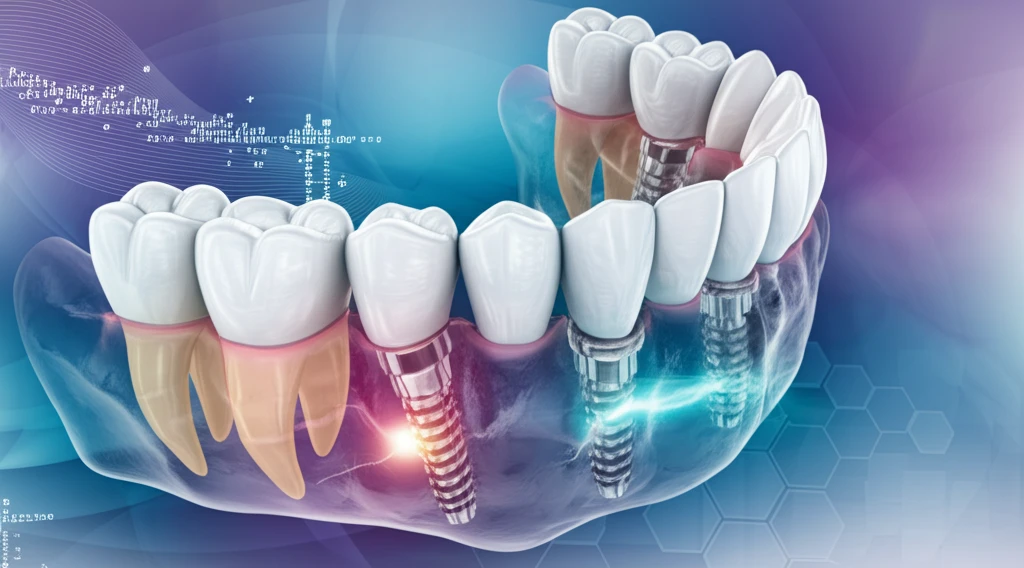
All-on-Four Dental Implants: Finding the Perfect Angle for a Confident Smile

"Exploring the impact of implant angulation on stress distribution for optimal All-on-Four outcomes"
For those facing the challenge of extensive tooth loss, complete dentures can feel like an unstable and inconvenient solution. All-on-Four dental implants offer a revolutionary alternative, providing a fixed and secure set of teeth that look and function like natural ones. This innovative approach involves placing four implants in either the upper or lower jaw to support a full arch of prosthetic teeth.
A key advantage of the All-on-Four technique lies in its ability to avoid extensive bone grafting, even in patients with significant bone loss. By strategically tilting the posterior implants, dentists can maximize contact with available bone, ensuring a stable foundation for the new teeth. But how does the angle of these tilted implants affect the overall success and long-term health of the All-on-Four system?
This article delves into the fascinating world of implant angulation, exploring how different angles impact stress distribution within the jawbone and surrounding tissues. Understanding these biomechanical principles is crucial for both dentists and patients seeking the best possible outcomes with All-on-Four dental implants.
A Growing Market With a Lower-Threshold Entry Point
The dental implant market continues to grow, with industry reports noting high success rates and improving patient quality of life. Full-arch solutions like All-on-4 can reduce treatment time and costs compared to traditional multi-implant procedures. However, the actual price of All-on-4 differs by country and clinic, so figures vary widely by location. Providers also note that All-on-4 is ideal for candidates who do not have the jaw or gum health needed for traditional implants, which helps explain its broadening appeal.
A Standardized Protocol With Real Constraints
All-on-4 refers to supporting an entire arch of teeth on just four dental implants, a protocol and name that is a registered trademark of Nobel Biocare. The approach was developed in part to address limitations of conventional implant dentistry, which demands the highest volume of bone, frequently requires extensive grafting, involves longer healing times, and significantly increases the financial investment. Prosthodontic reviews caution that many implant failures can be attributed to improper occlusal design, which can concentrate stresses in the bone and lead to rapid bone resorption. Technical constraints also exist, such as non-engaging 30-degree multi-unit abutments not being available for implants with internal conical connections.
From Brånemark's Discovery to Dr. Malo's Four-Implant Arch
All-on-4 traces its foundation to the discovery of osseointegration, the finding by Swedish physician Per-Ingvar Brånemark that bone could fuse naturally to titanium, a breakthrough that became the foundation for modern titanium implant dentistry. The All-on-4 technique itself was pioneered in the 1990s by Portuguese dentist and researcher Dr. Paulo Malo, whose research was sponsored by Nobel Biocare. Dr. Malo found that just four strategically placed implants could be sufficient to support an entire arch of prosthetic teeth. Sources differ on the exact milestone date, with some reporting the first All-on-4 placement in 1996 and others citing 1998 as the year of the breakthrough.
The Angle Effect: How Implant Tilt Influences Stress
The core question surrounding All-on-Four implant angulation is how it affects the forces exerted on the implants themselves and the surrounding bone. Too much stress in one area can lead to bone loss, implant failure, and ultimately, the need for costly revisions. Researchers have been investigating this for years, using sophisticated techniques to measure stress distribution in various All-on-Four configurations.
- Greater angulation (e.g., 35°) may lead to higher stress concentrations at the cervical level (the neck of the implant).
- Moderate angulation (e.g., 15°) can distribute stress more evenly, reducing the risk of localized bone loss.
- The length and design of the cantilever (the extension of the prosthetic teeth beyond the last implant) also play a significant role in stress distribution.
- Proper planning and execution are essential to achieving optimal outcomes with tilted implants.
Patient Reviews Emphasize Comfort and Natural Fit
Recent patient reviews and clinic materials increasingly emphasize All-on-4 as a full-arch solution built around comfort and a smooth transition. One patient in Los Algodones, Michele, shared her All-on-4 experience and explained why she recommends the procedure. Dental practices likewise position the treatment as a way for denture patients to achieve a more natural fit and feel. At G4 Dental Implant Centers, staff describe their everyday goal as making the transformation to "a new you" as comfortable and stress-free as possible. These accounts reflect the patient-experience focus that now shapes how many clinics present and deliver All-on-4 care.
Acknowledging the Risks of a Four-Implant Arch
Clinicians list implant failure as the primary risk, noting that with only four support points, higher stress falls on each individual implant and a failure can jeopardize the entire arch. If failure occurs after the final bridge is completed, there are very few options for replacing the implant while keeping the same bridge. Sources attribute many failures to poor healing or weak bone, as well as patients not following post-operative care instructions. Cracks and breakages can carry devastating consequences, adding further expenses and risking damage to the surrounding gums, tissues, and teeth. Poor planning or a lack of consultation with the oral surgeon can also compromise implant placement regardless of the quality of the device.
How All-on-4 Stacks Up Against the Alternatives
Comparisons of All-on-4 typically focus on alternatives such as removable snap-on dentures, traditional multi-implant restorations, and other full-arch designs. Snap-on dentures are frequently positioned as more budget-friendly, removable options, while All-on-4 is described as a permanent solution with greater stability. Full-arch guides also contrast All-on-4 with All-on-6, laying out the complete treatment timeline, risks, and the questions to ask before choosing a clinic. Geographic cost comparisons exist as well, with clinics publishing procedure-specific All-on-4 price comparisons between countries such as Australia and Vietnam for 2026. Meanwhile, All-on-4 continues to be weighed against traditional implant approaches on the basis of surgical and cost differences.
Finding Your Perfect Angle for a Lasting Smile
Ultimately, the best All-on-Four implant angulation is the one that provides the most stable and predictable outcome for your specific needs. Consulting with an experienced implant dentist is crucial for determining the ideal treatment plan, taking into account your individual anatomy, bone density, and overall health. With careful planning and execution, All-on-Four dental implants can provide a life-changing solution for restoring your smile and confidence.
A Balanced Verdict From Clinicians and Patients
Expert commentary converges on a balanced picture: All-on-4 can deliver better stability, a stronger bite function, and a smile that feels more secure than traditional removable dentures, but the experience depends heavily on the patient's oral health and bone structure. Patients who struggled with failed root canals, failing bridges, and failed individual implants have reported dramatically successful results with All-on-4. At the same time, clinicians note that reviews are generally good but complications do arise, and each All-on-4 case should be planned with the most likely failure in mind and a contingency plan in place. Given the thousands of reviews available across platforms, patients are advised to take care in separating genuine experiences from misleading or biased opinions.
More Predictable, More Accessible, More Material Choice
Industry reports describe All-on-4 as continuing to gain traction as a popular option for patients needing full-arch restorations. By 2026, a convergence of technology, technique, and patient-centered care is said to be making the All-on-4 solution more accessible, comfortable, and predictable than ever before. On the materials front, one U.S. source reports that titanium will still hold more than 90% of the implant market share in 2026, while zirconia implants could reach 10-15% of new placements. The same source places U.S. implant volumes at over 3 million implants annually, growing roughly 5-7% per year.
How Many Implants Is Enough?
The broader implant landscape includes active debate over how many implants best serve patients over the long term. A paper comparing the All-on-four technique with all-on-six and all-on-eight approaches argues that regardless of which variation is chosen, there is a best option for quality of life, long-term durability, bone maintenance, health improvement, and overall well-being. At the same time, All-on-4 continues to be promoted as the latest in tooth-replacement technology, offering a minimally invasive solution for full-arch restoration. The differing emphases highlight a systemic tension between the minimally invasive appeal of fewer implants and the durability arguments made for additional support points.
Restoring More Than Teeth: The Personal Toll and the Payoff
Before-and-after accounts underscore the emotional stakes of full-arch tooth loss, with one Milwaukee practice describing the emotional toll as debilitating and capable of affecting confidence in both personal and professional settings. Patient stories echo this, such as the case of "Sarah," who experienced difficulty chewing, self-consciousness about her appearance, and a decline in her overall quality of life before opting for All-on-4. Clinically, case reports note that placing just four implants can achieve complete rehabilitation of the jaw in a way that is less invasive and more affordable. Longitudinal study data, including follow-ups covering up to 18 years, show that well-maintained All-on-4 implants can provide stable function and aesthetics for decades.