
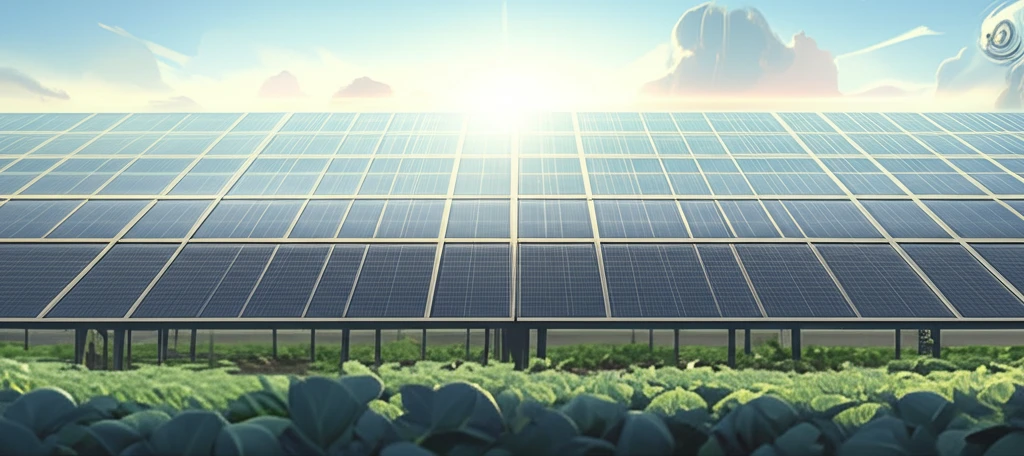
Agrivoltaics: Can Solar Panels and Farming Coexist for a Sustainable Future?

"Explore how integrating solar technology with agriculture can optimize land use, reduce environmental impact, and revolutionize sustainable farming."
As the world grapples with climate change and a growing population, innovative solutions are needed to balance food production and renewable energy. One promising approach is agrivoltaics, the co-location of solar photovoltaic (PV) modules and agriculture. This system not only generates clean energy but also optimizes land use, offering a sustainable path forward.
Traditional farming practices, intensified by the need to feed a growing population, contribute significantly to carbon emissions through machinery, fertilizers, and transportation. Simultaneously, the demand for land for solar farms often competes with agricultural needs. Agrivoltaics addresses both challenges by allowing farming and energy production to occur on the same plot of land.
The integration of solar panels into agricultural settings introduces additional functions such as sunlight sharing, land sharing, and power generation. However, traditional methods of assessing agricultural systems may not fully capture the benefits of agrivoltaics. New assessment metrics are needed to quantify the environmental and economic impacts accurately. This article explores the potential of agrivoltaics and how its success is measured.
No Agrivoltaic Statistics Provided
The supplied sources do not provide statistics about agrivoltaics, solar panels, farming, or environmental impacts. The Google Groups result concerns exporting shared-drive data to CSV, while the Amazon RDS result concerns M8i and R8i database instances. The NHBirds result mentions bird tallies but does not establish any connection to agrivoltaic systems.
No Relevant Methods Provided
The supplied sources do not describe accepted agrivoltaic methods, field designs, crop-management practices, or limitations. The Indeed and Townwork results are Tokyo-area employment listings and job-search pages. Their snippets cannot support conclusions about agricultural or solar-panel approaches.
Historical Context
No source material was supplied for this subsection. A reliable historical account would require evidence about the development of agrivoltaic research, milestones in dual-use solar farming, and foundational discoveries. Those details cannot be established from the provided materials.
What is Agrivoltaics and Why Does It Matter?
Agrivoltaics involves installing solar panels in agricultural fields, either ground-mounted between rows of crops or elevated above the crops. This approach allows for the simultaneous production of solar energy and agricultural products. The key is to design the system in a way that optimizes sunlight sharing, ensuring that crops receive enough light for healthy growth while maximizing energy generation.
- Optimized Land Use: Agrivoltaics makes the most of available land by combining two essential functions—food and energy production—on a single site.
- Reduced Environmental Impact: By generating clean energy on-site, agrivoltaics reduces reliance on fossil fuels and lowers carbon emissions associated with traditional farming practices.
- Climate Change Mitigation: Agrivoltaic systems contribute to climate change mitigation efforts by decreasing greenhouse gas emissions and promoting sustainable agriculture.
- Additional Income for Farmers: Farmers can generate additional revenue by selling the electricity produced by the solar panels, diversifying their income streams and enhancing economic stability.
Research Evidence Not Supplied
No source material was supplied for this subsection. Consequently, this paragraph cannot identify recent agrivoltaic studies, review findings, research locations, or unresolved questions. Any specific claim about current research would require additional sources.
Visual Sources, Not Agrivoltaic Evidence
The supplied sources document photographs and videos of Niagara Falls, including seasonal views, nighttime imagery, and stock photographs. Niagara Falls State Park, Niagara-Tours, Getty Images, and Pixabay do not provide evidence about agrivoltaic failures, disadvantages, or counterarguments. These materials therefore cannot substantiate a comparison between solar panels and farming.
Comparison Evidence Not Supplied
No source material was supplied for this subsection. A comparative analysis would need evidence covering agrivoltaic systems alongside conventional solar installations or agriculture. Such comparisons cannot be made from the available materials.
Looking Ahead: The Future of Agrivoltaics
Agrivoltaics represents a promising pathway toward a more sustainable and resilient future. By optimizing land use, reducing environmental impacts, and providing additional income for farmers, agrivoltaic systems offer a holistic solution to the challenges of food and energy production. Continued research and development in this field will unlock even greater potential, transforming the landscape of sustainable agriculture and renewable energy. Embracing agrivoltaics is a step toward a greener, more secure, and sustainable world.
Unrelated Competition Sources
The supplied sources concern the 2024–25 UEFA Champions League and related standings, results, statistics, and competition rules. They do not contain expert commentary about agrivoltaics, renewable energy, farming, or sustainability. The competition information therefore cannot support a synthesis of agrivoltaic evidence.
Unrelated Restaurant Listings
The supplied sources list pizza restaurants in Abu Dhabi and provide a Pizza Hut UAE store locator. They do not discuss future agrivoltaic technologies, research priorities, deployment prospects, or emerging applications. No agrivoltaic outlook can be derived from these restaurant listings.
Broader Context Not Documented
No source material was supplied for this subsection. Systemic challenges such as land use, grid access, regulation, financing, and community governance would require directly relevant evidence. Those issues cannot be described specifically from the available materials.
Human Impacts Not Documented
No source material was supplied for this subsection. Claims about farmers, workers, communities, livelihoods, or public responses to agrivoltaics would require firsthand accounts or relevant research. The provided materials do not support such claims.