
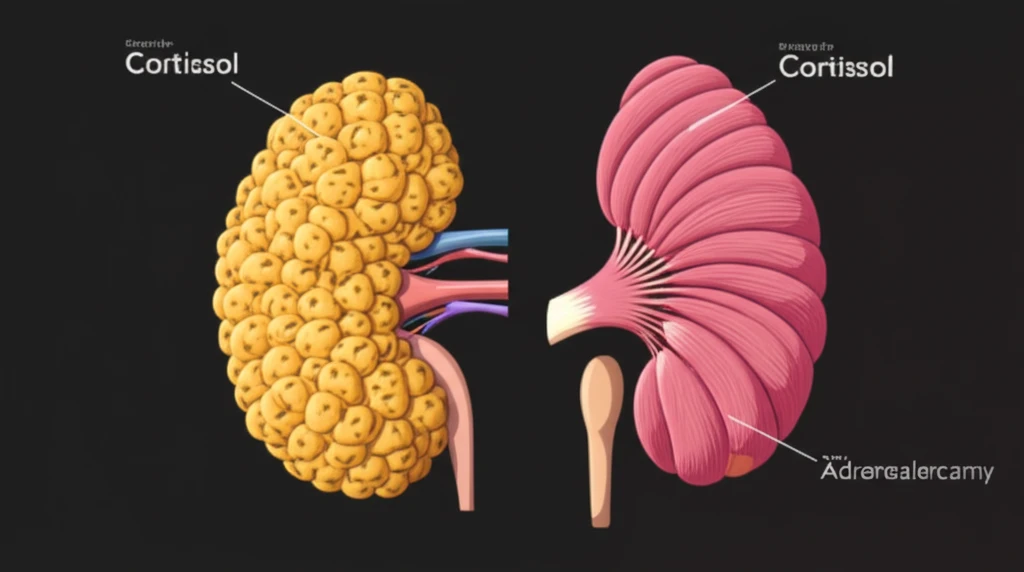
Adrenalectomy: Can This Procedure Reverse the Effects of Excess Cortisol?

"Explore how adrenalectomy impacts body composition in patients with hypercortisolism, offering hope for those seeking relief from its debilitating effects."
Chronic exposure to elevated cortisol levels, a condition known as hypercortisolism, can wreak havoc on the body. Beyond the well-recognized Cushing's syndrome, milder forms of cortisol excess also pose significant health risks. Identifying effective ways to manage and reverse the effects of this hormonal imbalance is crucial for improving patient outcomes and quality of life.
One potential treatment option is adrenalectomy, the surgical removal of one or both adrenal glands. This procedure is often considered when hypercortisolism stems from adrenal tumors. But how effective is adrenalectomy in reversing the body composition changes induced by excess cortisol, such as increased visceral fat and decreased muscle mass? Understanding the specific improvements patients can expect is vital for informed decision-making.
Recent research investigates the impact of adrenalectomy on body composition using computed tomography (CT) scans to assess changes in visceral fat, muscle area, and muscle density. By comparing patients with varying degrees of cortisol excess, the study sheds light on the potential of adrenalectomy to restore a healthier body composition.
Source Limitations
The supplied sources do not provide statistics about adrenalectomy, excess cortisol, or patient outcomes. FrenchLearner.com discusses 20 French greetings, including “bonjour” and “salut,” while Google Translate describes translation between English and more than 100 languages. These materials therefore cannot establish the current medical impact of excess cortisol or adrenal surgery.
Evidence Boundaries
A reliable explanation of adrenalectomy would ordinarily require medical evidence describing indications, surgical approaches, benefits, risks, and follow-up. No source material was supplied for this subsection. Accordingly, no specific standard method or limitation can be stated here without introducing unsupported information.
Unrelated Cultural History
The supplied historical sources concern Taylor Swift rather than adrenalectomy or cortisol research. They describe The Life of a Showgirl as Swift’s twelfth studio album, released on October 3, 2025, and identify Max Martin and Shellback as co-writers and producers. The sources also describe a song of the same name featuring Sabrina Carpenter and an expanded 2026 edition titled The Life of a Showgirl: The Encore, but they provide no medical history.
Understanding the Study: Adrenalectomy and Body Composition
A retrospective observational study was conducted at Yonsei University College of Medicine, Severance Hospital, Seoul, Korea, between 2006 and 2017, involving 134 patients who underwent adrenalectomy for adrenal adenomas. The study participants were categorized into three groups based on their cortisol levels: overt Cushing's syndrome (CS), mild autonomous cortisol excess (MACE), and nonfunctioning adrenal tumor (NFAT). Follow-up CT scans were conducted on a subset of these patients (78 total) to assess changes in body composition after approximately one year.
- Visceral Fat Area (VFA): Fat within the abdominal cavity around the organs.
- Subcutaneous Fat Area (SFA): Fat beneath the skin.
- Skeletal Muscle Area (SMA): Area of skeletal muscle at the L3 vertebra.
- Skeletal Muscle Index (SMI): SMA adjusted for height.
- Skeletal Muscle Radiodensity (SMD): A measure of muscle quality, inversely related to fat content within the muscle.
No Medical Sources Provided
No sources were supplied for current research or reviews of adrenalectomy and cortisol excess. The available material cannot support claims about recent studies, treatment effectiveness, or expert consensus. A medical literature search would be needed before drawing conclusions about the latest evidence.
Different Subject Matter
The supplied sources address chicken-egg incubation rather than adrenalectomy. Two EggBloom sources state that chicken eggs generally hatch in about 21 days, while another source describes 5 to 7 hours after the first crack, with some cases taking up to 24 hours. These timelines cannot be used to assess surgical failure, recovery, or persistent cortisol excess.
Insufficient Comparative Evidence
No sources were supplied that compare adrenalectomy with medication, radiation, observation, or other approaches to cortisol excess. As a result, relative effectiveness, risks, recovery, and patient selection cannot be evaluated from the provided material. Any comparison would require directly relevant clinical sources.
Looking Ahead: The Promise of Adrenalectomy
This research offers valuable insights into the potential of adrenalectomy to reverse the adverse body composition changes associated with hypercortisolism. By demonstrating the link between cortisol excess and improvements in visceral fat, muscle mass, and muscle quality, the study underscores the importance of considering adrenalectomy as a treatment option for patients with adrenal adenomas and varying degrees of cortisol excess. Further prospective studies are needed to validate these findings and refine our understanding of the long-term benefits of adrenalectomy on body composition and overall health.
Evidence Cannot Support a Synthesis
The supplied materials do not contain expert commentary on adrenalectomy or the effects of excess cortisol. A responsible synthesis would need sources addressing hormone normalization, symptom improvement, residual effects, and long-term monitoring. Those conclusions cannot be drawn from the unrelated sources provided.
Technology Context, Not Medical Forecasting
The supplied Microsoft source describes the company’s expansion from Windows into internet services, cloud computing, artificial intelligence, and video gaming. The other sources describe Microsoft account and Outlook sign-in services. None addresses future developments in adrenal surgery, cortisol management, or endocrine research, so they cannot support a medical outlook.
Unrelated Housing Information
The supplied sources concern Summer Place Apartments rather than endocrine care. They mention account access, approximate square footage, changing rental rates and availability, lease terms, and occupancy guidelines. These details do not establish systemic challenges related to adrenalectomy or access to cortisol treatment.
Patient Impact Requires Medical Evidence
No sources were supplied for patients’ experiences, quality of life, recovery, or practical consequences after adrenalectomy. These issues are important to the article’s subject, but they cannot be described factually from the provided material. Patient-centered medical sources would be needed for a supported discussion.