
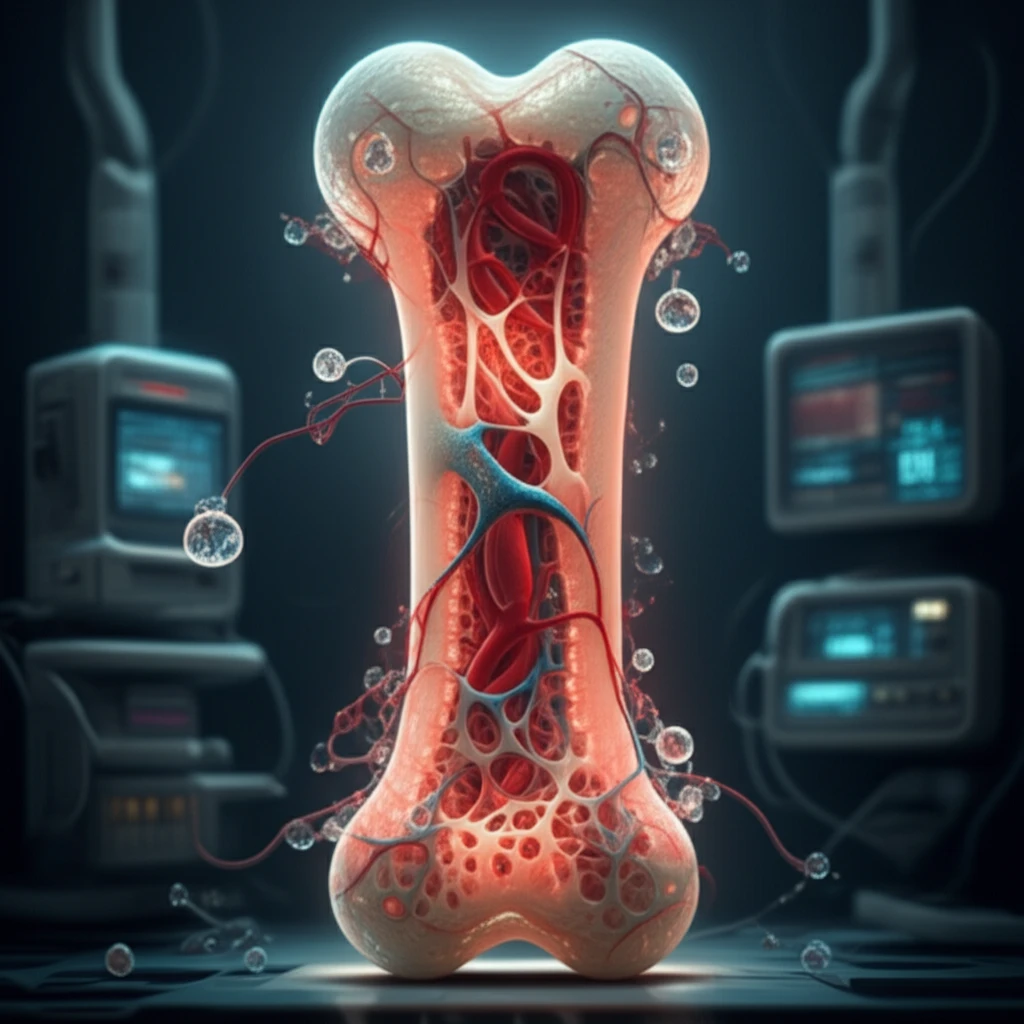
3D-Printed Bone Scaffolds: The Future of Healing?

"Combining cutting-edge 3D printing with bioactive hydrogels and cell co-culture to revolutionize bone regeneration and prevascularization for better healing."
Vascularization, the development of blood vessels, is crucial for the success of large bone constructs in bone tissue engineering. It ensures that the newly formed bone tissue receives an adequate supply of oxygen and nutrients, facilitating its growth and integration with the host tissue. However, achieving sufficient vascularization in engineered bone grafts remains a significant challenge.
To address this challenge, researchers are exploring innovative strategies that combine 3D printing with hydrogel-based prevascularization techniques. This approach involves creating porous bone scaffolds using 3D printing, coating them with bioactive hydrogels containing human adipose-derived mesenchymal stem cells (ADMSC) and human umbilical vein endothelial cells (HUVEC), and then co-culturing these cells to promote vascularization.
This article delves into a study that utilizes this combined approach to generate pre-vascularized bone constructs. It examines how 3D printing, bioactive hydrogels, and cell co-culture work together to enhance bone regeneration and vascularization, offering new possibilities for treating large bone defects and improving patient outcomes.
How Does the Combination of 3D Printing, Hydrogels, and Cell Co-Culture Enhance Bone Regeneration?
The study's methodology involved several key steps. First, researchers encapsulated ADMSC and HUVEC within bioactive hydrogels made from hyaluronic acid (HA) and gelatin. These hydrogels provided a supportive environment for the cells, allowing them to interact and form capillary-like networks.
- Cell Encapsulation: ADMSC and HUVEC are mixed and then loaded inside silicone molds and exposed to UV light.
- Cellular Spheroid Encapsulation: ADMSC or ADMSC-HUVEC cell spheroids are created and then encapsulated within hydrogels and kept in hybrid media.
- Composite Constructs: 3D printing of PCL/HAp scaffolds and incorporation of cell-laden hydrogels that are either ADMSC or ADMSC-HUVEC. ADMSC-HUVEC can also be surface seeded onto PCL/Hap scaffolds.
What Does This Mean for the Future of Bone Defect Treatments?
The findings of this study highlight the potential of prevascularized 3D printed scaffolds with anatomical shapes for healing larger bone defects. By combining 3D printing precision with the bioactive properties of hydrogels and cell co-culture, researchers can create constructs that not only provide structural support but also actively promote vascularization and integration with the host tissue.
This approach represents a significant step forward in bone tissue engineering, offering a promising solution to the challenges associated with large bone defect treatments. The ability to generate patient-specific scaffolds with enhanced vascularization could lead to improved patient outcomes, reduced complications, and faster healing times.
Further research and development in this area could pave the way for clinical translation, bringing the benefits of prevascularized 3D printed bone scaffolds to patients in need of bone reconstruction and regeneration.