
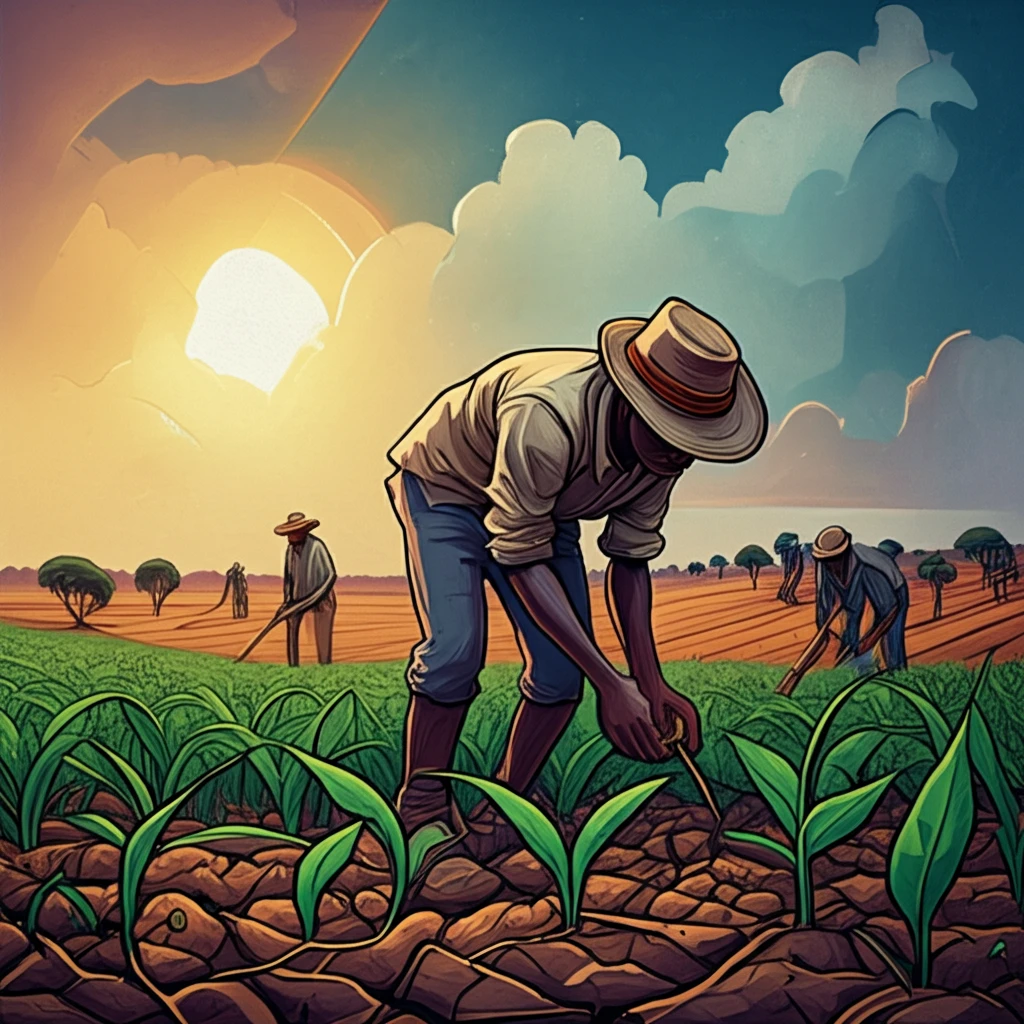
Zambia's Climate-Smart Farming Revolution: Growing Resilience, One Seed at a Time

"Discover how climate-smart agriculture (CSA) is transforming Zambia's farming landscape, empowering smallholder farmers to thrive in the face of climate change."
Zambia's agricultural heartland is facing a growing challenge: climate change. Erratic rainfall, prolonged droughts, and devastating floods are threatening the livelihoods of smallholder farmers, who depend on agriculture for their survival. Recognizing the urgency of the situation, Zambia is embracing climate-smart agriculture (CSA) as a powerful tool to build resilience and ensure food security.
CSA is more than just a set of farming techniques; it's a holistic approach that integrates climate science, sustainable practices, and innovative technologies to help farmers adapt to changing weather patterns, reduce greenhouse gas emissions, and increase productivity. In Zambia, this transformation is being driven by a collaborative effort between government agencies, research institutions, private sector companies, and, most importantly, the farmers themselves.
This article delves into the heart of Zambia's climate-smart revolution, exploring the innovative strategies, successful partnerships, and inspiring stories of resilience that are shaping a more sustainable and food-secure future for the nation.
CSA's Role in Zambia's Food Security
Climate-smart agriculture (CSA) is designed to enhance the capacity of farming systems to sustainably support food security in the context of climatic changes. Research into CSA practices in Zambia has examined reduced tillage, crop rotation, and legume intercropping—combined with improved seeds and inorganic fertiliser—as means to improve maize yields. The Zambia Agriculture Research Institute (ZARI) has been recognised by national leadership for its continued efforts in improving the agriculture sector through such approaches.
Guiding Principles and Key Practices
Climate-smart agriculture is increasingly seen as a promising approach to feed the growing world population under climate change, serving as a method for guiding agricultural management in the face of shifting climatic conditions. In Zambia, the FAO has identified agroforestry and conservation agriculture as core CSA practices, alongside questions of adoption and impact. The World Bank has noted that CSA technology could help Zambia accelerate and sustain agricultural growth despite climate vulnerabilities, though realising this potential depends on effective implementation.
Rainfed Roots and Early Project Impact
The dominance of rainfed agriculture in Zambia's agricultural sector has long meant that climate change poses a considerable challenge to food production. As early as 2004, the Save Environment and People Agency (SEPA) launched a climate-smart agriculture project in Mufumbwe District, North-Western Province, benefiting some 5,000 farmers. The Zambian government has estimated substantial losses to GDP from diminishing returns in agriculture and natural resources over the next 10 to 20 years due to climate change.
Seeds of Change: Innovations in Action
At the core of Zambia's CSA strategy lies the adoption of drought-resistant maize varieties. These specially bred seeds are able to withstand prolonged periods of water scarcity, ensuring that farmers can still harvest a decent yield even in challenging conditions. The initiative involves:
- Training public and private partners, including agro-dealers, on stress-tolerant seed knowledge. This equips them with the expertise to advise farmers on the best seed choices for their specific needs.
- Conducting farmer awareness campaigns on CSA-related inputs, technologies, and information. These campaigns educate farmers on the benefits of stress-tolerant seeds and other CSA practices.
- Linking primary seed producers to the smallholder farmer market through last-mile agro-dealer outlets and train agro-dealers in CSA information so that they become a locally embedded extension support system to farmers.
Growing Institutional Commitment
Most developing-country governments in Sub-Saharan Africa, including Zambia's, along with international organizations have committed major resources to promote climate-smart agriculture. A 2022 review paper focused specifically on climate-smart agriculture for Zambia's smallholder farmers synthesised the state of knowledge in this area. Recent 2024 studies have continued to assess the effects of climate-smart agriculture on smallholder farmers, reflecting sustained academic and policy interest.
Rainfed Dependency and Diversification Challenges
Despite the promise of CSA, the dominance of rainfed agriculture in Zambia's agricultural sector continues to mean that climate change poses a considerable challenge that conservation agriculture alone may not resolve. Case studies from Zambia and Malawi have explored the drivers of crop diversification and its impacts on welfare outcomes, with particular attention to climatic variables and institutional factors. While practices such as conservation agriculture are designed to enhance sustainability by protecting soil from erosion and degradation, their adoption remains uneven across smallholder communities.
Country-Level CSA Profiling
In 2017, the International Center for Tropical Agriculture (CIAT) published a dedicated Climate-Smart Agriculture Country Profile for Zambia as part of a broader Africa series. This profile provides a structured assessment of CSA priorities, practices, and potential within the Zambian context, offering a basis for comparing Zambia's approach with those of other African nations.
A Promising Future, Rooted in Resilience
Zambia's journey towards climate-smart agriculture is an ongoing process, but the progress made so far is undeniable. By embracing innovation, fostering collaboration, and empowering farmers with the knowledge and resources they need, Zambia is building a more resilient and food-secure future for all its citizens. As climate change continues to pose a threat to agricultural systems around the world, Zambia's experience offers valuable lessons and inspiration for other nations seeking to adapt and thrive in a changing world.
Beyond One-Dimensional Explanations
A BBC report in early January warned that climate change has brought parts of Zambia to the brink of famine, with hunger affecting almost 2 million people. However, experts caution that one-dimensional explanations are unlikely to capture the full picture or bring about sustainable change. Understanding the interplay of climate stress, agricultural systems, institutional capacity, and poverty is essential for meaningful progress.
A Path Still Being Shaped
Zambia's climate-smart agriculture journey remains a work in progress, with new research continuing to refine understanding of which combinations of practices work best under varying agro-ecological conditions. Scaling successful pilots to millions of smallholder farmers will likely require stronger institutional coordination, sustained funding, and locally adapted extension services. The coming decade will be critical in determining whether CSA can deliver on its promise of resilience at a national scale.
Investment Gaps and Soil-Centred Solutions
Despite wide availability of deployable capital into climate-smart agriculture, investors still lack sufficient investment opportunities as well as suitable frameworks to identify them, according to the AICCRA Zambia Accelerator Program. On the farm level, climate-smart practices such as conservation agriculture aim at conserving soil moisture, retaining crop residues for soil fertility, disturbing the soil as minimally as possible, and diversifying through rotation or intercropping. Bridging the gap between financial resources and on-the-ground implementation remains a systemic challenge.
Compounding Crises in Rural Communities
The agricultural sector in Zambia has faced compounding pressures from both climate change and the COVID-19 pandemic. Rural communities have experienced particular vulnerability, with vaccination rates and health service uptake remaining lower in rural areas than in urban centres. These overlapping crises underscore the need for climate-smart strategies that also account for public health and socio-economic resilience among smallholder farming populations.