
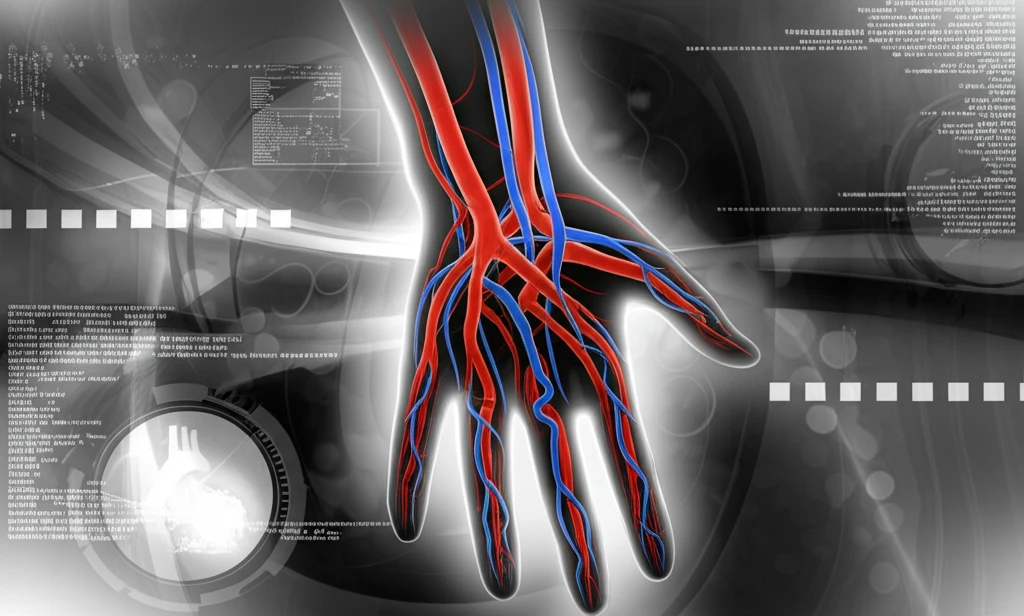
Vibrant illustration of hand and wrist arteries, symbolizing vascular health.

Wrist and Hand Artery Health: What Your Angioscan Reveals

"Unlock insights into your wrist and hand arterial health with angioscanning. Discover how this advanced imaging technique aids in diagnosing and treating vascular issues for optimal hand function."


The intricate network of blood vessels in our hands and wrists is vital for everyday function. From typing on a keyboard to performing delicate surgical procedures, healthy arteries ensure that our hands receive the oxygen and nutrients they need. However, various conditions can compromise this vascular system, leading to pain, impaired function, and even tissue damage.

Vascular diseases of the hand can manifest in several ways, including acute or secondary digital ischemia, which may result from embolisms, atherosclerosis, or inflammatory arteritis. Another notable condition is hypothenar hammer syndrome, often linked to aneurysms of the ulnar artery. Additionally, certain bone conditions like scaphoid and lunate pseudarthrosis (Kienbock's disease) can disrupt vascular flow, necessitating vascularized bone grafts.

In the pursuit of accurate diagnosis and effective treatment, medical imaging plays a crucial role. Among the various imaging modalities, angioscanning stands out as a powerful tool for visualizing the arterial anatomy of the wrist and hand. By providing detailed images of blood vessels, angioscanning helps clinicians identify abnormalities, assess the extent of vascular damage, and guide treatment decisions. This article delves into the significance of radio-anatomical correlation in vascularizing the wrist and hand, emphasizing the role of angioscanning in improving outcomes for patients with vascular conditions.

Understanding Angioscanning and Its Role in Vascular Assessment

Vibrant illustration of hand and wrist arteries, symbolizing vascular health.

Angioscanning, also known as computed tomography angiography (CTA), is a non-invasive imaging technique that utilizes X-rays and contrast dye to visualize blood vessels. During an angioscan of the wrist and hand, a contrast agent is injected into a vein, allowing the arteries to become visible on the CT images. These images are then reconstructed to create detailed three-dimensional views of the vascular anatomy.

This process allows healthcare professionals to identify a variety of vascular abnormalities, which may include:

  • Aneurysms: Bulges in the arterial wall that can weaken and rupture.
  • Stenosis: Narrowing of the arteries due to plaque buildup or other causes.
  • Occlusions: Blockages of the arteries that can lead to ischemia (reduced blood flow).
  • Vascular malformations: Abnormal connections between arteries and veins.
  • Thrombosis: Formation of blood clots within the arteries.
A retrospective study involving 50 angioscanners was conducted on patients who presented with suspected digital ischemia. The angioscanning protocol involved using a multi-slice 64-barrette scanner. Patients were positioned in a prone position with their arms above their heads and hands in pronation. Contrast-enhanced images were acquired to cover the forearms, wrists, and hands, followed by a 50-second acquisition after injecting an iodine contrast agent at a concentration of 400mg/mL at 2 cc/s.

Improving Outcomes Through Advanced Vascular Imaging

Angioscanning has revolutionized the diagnosis and management of vascular conditions affecting the wrist and hand. By providing detailed anatomical and functional information, this imaging technique empowers clinicians to make informed decisions, personalize treatment strategies, and ultimately improve outcomes for their patients. As technology continues to advance, angioscanning promises to play an even greater role in the future of vascular care, ensuring that individuals can maintain healthy and functional hands for years to come.

About this Article -

This article was crafted using a human-AI hybrid and collaborative approach. AI assisted our team with initial drafting, research insights, identifying key questions, and image generation. Our human editors guided topic selection, defined the angle, structured the content, ensured factual accuracy and relevance, refined the tone, and conducted thorough editing to deliver helpful, high-quality information.See our About page for more information.

This article is based on research published under:

DOI-LINK: 10.1016/j.morpho.2018.07.024, Alternate LINK

Title: Corrélation Radio-Anatomique De La Vascularisation Artérielle Du Poignet Et De La Main : À Propos De 50 Angioscanners Du Membre Supérieur

Subject: Anatomy

Journal: Morphologie

Publisher: Elsevier BV

Authors: F. Zohra Touia, R. Sellamna, M. Yaker, S. Rebih, A. Cherfi Mokrane, A. Benchneb, R. Ait Chalal, A. Chikouche

Published: 2018-09-01

Everything You Need To Know

1

What is angioscanning, and how does it help in diagnosing wrist and hand artery issues?

Angioscanning, specifically computed tomography angiography (CTA), is a non-invasive imaging technique that uses X-rays and contrast dye to visualize blood vessels in the wrist and hand. It helps diagnose vascular issues by providing detailed images of the arterial anatomy. This allows clinicians to identify abnormalities such as aneurysms, stenosis, occlusions, vascular malformations, and thrombosis. The detailed information from the angioscan assists in assessing the extent of vascular damage and guiding treatment decisions, leading to improved hand health.

2

What conditions can angioscanning help diagnose in the wrist and hand?

Angioscanning can diagnose a variety of vascular conditions affecting the wrist and hand. These include acute or secondary digital ischemia which might arise from embolisms, atherosclerosis, or inflammatory arteritis. Furthermore, it aids in identifying hypothenar hammer syndrome, often associated with aneurysms of the ulnar artery. It can also help in assessing vascular flow disruptions due to bone conditions such as scaphoid and lunate pseudarthrosis (Kienbock's disease). By visualizing the arterial anatomy, angioscanning supports the diagnosis and management of these conditions.

3

How is an angioscan performed on the wrist and hand?

An angioscan, also known as computed tomography angiography (CTA), involves injecting a contrast agent into a vein to make the arteries visible on the CT images. For a wrist and hand angioscan, the patient is typically positioned in a prone position with their arms above their heads and hands in pronation. A multi-slice 64-barrette scanner is used to acquire contrast-enhanced images that cover the forearms, wrists, and hands. Images are acquired after injecting an iodine contrast agent at a concentration of 400mg/mL at 2 cc/s, which are then reconstructed into detailed three-dimensional views.

4

What is the significance of radio-anatomical correlation in the context of angioscanning?

Radio-anatomical correlation is crucial in angioscanning because it involves correlating the images obtained (the 'radio' aspect) with the actual anatomy of the wrist and hand. This correlation allows clinicians to understand the precise location and nature of any vascular abnormalities, such as aneurysms, stenosis, occlusions, and other issues. By precisely mapping the blood vessels, angioscanning provides a detailed understanding of how these abnormalities affect blood flow, which is essential for accurate diagnosis and targeted treatment strategies.

5

How can angioscanning improve outcomes for patients with wrist and hand vascular conditions?

Angioscanning improves outcomes by providing detailed anatomical and functional information about the arteries in the wrist and hand. This enables clinicians to make informed decisions, personalize treatment strategies, and monitor the effectiveness of interventions. The detailed images from angioscanning allow for early detection of issues such as aneurysms, stenosis, and occlusions. This leads to timely interventions and improved hand function. With the detailed insights, clinicians can tailor treatments to individual patient needs, leading to better overall outcomes and maintaining healthy, functional hands.

Newsletter Subscribe

Subscribe to get the latest articles and insights directly in your inbox.