
WPC's Secret Weapon: How Fiber-Reinforced Shells Can Solve Your Expansion Problems

"Unlock the potential of wood-plastic composites (WPCs) by understanding how glass-fiber reinforced shells revolutionize thermal stability. A simplified guide to a complex problem."
Wood-plastic composites (WPCs) have become increasingly popular for their durability and sustainability, but they aren't without challenges. One significant hurdle is their tendency to expand or contract with temperature changes, potentially leading to structural issues or aesthetic flaws in applications like decking, siding, and furniture.
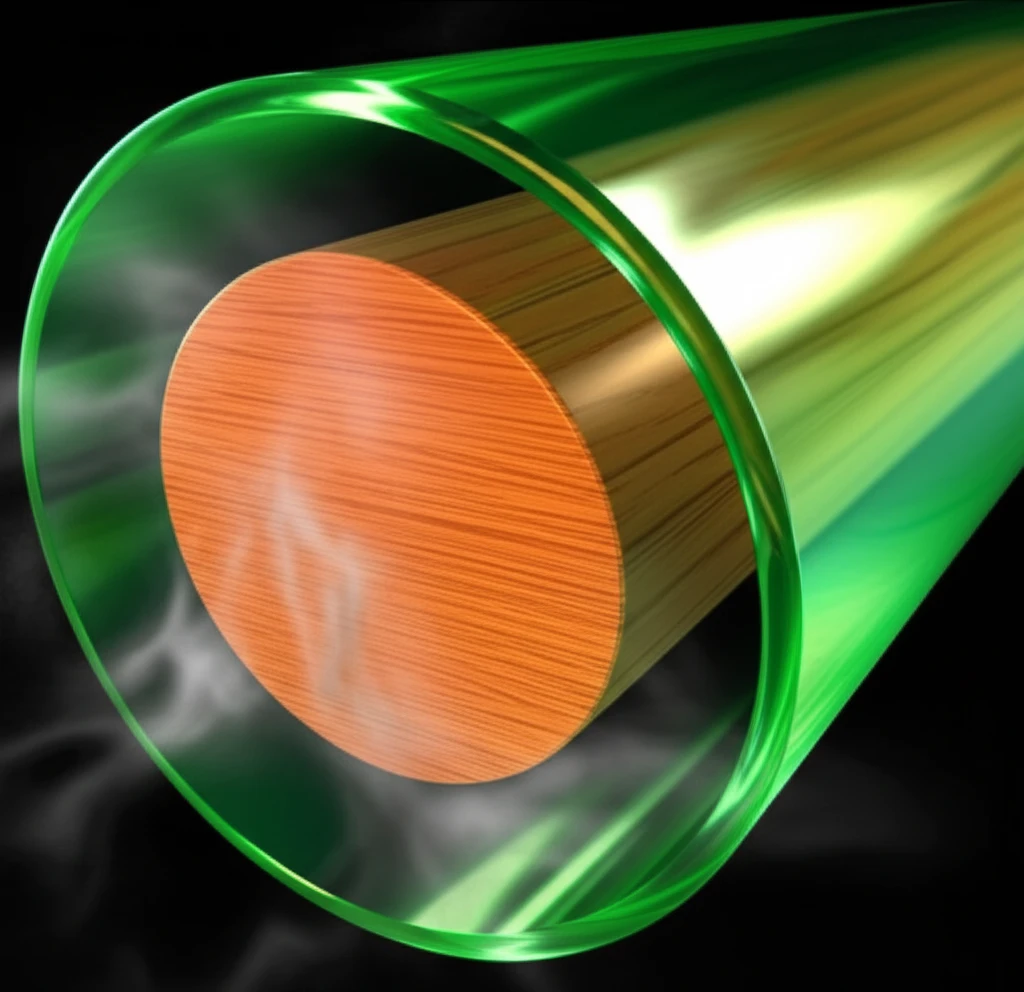
Fortunately, innovative solutions are emerging to combat this problem. One promising approach involves co-extruding WPCs with a special core-shell structure. In this design, the outer shell is reinforced with materials like glass fiber, which possess inherently low thermal expansion properties. By carefully controlling the composition and thickness of these shells, manufacturers can significantly reduce the overall thermal expansion of the composite.
This article delves into the science behind this technology, explaining how glass-fiber reinforced shells work to minimize thermal expansion in WPCs. We'll explore the key factors influencing this behavior, including the materials used, the composite structure, and the role of finite element modeling in optimizing performance. Get ready to unlock the secrets to creating dimensionally stable WPCs that can withstand the rigors of fluctuating temperatures.
How Do Fiber-Reinforced Shells Tame Thermal Expansion in WPCs?
The core principle behind using fiber-reinforced shells lies in leveraging materials with contrasting thermal expansion properties. Standard WPC materials typically exhibit a relatively high coefficient of thermal expansion (LCTE), meaning they expand and contract noticeably with temperature changes. Glass fibers, on the other hand, possess a very low LCTE. By encasing the WPC core with a shell containing glass fibers, the overall expansion behavior of the composite can be significantly reduced.
- Material Composition: The type and amount of fiber used in the shell directly impact the composite's thermal expansion. Higher concentrations of glass fiber generally lead to lower overall LCTE values.
- Shell Thickness: The thickness of the reinforced shell also plays a role. Thicker shells provide greater restraint, but can also affect the composite's weight and cost.
- Core Material: The properties of the core WPC material influence the overall behavior. A core with inherently lower thermal expansion will complement the shell's efforts.
- Co-extrusion Process: This manufacturing technique allows for the creation of a seamless bond between the core and shell, ensuring optimal stress transfer and preventing delamination.
The Future of Stable WPCs: Customization and Climate Resilience
The development of co-extruded WPCs with fiber-reinforced shells represents a significant advancement in material science. By carefully selecting materials and optimizing the composite structure, manufacturers can create WPCs with exceptional dimensional stability and resistance to thermal expansion.
This technology opens doors to a wider range of applications for WPCs, particularly in demanding environments where temperature fluctuations are a concern. From durable decking and siding to long-lasting outdoor furniture, fiber-reinforced shells ensure that WPCs maintain their structural integrity and aesthetic appeal for years to come.
Furthermore, the use of finite element modeling allows for the customization of WPC designs to meet specific performance requirements. By simulating the thermal behavior of different composite structures, engineers can fine-tune the material composition and shell thickness to achieve optimal results for any given application. As the demand for sustainable and high-performance building materials continues to grow, co-extruded WPCs with fiber-reinforced shells are poised to play an increasingly important role.