
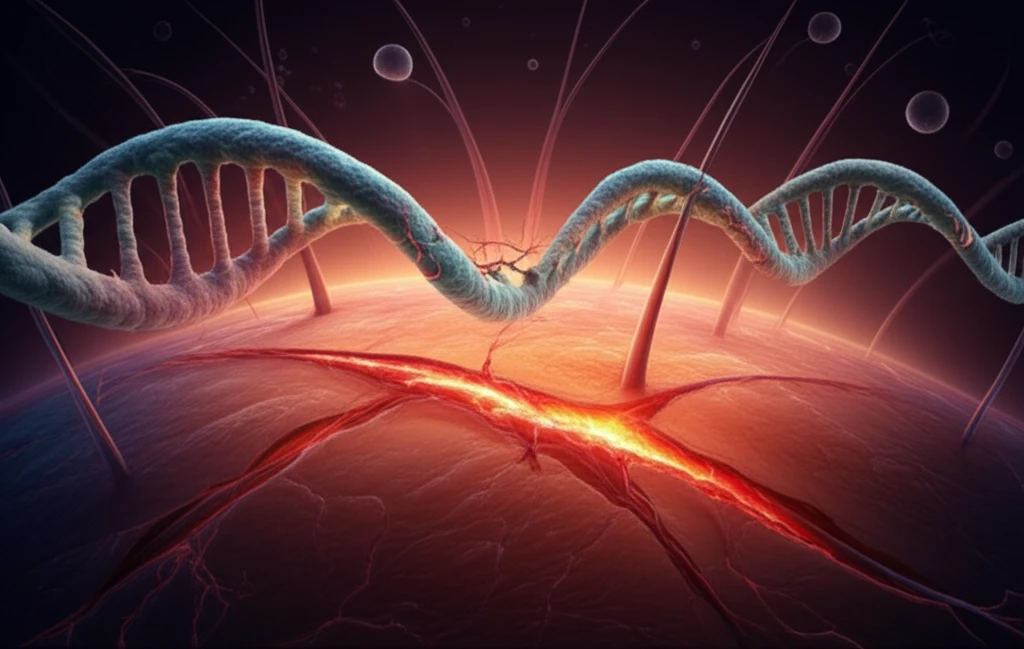
Glowing skin cells repairing a wound with mRNA strands.

Wound Healing Breakthrough: Can mRNA Technology Accelerate Recovery?

"New research explores how modified messenger RNA could revolutionize skin repair, offering faster and more effective treatments for wounds."


Wound healing is a complex process involving multiple stages, from inflammation to tissue remodeling. Growth factors play a crucial role in this process, but their effectiveness in chronic wounds is often limited due to poor bioavailability and rapid degradation. This has led researchers to explore innovative strategies to enhance growth factor delivery and efficacy.

One promising approach involves messenger RNA (mRNA) therapy. Unlike gene therapy, which permanently alters a cell's DNA, mRNA therapy offers a transient effect, potentially increasing growth factor concentration in the wound area without long-term genetic modifications. This could be particularly beneficial in preventing complications like tumorigenesis.

Recent research has focused on using modified mRNA to deliver keratinocyte growth factor (KGF), a key protein involved in skin repair. By transfecting cells with KGF-encoding mRNA, scientists aim to accelerate cell proliferation and migration, ultimately promoting faster and more effective wound healing.

KGF-mRNA: A New Frontier in Wound Healing

Glowing skin cells repairing a wound with mRNA strands.

The study published in Nucleic Acid Therapeutics, details how researchers developed a modified KGF messenger RNA (mRNA) to improve wound healing. The approach centers around leveraging the natural healing properties of keratinocyte growth factor (KGF), which stimulates cell proliferation and movement, critical for effective skin repair.

The researchers introduced KGF-mRNA into skin cells (keratinocytes) in vitro. The cells then began producing KGF protein, which was evaluated for its impact on cell migration and re-epithelialization, essential steps in wound closure. A scratch assay was used to mimic a wound and observe how quickly the cells could repair the "scratch."

  • Enhanced KGF Production: Cells transfected with KGF-mRNA showed a significant increase in KGF protein release.
  • Accelerated Re-epithelialization: The increased KGF levels led to markedly improved re-epithelialization in the scratch assays, indicating faster wound closure.
  • Temporary Effect: Unlike gene therapy, mRNA's effects are temporary, reducing risks associated with permanent genetic alterations.
  • Targeted Delivery: This method allows for a localized increase in growth factor expression directly in the treated area.
The study's results suggest that KGF-mRNA transfection is a promising therapeutic strategy, especially for difficult-to-heal wounds. By temporarily boosting growth factor expression in the treated area, it can accelerate the natural healing process without altering the cell's DNA.

The Future of Wound Care: mRNA and Beyond

This research opens new avenues for wound treatment. The use of mRNA to deliver growth factors offers a controlled and temporary approach, potentially overcoming the limitations of traditional methods.

While these findings are promising, further research is needed. Future studies should focus on in vivo testing to confirm the effectiveness and safety of KGF-mRNA therapy in living organisms. Additionally, refining mRNA delivery techniques and exploring combinations with other growth factors could further enhance wound healing outcomes.

The potential of mRNA therapy extends beyond wound care. This technology could revolutionize treatments for various conditions, from tissue regeneration to cancer therapy, marking a significant step forward in regenerative medicine.

About this Article -

This article was crafted using a human-AI hybrid and collaborative approach. AI assisted our team with initial drafting, research insights, identifying key questions, and image generation. Our human editors guided topic selection, defined the angle, structured the content, ensured factual accuracy and relevance, refined the tone, and conducted thorough editing to deliver helpful, high-quality information.See our About page for more information.

This article is based on research published under:

DOI-LINK: 10.1089/nat.2018.0737, Alternate LINK

Title: Keratinocyte Growth Factor Modified Messenger Rna Accelerating Cell Proliferation And Migration Of Keratinocytes

Subject: Drug Discovery

Journal: Nucleic Acid Therapeutics

Publisher: Mary Ann Liebert Inc

Authors: Markus Denzinger, Antonia Link, Julia Kurz, Sabrina Krauss, Robert Thoma, Christian Schlensak, Hans Peter Wendel, Stefanie Krajewski

Published: 2018-12-01

Everything You Need To Know

1

What is the main focus of this research?

Wound healing is a complex biological process, involving multiple coordinated stages. The process begins with inflammation, followed by cell proliferation and migration, and finally tissue remodeling. This study focuses on enhancing cell proliferation and migration using a modified messenger RNA (mRNA) to speed up the healing process.

2

Why is messenger RNA (mRNA) therapy important in this context?

Modified messenger RNA (mRNA) therapy is significant because it offers a transient effect, unlike gene therapy, which alters a cell's DNA permanently. The use of KGF-mRNA allows for a localized increase in growth factor expression, specifically Keratinocyte Growth Factor (KGF), directly in the treated area. This approach could prevent complications associated with permanent genetic alterations, like tumorigenesis.

3

What is Keratinocyte Growth Factor (KGF) and its role in this research?

Keratinocyte Growth Factor (KGF) is a key protein involved in skin repair. Introducing KGF-encoding mRNA into skin cells (keratinocytes) stimulates cell proliferation and movement. This process is essential for re-epithelialization, which is a critical step in wound closure. The research uses KGF-mRNA to accelerate this process by increasing KGF production in the wound area.

4

What were the key findings of the study?

The study's results suggest that KGF-mRNA transfection is a promising strategy. The key findings indicate that cells transfected with KGF-mRNA showed a significant increase in KGF protein release. This led to accelerated re-epithelialization, indicating faster wound closure. The temporary nature of mRNA therapy also reduces the risk of long-term genetic alterations.

5

What are the implications of this research for wound care?

The future of wound care is promising with the use of mRNA. The use of mRNA to deliver growth factors offers a controlled and temporary approach. This new approach has the potential to overcome the limitations of traditional methods. This research also opens new avenues for treating difficult-to-heal wounds by temporarily boosting growth factor expression in the treated area, thereby accelerating the natural healing process.

Newsletter Subscribe

Subscribe to get the latest articles and insights directly in your inbox.