
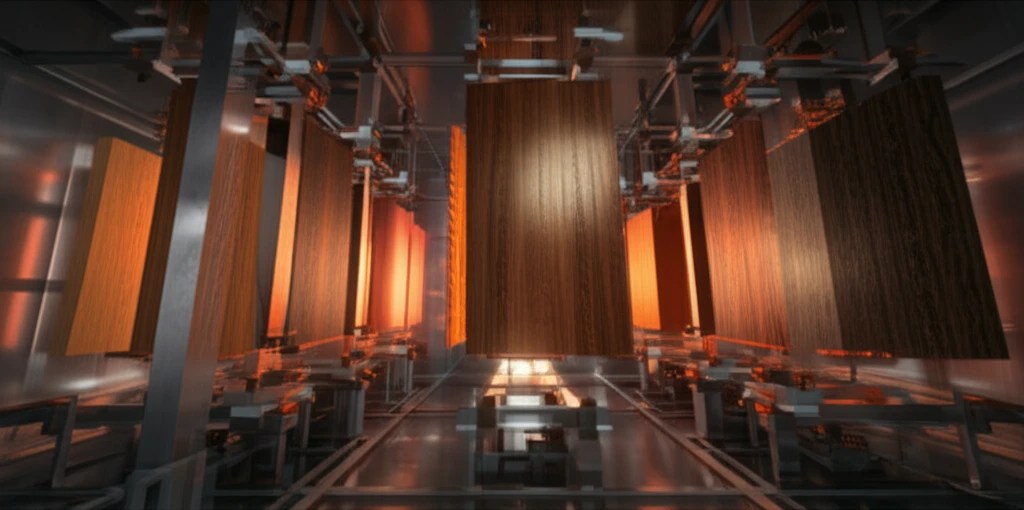
Heat-treated wood samples in a controlled environment.

Wood's Hot Makeover: How Heat Treatment Can Change Everything

"Discover how temperature and clamping during heat treatment dramatically alter wood's strength, color, and durability, and whether it's the right choice for your next project."


Thermal modification, or heat treatment, offers a way to improve wood's performance by simply applying heat. This process typically occurs between 160 to 260°C. Lower temperatures might lead to slight changes in the wood, while temperatures exceeding 260°C can cause structural components to degrade.

During heat treatment, the wood's structure undergoes changes, including adjustments to hydrophilic polymers and the plasticization of lignin. These modifications reduce swelling and water absorption, improving the wood's overall stability.

While research has explored the effects of heat treatment on various wood types, less is known about its impact on high-density woods. This article explores how different temperatures and clamping methods during heat treatment affect the physical and mechanical properties of Okan (Cylicodiscus gabunensis) wood, a high-density species known for its strength and durability.

Heat Treatment and Wood: The Essentials You Need to Know

Heat-treated wood samples in a controlled environment.

Researchers Wahyu Hidayat, Jae Hyuk Jang, Se Hwi Park, Yue Qi, Fauzi Febrianto, Seung Hwan Lee, and Nam Hun Kim sought to understand how heat treatment affects the color, density, strength, and water resistance of Okan wood. They conducted heat treatments on both sapwood (outer layers) and heartwood (inner core) samples, using an electric oven with controlled temperatures of 160°C, 180°C, 200°C, and 220°C for two hours.

To explore the effect of clamping, some wood samples were tightly stacked and clamped during the heat treatment, while others were left unclamped. This allowed the researchers to compare how physical constraints during heating influenced the final properties of the wood.

Here's a summary of the key methods:
The scientists carefully examined the color changes, weight loss, volume shrinkage, equilibrium moisture content (EMC), water absorption (WA), and mechanical strength (MOR, MOE, compression, and shear strength) of the treated wood. By comparing these properties before and after treatment, and between clamped and unclamped samples, they could identify the specific impacts of temperature and clamping.

Heat-Treated Wood: Is It Right for You?

Heat treatment offers a compelling way to enhance wood properties, but the optimal approach depends heavily on the intended use and wood type. The study by Hidayat et al. provides valuable insights into how temperature and clamping methods can be fine-tuned to achieve specific outcomes in Okan wood. This knowledge contributes to more sustainable and effective utilization of wood resources, opening doors for innovative applications in construction, furniture, and beyond. The key is to understand the trade-offs and tailor the process to meet your specific needs.

About this Article -

This article was crafted using a human-AI hybrid and collaborative approach. AI assisted our team with initial drafting, research insights, identifying key questions, and image generation. Our human editors guided topic selection, defined the angle, structured the content, ensured factual accuracy and relevance, refined the tone, and conducted thorough editing to deliver helpful, high-quality information.See our About page for more information.

Everything You Need To Know

1

What is heat treatment, and how does it change wood?

Heat treatment, also known as thermal modification, involves applying heat to wood, typically between 160 to 260°C. This process alters the wood's structure by modifying hydrophilic polymers and plasticizing lignin. These changes reduce swelling and water absorption, enhancing the wood's stability, strength, and durability. Specifically, the study by Hidayat et al. on Okan wood, demonstrates how different temperatures and clamping methods during heat treatment affect its physical and mechanical properties.

2

How does the temperature of heat treatment affect wood properties like Okan?

The temperature during heat treatment significantly impacts the properties of wood. Lower temperatures may lead to slight changes, while temperatures exceeding 260°C can cause structural degradation. In the case of Okan wood, researchers like Hidayat, Jang, Park, Qi, Febrianto, Lee, and Kim used temperatures of 160°C, 180°C, 200°C, and 220°C. They found that increasing the temperature influences color, density, strength, and water resistance, showing the importance of temperature control for specific outcomes.

3

What role does clamping play during the heat treatment of wood, and how does it influence the final product?

Clamping during heat treatment can influence the final properties of the wood by providing physical constraints. The study on Okan wood compared clamped and unclamped samples to identify how these constraints influenced the final properties. Clamping can affect the wood's dimensional stability, potentially reducing warping or other deformations during heating, which is critical for applications where precision is required. The specific impacts depend on the wood type and the intensity of the clamping.

4

What specific properties of Okan wood were studied during heat treatment, and what were the findings?

Researchers studied various properties of Okan wood, including color changes, weight loss, volume shrinkage, equilibrium moisture content (EMC), water absorption (WA), and mechanical strength (MOR, MOE, compression, and shear strength). They compared these properties before and after heat treatment, and between clamped and unclamped samples. These experiments helped to identify the specific impacts of temperature and clamping. The findings from this study on Okan wood contribute to better understanding the potential for more sustainable and effective wood utilization.

5

Is heat-treated wood a good choice for all projects, and what factors should be considered when deciding?

Heat-treated wood offers significant benefits, but its suitability depends on the intended use and the wood type. The research by Hidayat et al. on Okan wood highlights how temperature and clamping can be tailored for specific outcomes. When deciding, consider the project's requirements for strength, moisture resistance, and dimensional stability. Understanding the trade-offs associated with different heat treatment methods allows for more sustainable and effective utilization of wood resources in applications like construction and furniture. The optimal approach depends on balancing these factors to meet specific project needs.

Newsletter Subscribe

Subscribe to get the latest articles and insights directly in your inbox.