
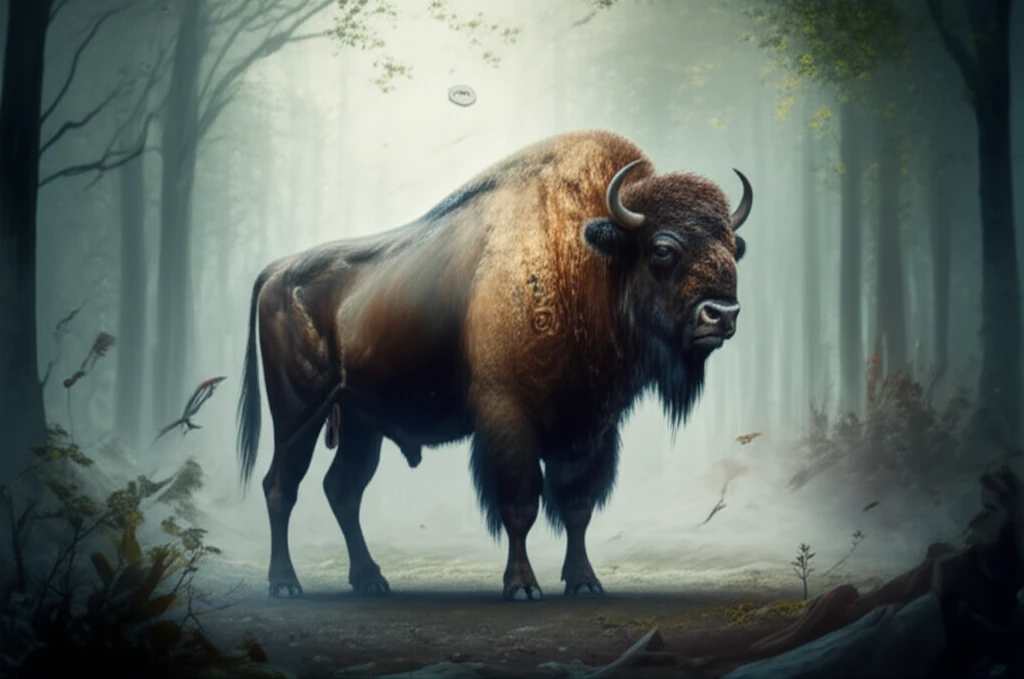
Surreal image of a wisent dissolving into DNA strands in a forest clearing.

Wisent's Identity Crisis: How Ancient DNA Reveals Evolutionary Surprises

"Unraveling the tangled family tree of the European bison and what it tells us about the complexities of species evolution."


For decades, scientists have relied on mitochondrial DNA (mtDNA) to trace the evolutionary history of animals. However, discrepancies often arise between mtDNA and nuclear DNA, creating puzzles in species' family trees. The wisent, or European bison, presents one such enigma. While physically similar and cross-fertile with the American bison, its mtDNA surprisingly aligns more closely with that of cattle, sparking debate about its origins.

The traditional theory suggested that the wisent arose from a hybrid cross between bison and an extinct, cattle-like species. This explanation, however, has come under scrutiny as advancements in genomic analysis offer new insights into the complexities of species evolution, particularly the roles of ancient hybridization and incomplete lineage sorting (ILS).

Now, by analyzing complete nuclear genome sequences of bovine species, scientists are rewriting the wisent's story. This new research delves into the wisent's genetic code, revealing only minor gene flow from cattle and highlighting the significant role of incomplete lineage sorting (ILS). This challenges the hybrid origin theory and offers a new perspective on how closely related species can develop distinct genetic profiles.

Decoding the Wisent Genome: Beyond the Hybrid Theory

Surreal image of a wisent dissolving into DNA strands in a forest clearing.

The recent study, published in Communications Biology, employed a comprehensive approach, combining existing genomic data with new whole-genome sequences from wisent and bison. Researchers meticulously analyzed over 4 million fourfold degenerate sites—DNA positions less prone to mutation—across the genomes of wisent, American bison, yak, zebu, taurine cattle, and water buffalo. This extensive dataset provided a robust foundation for reconstructing the wisent's evolutionary history.

The resulting phylogenetic trees, constructed using maximum likelihood methods, strongly supported the close relationship between wisent and American bison, consistent with their morphological similarities and ability to interbreed. However, the analysis also revealed a notable heterogeneity in nuclear gene tree topologies, indicating a complex evolutionary process beyond simple hybridization.

  • Limited Gene Flow: The study found only minor and recent gene flow between wisent and cattle, undermining the hypothesis of a hybrid origin involving a significant contribution from a cattle-like ancestor.
  • Heterogeneous Phylogeny: An appreciable heterogeneity of the nuclear gene tree topologies of the bovine species was identified, challenging traditional understandings of their relationships.
  • Incomplete Lineage Sorting (ILS): The relative frequencies of various topologies, including the mtDNA topology, were consistent with frequencies of incomplete lineage sorting (ILS) as estimated by tree coalescence analysis.
Further analyses, including coalescent simulations, confirmed that ILS could account for the observed discordance between mtDNA and nuclear DNA phylogenies. ILS occurs when genetic lineages fail to sort completely in newly formed species, leading to gene trees that differ from the overall species tree. In the case of the wisent, the mtDNA lineage appears to have sorted differently from the majority of nuclear genes, resulting in its unexpected affinity with cattle.

The Wisent's Legacy: Rethinking Species Evolution

These findings have broader implications for understanding species evolution. The wisent's story underscores the importance of considering ILS and other complex evolutionary processes when interpreting phylogenetic relationships based on single genes or limited genomic data. Relying solely on mtDNA can paint a misleading picture, particularly in cases of closely related species with a history of interbreeding.

By integrating whole-genome data and advanced analytical techniques, scientists can gain a more nuanced understanding of the factors shaping species' genetic makeup and evolutionary trajectories. This approach is crucial for resolving phylogenetic uncertainties and uncovering the hidden complexities of species diversification.

Ultimately, the wisent's journey from presumed hybrid to a poster child for incomplete lineage sorting highlights the dynamic nature of evolution and the power of genomics to reveal unexpected twists in the history of life. This challenges conventional wisdom and emphasizes the need for comprehensive genomic analyses to fully understand the evolutionary relationships between species.

About this Article -

This article was crafted using a human-AI hybrid and collaborative approach. AI assisted our team with initial drafting, research insights, identifying key questions, and image generation. Our human editors guided topic selection, defined the angle, structured the content, ensured factual accuracy and relevance, refined the tone, and conducted thorough editing to deliver helpful, high-quality information.See our About page for more information.

This article is based on research published under:

DOI-LINK: 10.1038/s42003-018-0176-6, Alternate LINK

Title: Incomplete Lineage Sorting Rather Than Hybridization Explains The Inconsistent Phylogeny Of The Wisent

Subject: General Agricultural and Biological Sciences

Journal: Communications Biology

Publisher: Springer Science and Business Media LLC

Authors: Kun Wang, Johannes A. Lenstra, Liang Liu, Quanjun Hu, Tao Ma, Qiang Qiu, Jianquan Liu

Published: 2018-10-19

Everything You Need To Know

1

What was the previously accepted explanation for the wisent's origin, and how has it been challenged?

The traditional theory suggested the wisent evolved from a hybrid cross between bison and a cattle-like species. However, advancements in genomic analysis, particularly the study of nuclear DNA, challenge this, suggesting only minor gene flow from cattle. The closer relationship between wisent and American bison aligns more with their physical similarities and ability to interbreed, pointing away from a significant cattle contribution.

2

What is incomplete lineage sorting (ILS), and how does it explain the wisent's unusual genetic characteristics?

Incomplete lineage sorting (ILS) occurs when genetic lineages within a species fail to completely separate during speciation. This can lead to some genes, like mitochondrial DNA (mtDNA) in the wisent, showing a closer relationship to a different species (cattle in this case) than the rest of the genome. The analysis of the wisent genome suggests that ILS, rather than hybridization, is a key factor in explaining the discordance between mtDNA and nuclear DNA phylogenies.

3

What specific data and methods were used to investigate the wisent's evolutionary history?

Researchers analyzed over 4 million fourfold degenerate sites across the genomes of the wisent, American bison, yak, zebu, taurine cattle, and water buffalo. This extensive dataset, combined with existing genomic data and new whole-genome sequences from wisent and bison, allowed them to reconstruct the wisent's evolutionary history, build phylogenetic trees, and conduct coalescent simulations to assess the role of incomplete lineage sorting (ILS).

4

What are the broader implications of the wisent research for understanding species evolution and the use of genetic data?

The wisent's story demonstrates that relying solely on mitochondrial DNA (mtDNA) can be misleading when determining species relationships, especially in cases of closely related species with a history of interbreeding. Incomplete lineage sorting (ILS) and other complex evolutionary processes can cause discrepancies between mtDNA and nuclear DNA phylogenies. A more comprehensive genomic analysis, considering the entire nuclear genome, is essential for a more accurate understanding of species evolution.

5

How does this research change our understanding of the wisent and its place in the evolutionary history of bovine species?

The study, published in *Communications Biology*, challenges traditional understandings of species relationships and highlights the importance of considering complex evolutionary processes like incomplete lineage sorting (ILS). By demonstrating that the wisent's genetic makeup is primarily bison with only minor gene flow from cattle, and explaining the mtDNA anomaly through ILS, it encourages a reevaluation of how we interpret phylogenetic relationships and emphasizes the need for comprehensive genomic data in evolutionary studies.

Newsletter Subscribe

Subscribe to get the latest articles and insights directly in your inbox.