
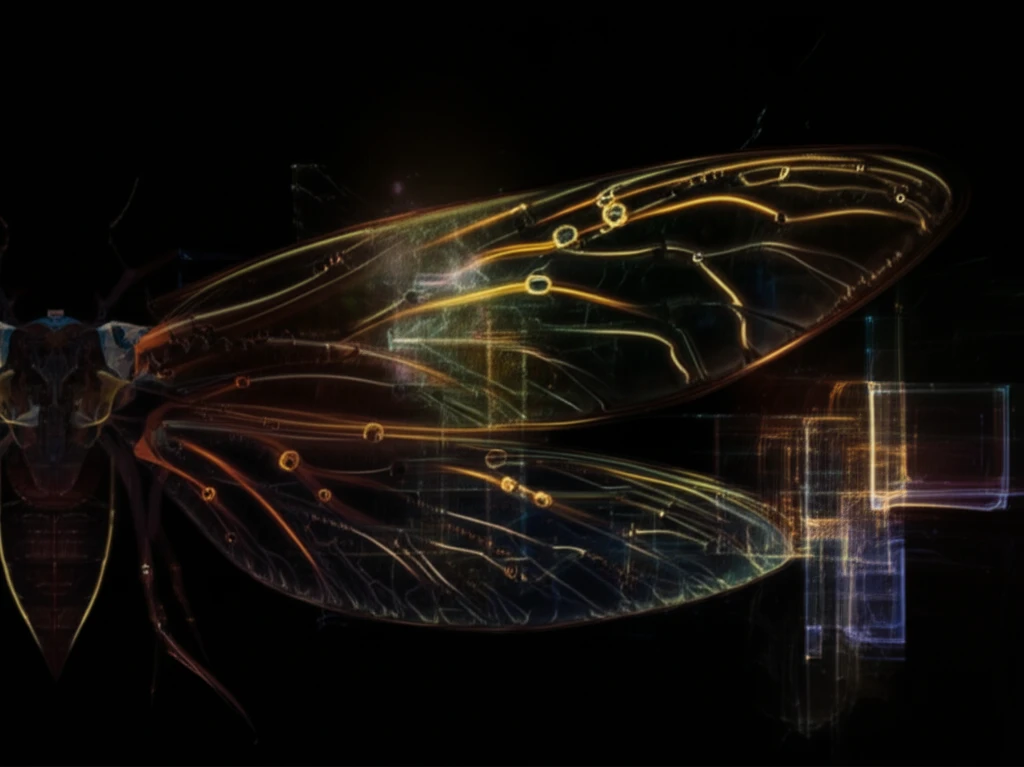
Illustration of a futuristic insect wing with glowing neural-inspired sensors against a backdrop of data streams and algorithms.

Wings of Wonder: How Neural-Inspired Sensors Are Revolutionizing Flight

"From Insect Wings to Advanced Tech: Unveiling the Secrets of Efficient, Sparse Sensing"


In the realm of technological advancement, the quest for efficiency is ever-present. Whether it's optimizing energy consumption in our homes or improving the speed of our smartphones, we consistently seek ways to do more with less. This principle extends beyond the digital world, finding a fascinating application in the study of how nature's most sophisticated systems operate. Imagine a world where complex data can be processed with minimal resources, mirroring the elegant efficiency of the natural world.

Consider the remarkable abilities of insects. Specifically, the effortless grace and precision with which they navigate the skies, often in the face of turbulent conditions, which has long captivated scientists and engineers alike. These creatures achieve extraordinary feats of aerial control using surprisingly minimal sensory input. Their wings, equipped with specialized sensors, provide critical information for flight stabilization and maneuverability. This raises a compelling question: can we replicate this efficiency in our technology?

This article delves into the innovative field of neural-inspired sensors, exploring how they are modeled after the sensory systems of insects. We will examine a groundbreaking study that unveils the potential of these sensors to enable sparse, efficient classification of spatiotemporal data, leading to exciting possibilities for various applications. We'll discuss the science of these sensors, their applications, and how they are revolutionizing our understanding of sensing and data processing.

The Insect's Secret: Decoding Flight with Neural-Inspired Sensors

Illustration of a futuristic insect wing with glowing neural-inspired sensors against a backdrop of data streams and algorithms.

The key to understanding how insects fly with such precision lies in the intricate workings of their sensory systems. Insects possess mechanosensory structures called campaniform sensilla on their wings, which detect mechanical deflections. These structures, akin to tiny strain gauges, are not just simple sensors. Instead, they act as sophisticated information processors. These sensors don't just report forces; they respond to specific patterns of force, functioning as a kind of built-in temporal filter.

This biological approach offers a powerful alternative to traditional methods of sensing, which often rely on large quantities of data and complex processing. The study highlights the concept of sparse sensing, where only a small number of sensors are needed to achieve high accuracy. This is particularly relevant in situations where data acquisition and processing are costly or limited.

  • Efficient Data Processing: Neural-inspired sensors combine temporal and spatial information to reduce the amount of data needed for accurate classification.
  • Robustness: These sensors exhibit remarkable resilience to noise and disturbances, mimicking the adaptability of insects in flight.
  • Biologically Inspired: The design is based on the natural sensory systems of insects, which provides an efficient and effective approach to data processing.
The application of neural-inspired sensors extends beyond insect flight. These principles are applicable in various fields where efficient, robust sensing is essential, including robotics, environmental monitoring, and medical devices. The shift towards more intelligent and efficient sensing solutions has the potential to revolutionize the way we interact with the world around us.

The Future of Sensing: Embracing Nature's Wisdom

The research on neural-inspired sensors offers a compelling glimpse into the future of sensing technology. By drawing inspiration from the elegance and efficiency of biological systems, we can unlock new possibilities for creating intelligent, adaptable systems. This study represents a significant step towards designing more efficient, robust, and versatile sensing solutions. As we continue to explore and learn from nature's designs, we can expect to see even more groundbreaking innovations that shape our world.

About this Article -

This article was crafted using a human-AI hybrid and collaborative approach. AI assisted our team with initial drafting, research insights, identifying key questions, and image generation. Our human editors guided topic selection, defined the angle, structured the content, ensured factual accuracy and relevance, refined the tone, and conducted thorough editing to deliver helpful, high-quality information.See our About page for more information.

This article is based on research published under:

DOI-LINK: 10.1073/pnas.1808909115, Alternate LINK

Title: Neural-Inspired Sensors Enable Sparse, Efficient Classification Of Spatiotemporal Data

Subject: Multidisciplinary

Journal: Proceedings of the National Academy of Sciences

Publisher: Proceedings of the National Academy of Sciences

Authors: Thomas L. Mohren, Thomas L. Daniel, Steven L. Brunton, Bingni W. Brunton

Published: 2018-09-13

Everything You Need To Know

1

What are neural-inspired sensors and what makes them unique?

Neural-inspired sensors are advanced technological tools designed by drawing inspiration from the sensory systems of insects. Their uniqueness stems from their ability to process spatiotemporal data efficiently, requiring only a small number of sensors to achieve high accuracy. This approach contrasts with traditional methods that often depend on large quantities of data and complex processing. Mimicking insect sensory systems, these sensors offer a biologically-inspired method for efficient data classification.

2

How do insects use their wings to achieve such remarkable flight control?

Insects achieve their impressive flight control through specialized mechanosensory structures on their wings called campaniform sensilla. These structures act like tiny strain gauges, detecting mechanical deflections and responding to specific patterns of force. Functioning as built-in temporal filters, these sensors provide critical information for flight stabilization and maneuverability, allowing insects to navigate even in turbulent conditions with minimal sensory input.

3

What is 'sparse sensing,' and why is it important in the context of neural-inspired sensors?

Sparse sensing is a concept where high accuracy is achieved using only a small number of sensors. It's particularly relevant to neural-inspired sensors because these sensors are designed to efficiently process data, reducing the amount of information needed for classification. This is important because it lowers the costs associated with data acquisition and processing, making it valuable in situations where resources are limited or costly.

4

Beyond insect flight, where else can neural-inspired sensors be applied, and what impact could they have?

Neural-inspired sensors have broad applications beyond studying insect flight. Their principles can be applied in fields such as robotics, environmental monitoring, and medical devices where efficient and robust sensing is essential. This shift towards intelligent sensing solutions can revolutionize how we interact with the world, leading to more adaptable, efficient, and intelligent systems. For example, more accurate environmental monitoring or more efficient medical devices.

5

How do neural-inspired sensors combine temporal and spatial information, and why is this important for efficient data processing?

Neural-inspired sensors integrate both temporal (time-based) and spatial (location-based) information from the environment. This combination allows them to discern patterns and changes over time and space, much like how insect sensory systems operate. By combining these information types, these sensors reduce the volume of data needed for accurate classification. This means they can process information more efficiently, which is crucial when dealing with limited computational resources or when real-time processing is required.

Newsletter Subscribe

Subscribe to get the latest articles and insights directly in your inbox.