
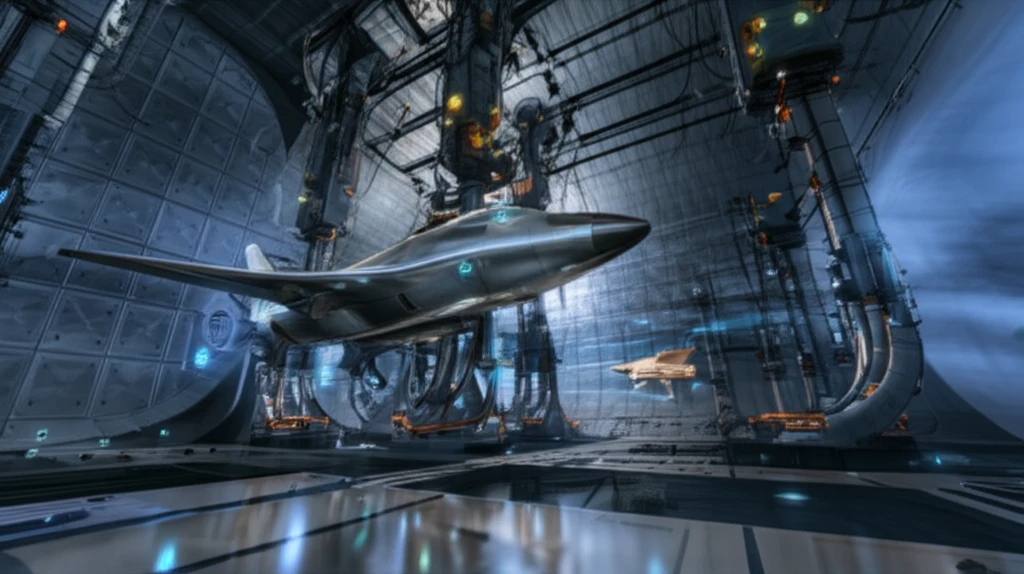
Futuristic wind tunnel with advanced auto-adjusting systems.

Wind Tunnel Tech: How Auto-Adjusting Systems are Revolutionizing Testing

"Explore the innovative design and benefits of angle auto direction-adjusting systems for wind tunnel motion mechanisms."


Wind tunnels are critical for evaluating the performance of various designs, from aircraft to automobiles. These tunnels allow engineers to simulate real-world conditions and gather data on how their designs behave under different airflow scenarios. However, ensuring accurate and reliable results requires precise control over the testing environment.

One of the key challenges in wind tunnel testing is maintaining the correct angle of attack for the test article. The angle of attack refers to the angle between the oncoming airflow and the object being tested. To accurately measure parameters like flow stability, dynamic pressure, and flow deviation, it's essential that the probe direction remains aligned with the inflow direction.

To address this challenge, engineers have developed angle auto direction-adjusting systems. These systems automatically adjust the orientation of the test article to maintain the desired angle of attack, improving the efficiency and accuracy of wind tunnel testing. This article delves into the design, working principles, and benefits of these innovative systems.

Decoding Auto-Adjusting Systems: Key Components and How They Work

Futuristic wind tunnel with advanced auto-adjusting systems.

The core of an angle auto direction-adjusting system lies in its ability to precisely control the motion of the test article. These systems typically consist of several key components:

At the heart of the system is a motion mechanism constructed using components like beeline anchor cells, single-slide ball screw drive positioning cells, and rotary platforms. These components work together to provide the necessary degrees of freedom for adjusting the test article's orientation.

  • Beeline Anchor Cell: Provides linear support and stability.
  • Single-Slide Ball Screw Drive Positioning Cells: Enable precise linear movement along one axis.
  • Rotary Platform: Allows for rotational adjustments, enabling the system to control the angle of attack.
The system typically has four degrees of freedom (X, Y, Z, and M axes), each driven by a servomotor. The M-axis controls the angle, allowing the system to automatically adjust the probe's direction. By driving the M-axis with a motor, the system achieves accurate probe auto direction-adjusting.

The Future of Wind Tunnel Technology

Angle auto direction-adjusting systems represent a significant advancement in wind tunnel testing technology. By integrating self-adapting fuzzy PID control, these systems offer improved accuracy, efficiency, and robustness. As technology advances, we can expect even more sophisticated control algorithms and hardware components, further enhancing the capabilities of wind tunnels and enabling more precise aerodynamic testing.

About this Article -

This article was crafted using a human-AI hybrid and collaborative approach. AI assisted our team with initial drafting, research insights, identifying key questions, and image generation. Our human editors guided topic selection, defined the angle, structured the content, ensured factual accuracy and relevance, refined the tone, and conducted thorough editing to deliver helpful, high-quality information.See our About page for more information.

This article is based on research published under:

DOI-LINK: 10.1051/matecconf/20166302043, Alternate LINK

Title: The Design Of Angle Auto Direction-Adjusting System For Wind Tunnel Motion Mechanism

Subject: General Medicine

Journal: MATEC Web of Conferences

Publisher: EDP Sciences

Authors: Xiao Tao Yu

Published: 2016-01-01

Everything You Need To Know

1

What is an angle auto direction-adjusting system?

An angle auto direction-adjusting system is a sophisticated mechanism used in wind tunnels to precisely control the orientation of a test article. It's composed of several key components: the 'Beeline Anchor Cell' for linear support, 'Single-Slide Ball Screw Drive Positioning Cells' for precise linear movement, and a 'Rotary Platform' for rotational adjustments. These components, driven by servomotors, work together to allow the system to maintain the desired angle of attack.

2

Why are angle auto direction-adjusting systems important?

The 'angle of attack' is the angle between the oncoming airflow and the object being tested within the wind tunnel. Maintaining the correct angle is crucial for accurate aerodynamic testing. The 'angle auto direction-adjusting systems' are important because they ensure the probe direction remains correctly aligned with the inflow direction. This precise alignment enables engineers to accurately measure flow stability, dynamic pressure, and flow deviation, leading to more reliable data and improved design outcomes.

3

What is the purpose of 'Single-Slide Ball Screw Drive Positioning Cells' within the system?

The 'Single-Slide Ball Screw Drive Positioning Cells' are key components of the motion mechanism within the angle auto direction-adjusting system. These cells provide precise linear movement along a single axis. Their function is critical because they contribute to the system's overall ability to finely adjust the position of the test article. This precise movement is essential for achieving the desired angle of attack and obtaining accurate test results.

4

What is the role of the 'Rotary Platform' in an angle auto direction-adjusting system?

The use of a 'Rotary Platform' within an angle auto direction-adjusting system is significant because it allows for rotational adjustments of the test article. This capability is essential for controlling the angle of attack, which is a fundamental parameter in aerodynamic testing. By integrating the 'Rotary Platform', the system can automatically adjust the test article's orientation to precisely align with the airflow, enabling accurate measurement of aerodynamic forces and flow characteristics.

5

What are the implications of integrating 'self-adapting fuzzy PID control'?

Integrating 'self-adapting fuzzy PID control' in angle auto direction-adjusting systems has a significant impact. This technology allows for improved accuracy, efficiency, and robustness in wind tunnel testing. As these systems become more advanced, we can anticipate more sophisticated control algorithms and hardware components. This will lead to even more precise aerodynamic testing, enabling engineers to gather more reliable data and optimize designs with greater confidence.

Newsletter Subscribe

Subscribe to get the latest articles and insights directly in your inbox.