
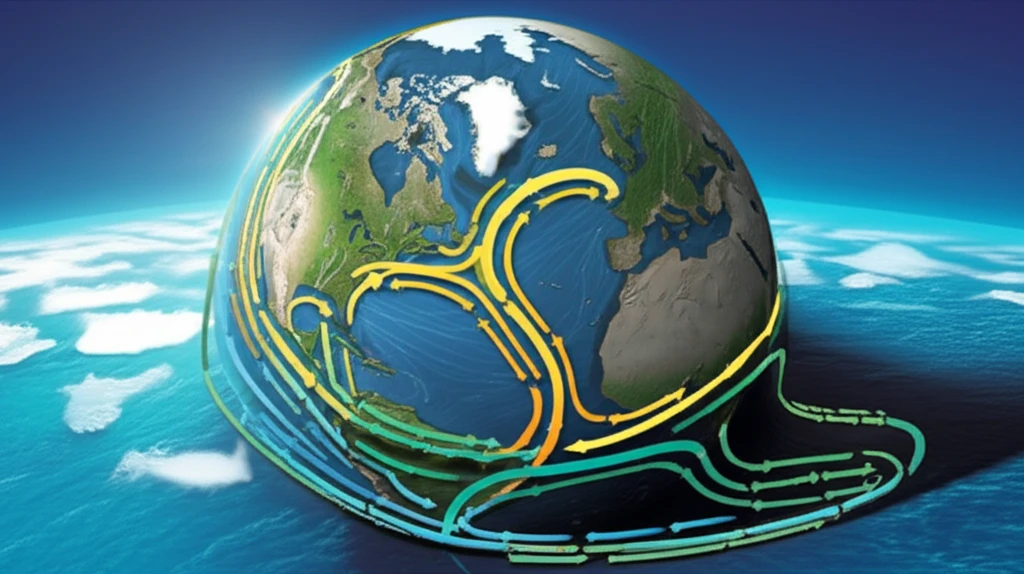
Will the Atlantic Current Collapse? New Models Predict Ocean Circulation Instability

"Climate models reveal troubling signs for the Atlantic Meridional Overturning Circulation (AMOC), impacting global climate and Arctic warming."
The world's climate is governed by intricate ocean currents that act as enormous conveyor belts, redistributing heat and influencing weather patterns across the globe. Among these, the Atlantic Meridional Overturning Circulation (AMOC) plays a pivotal role, transporting warm surface water towards the Arctic and returning cold, deep water southward.
However, recent studies have raised concerns about the stability of the AMOC. As climate change progresses, factors such as increased freshwater input from melting ice and altered salinity levels threaten to disrupt this delicate balance. Understanding these dynamics is crucial for predicting future climate scenarios and preparing for potential consequences.
This article delves into the latest research, drawing from a comprehensive analysis of climate models, to explore the current state of North Atlantic deep water formation and the AMOC. We will examine the biases in these models, investigate the potential causes of these biases, and discuss the broader implications for Arctic warming and global climate.
Decoding Deep Water Formation: What Climate Models Reveal
Deep water formation, a key component of the AMOC, occurs in the North Atlantic when surface water becomes dense enough to sink, driving the circulation. Climate models are essential tools for simulating this process and assessing its future behavior. This study compares 23 state-of-the-art global climate models from the Climate Model Intercomparison Project phase 5 (CMIP5) to observational data, revealing critical insights into how these models represent deep convection.
- Overestimation of Depth: Models often predict convection that reaches depths greater than observed.
- Excessive Area: The area over which convection occurs is frequently larger in models than in reality.
- Increased Frequency: Models tend to simulate deep convection more often than is observed in the actual ocean.
- Southern Shift: The location of deep convection is often displaced too far to the south.
The Future of Ocean Currents: Why Model Accuracy Matters
The dynamical drivers of deep convection and AMOC in models hold the key to realistically forecasting Arctic oceanic warming and its far-reaching consequences for global ocean circulation, the cryosphere, and marine life. Further research and model improvements are essential to refine our understanding of these complex processes and ensure more accurate climate projections. Addressing these biases will enable us to better predict the future of the AMOC and prepare for the impacts of a changing climate.