
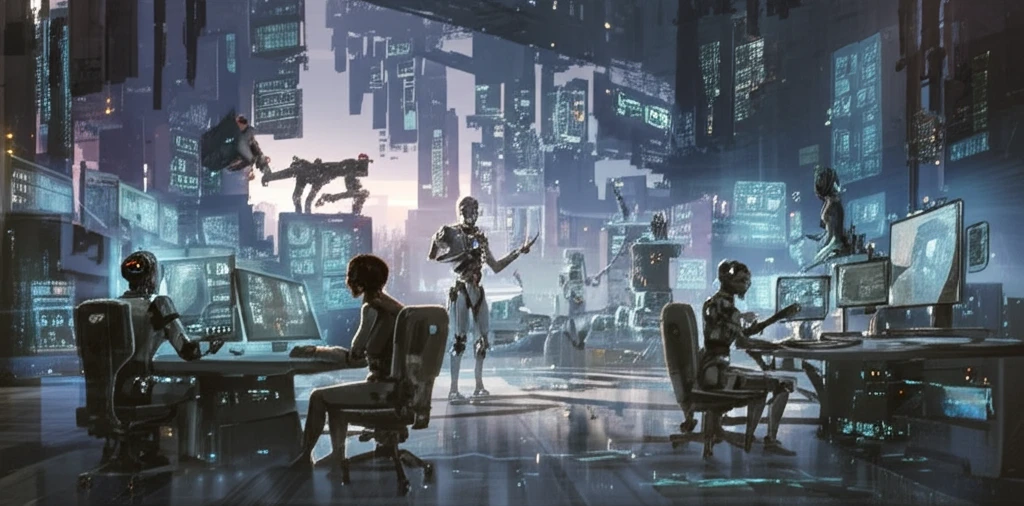
Will AI Steal Your Job? Navigating the Future of Work in the Age of Artificial General Intelligence

"Discover how Artificial General Intelligence (AGI) could reshape the job market and what you can do to prepare for the coming changes in automation and wages."
The rise of artificial intelligence (AI) promises unprecedented advancements, but it also stirs anxieties about widespread job displacement. The concept of Artificial General Intelligence (AGI), where AI systems can perform any task a human can, is no longer confined to science fiction. Leaders in both AI research and industry are urging us to consider the implications of this potential reality.
This article unpacks how the transition to AGI might unfold, what it could mean for your job, and how wages and the overall economy could be affected. By examining different scenarios and the underlying economic forces, we aim to provide a clearer picture of a future where AI plays an increasingly dominant role.
We'll explore how human work can be broken down into smaller tasks, each with varying levels of complexity, and how technological advancements make automating these tasks increasingly feasible. This analysis will reveal the critical factors that determine whether wages rise or fall in the face of advancing AI.
From Definition to the Big Screen
Artificial intelligence is the capability of computational systems to perform tasks typically associated with human intelligence, such as learning, reasoning, problem-solving, perception, and decision-making. The term draws on "artificial" in its most literal sense: man-made, created by humans rather than produced by nature. The subject has crossed fully into popular culture, with Luca Guadagnino's 2026 film "Artificial," starring Andrew Garfield as OpenAI CEO Sam Altman, dramatizing Altman's controversial firing and rehiring by the company's board in 2023. The film follows the board gaining control and removing Altman, only for him to return, an episode widely described as a confusing firing-and-rehiring cycle. Its existence underscores how closely the public now tracks AI leadership and direction as debates over the future of work intensify.
Forecasting Automation's Toll
Much of the public debate about AI and jobs rests on expert forecasts of how many occupations could be automated, though such projections are inherently uncertain and vary widely with methodology and assumptions. A common approach is to analyze which tasks—rather than whole jobs—are most amenable to automation, since few roles consist of a single routine activity. A recurring limitation is that historical data on past technological transitions does not reliably predict the pace or shape of AI adoption, which depends on costs, regulation, and organizational willingness to change. As a result, estimates of AI's labor market impact are best read as plausible scenarios rather than settled predictions.
A Century of Automation Alarms
Concerns about technology displacing workers are not new; every wave of automation, from mechanized manufacturing to computers, has prompted fears that machines would render human labor obsolete. In practice, such predictions have usually been only partially accurate, with some tasks disappearing while entirely new categories of work emerged. Within AI specifically, the field's own history shows a recurring pattern of hype outpacing capability, followed by reassessment, before later breakthroughs revived progress. This record suggests that the timeline for artificial general intelligence—and its effects on employment—remains genuinely difficult to forecast.
The Task Complexity Spectrum: Will There Always Be Work for Humans?
Imagine every task you do at work, from the simplest to the most complex, placed on a spectrum. Some tasks, like basic data entry, are easily automated. Others, requiring creativity, critical thinking, or complex problem-solving, have been harder to automate – until now.
- Unbounded Complexity: This scenario suggests that no matter how advanced AI becomes, there will always be tasks too complex for it to handle. Think of truly novel research or artistic creation.
- Bounded Complexity: This scenario proposes that there's a limit to the complexity of tasks humans can perform, and therefore, AI could eventually automate everything.
Evolving Evidence on AI's Labor Effects
Research on AI and the labor market is still emerging, and findings so far are more nuanced than simple headlines suggest. Studies tend to indicate that generative tools raise productivity on certain routine and administrative tasks, while leaving deeper questions about displacement largely unresolved. Because the technology is evolving quickly, peer-reviewed evidence lags behind real-world deployment, making many current conclusions provisional. Researchers broadly agree that the ultimate effect depends on how organizations, workers, and policymakers adapt over the coming years.
Skepticism and Overstated Claims
Strong counterarguments exist to the view that AI will rapidly take over human work, and past predictions of automation-driven mass unemployment have repeatedly failed to materialize. Skeptics note that new technologies often create demand for skills that previously did not exist, and that adoption is slowed by cost, reliability, and social resistance. Overhyped AI claims have also been a recurring pattern, with systems falling short of marketed capabilities and being quietly abandoned after failing in practice. These experiences counsel against accepting any single dramatic forecast about AI's impact on jobs at face value.
AI Versus Earlier Transformations
Comparing AI with earlier transformative technologies, such as electricity, the internet, or industrial machinery, offers instructive parallels, though the comparison has limits. Previous waves mostly changed which tasks people performed rather than whether they worked, reshaping skill demands instead of erasing employment altogether. AI differs in that it can act on reasoning, language, and decision-making—domains long assumed to be uniquely human. Whether that difference will translate into faster or deeper disruption of work remains an open and contested question.
Preparing for an Uncertain Future
The future of work in the age of AGI remains uncertain, but understanding the potential scenarios and the economic forces at play is the first step towards preparing for it. By focusing on adaptability, continuous learning, and developing skills that complement AI, you can increase your resilience and thrive in a rapidly changing job market.
Toward a Balanced Verdict
Weighing the evidence, most commentary lands between two extremes: AI is neither guaranteed to eliminate the workforce nor a passing fad with no labor market consequences. The more defensible synthesis is that AI will likely redistribute work, changing the mix of tasks humans perform while raising new demands for adaptation and learning. Uncertainty itself is a central finding, given how much depends on the speed of capability growth and on decisions made by businesses and governments. In that light, the practical priority is less about predicting the future than building flexibility to respond to it.
Plausible Next Steps on the Horizon
Looking ahead, the most likely near-term developments involve incremental improvements in AI's reliability, cost, and integration into everyday tools, rather than an overnight arrival of fully general intelligence. The prospect of artificial general intelligence—machines matching human capability across all cognitive tasks—remains a speculative frontier with no firm timeline. Depending on how it unfolds, workplaces could see more assistance-style deployment of AI, reshaping training, pay, and job definitions. Because the horizon is uncertain, scenarios rather than definitive deadlines are the most honest way to frame what comes next.
Structural Pressures Beyond Technology
AI's effect on employment sits within a broader set of systemic challenges, including inequality, education, and the stability of welfare and retraining systems. Whether automation displaces workers or empowers them may depend as much on institutional responses as on the technology itself. Weak social safety nets and uneven access to digital skills could amplify harms, while proactive investment in education and support could cushion transitions. These systemic factors mean that "AI takes your job" is substantially a policy story, not only a technological one.
Work, Identity, and Everyday Uncertainty
For individual workers, the AI debate is not abstract: it touches livelihood, identity, and anxiety about the future of one's profession. Even absent mass layoffs, the mere perception that skills are at risk can shape career choices, wages, and job satisfaction. Real-world impacts are unevenly distributed, with some workers experiencing productivity gains while others face intensifying monitoring, competition, or task pressure. Attending to these human experiences is essential to any honest discussion of AI and the future of work.