
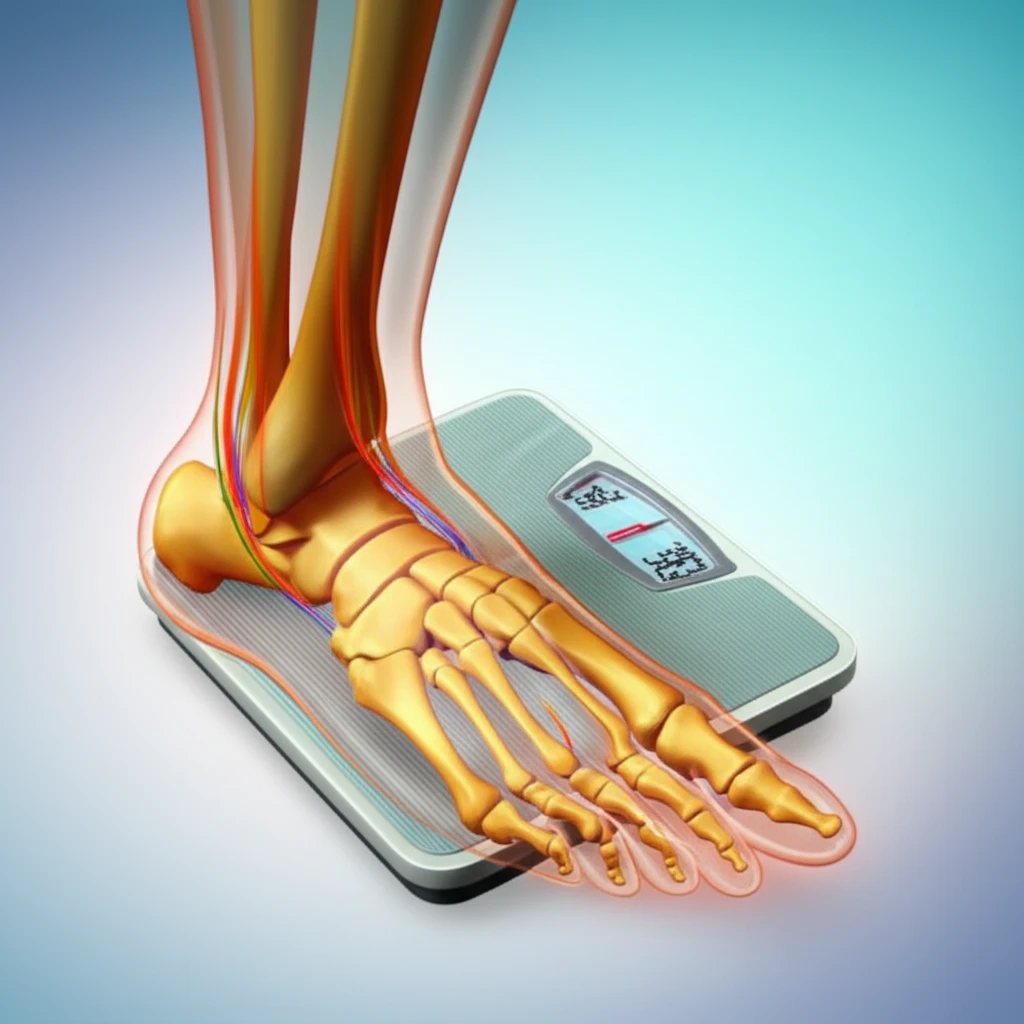
Illustration of a foot under pressure, with highlighted angles, in a weight-bearing radiograph.

Weight-Bearing Woes? Unpacking How Foot Radiographs Change Under Pressure

"From subtle shifts to significant changes, discover the impact of weight on your foot's inner workings."


Our feet are marvels of engineering, designed to support our weight and absorb the shocks of movement. But what happens to these intricate structures when we put them under pressure? Clinical decisions about foot health often rely on weight-bearing radiographs, but the impact of varying weight levels on these images has been a subject of scientific inquiry. Recent research has begun to unravel the subtle, yet significant, changes that occur within our feet as we stand, walk, and bear weight.

This article explores a fascinating study that examines how the angle of our big toe (hallux valgus), the space between our foot bones (intermetatarsal angle), and other key measurements shift as we transition from non-weight-bearing to full weight-bearing. By understanding these changes, we can gain valuable insights into foot mechanics and how they relate to common foot conditions and treatments.

Whether you're a healthcare professional, a fitness enthusiast, or simply curious about your body, join us as we delve into the intriguing world of foot radiographs and discover how the simple act of standing can reshape the architecture of your feet.

The Weighty Truth: How Weight-Bearing Changes Foot Radiographs

Illustration of a foot under pressure, with highlighted angles, in a weight-bearing radiograph.

The study, published in the journal Foot & Ankle Specialist, investigated the effects of different weight-bearing conditions on the feet. Researchers took radiographs of healthy individuals under five distinct conditions: non-weight-bearing, 10% body weight, 25% body weight, 50% body weight, and 100% body weight. They meticulously measured various angles and distances in the foot to see how they changed with each weight level.

The results revealed some interesting patterns. Two key measurements, the talonavicular coverage angle (TNCA) and the talocalcaneal angle (TCA), showed significant increases with increasing weight-bearing. This suggests a flattening of the arch, a common occurrence when weight is applied to the foot. Conversely, the cuboid height to ground (CHG) decreased, indicating a lowering of the arch as weight increased. However, other measurements, such as the hallux valgus angle (HVA) and intermetatarsal angle (IMA), remained relatively stable across different weight-bearing conditions. This study highlights the dynamic nature of the foot and how it adapts under pressure.

  • The TNCA and TCA angles increased significantly with increased weight-bearing, indicating arch flattening.
  • The CHG decreased with increasing weight, reflecting the arch's descent.
  • The HVA and IMA did not change significantly across the different weight-bearing conditions.
These findings have implications for how we interpret foot radiographs and treat related conditions. They suggest that weight-bearing does indeed alter the structure of the foot, particularly in the arch region. This knowledge is crucial for clinicians who rely on these images to diagnose and manage foot problems. As the study points out, the changes observed between 25% and 100% weight-bearing were not significantly different, suggesting that the foot may reach a certain 'loaded' state where further weight doesn't drastically alter the measurements.

Stepping Forward: Implications and Future Directions

This study offers valuable insights into the biomechanics of the foot and how they are influenced by weight. The findings underscore the importance of considering weight-bearing conditions when interpreting foot radiographs. For instance, post-injury or post-surgical rehabilitation protocols might need to consider the level of weight allowed on the foot to assess its accurate structure. Further research is needed to investigate the specific impact of weight-bearing on various foot pathologies. It is important to find how these findings may translate to real-world clinical scenarios to improve diagnoses and optimize patient care. By gaining a deeper understanding of the foot's response to weight, we can take better care of our feet and maintain our mobility for years to come.

About this Article -

This article was crafted using a human-AI hybrid and collaborative approach. AI assisted our team with initial drafting, research insights, identifying key questions, and image generation. Our human editors guided topic selection, defined the angle, structured the content, ensured factual accuracy and relevance, refined the tone, and conducted thorough editing to deliver helpful, high-quality information.See our About page for more information.

This article is based on research published under:

DOI-LINK: 10.1177/1938640018810412, Alternate LINK

Title: The Influence Of Percentage Weight-Bearing On Foot Radiographs

Subject: Orthopedics and Sports Medicine

Journal: Foot & Ankle Specialist

Publisher: SAGE Publications

Authors: Trevor J. Shelton, Sohni Singh, Eduardo Bent Robinson, Lorenzo Nardo, Eva Escobedo, Lyle Jackson, Christopher D. Kreulen, Eric Giza

Published: 2018-10-31

Everything You Need To Know

1

How does weight-bearing affect the structure of the foot as seen in radiographs?

Weight-bearing significantly alters foot structure on radiographs, particularly in the arch region. The talonavicular coverage angle (TNCA) and talocalcaneal angle (TCA) increase with weight, indicating arch flattening. Conversely, the cuboid height to ground (CHG) decreases, showing arch descent. However, the hallux valgus angle (HVA) and intermetatarsal angle (IMA) remain relatively stable across different weight-bearing conditions. Understanding these changes is crucial for accurate interpretation of foot radiographs and the management of foot problems. Further research is needed to understand how these structural adaptations relate to foot pathologies and clinical outcomes.

2

What specific measurements change in foot radiographs under different weight-bearing conditions?

Under different weight-bearing conditions, key measurements in foot radiographs exhibit notable changes. The talonavicular coverage angle (TNCA) and talocalcaneal angle (TCA) increase significantly as weight-bearing increases, reflecting a flattening of the arch. The cuboid height to ground (CHG) decreases with increasing weight, indicating arch descent. However, the hallux valgus angle (HVA) and intermetatarsal angle (IMA) do not show significant changes across varying weight levels. These specific changes provide insights into how the foot dynamically adapts to pressure.

3

Why are weight-bearing radiographs important for assessing foot health?

Weight-bearing radiographs provide a more accurate representation of the foot's structure under functional conditions, as opposed to non-weight-bearing radiographs. Changes in measurements such as the talonavicular coverage angle (TNCA), talocalcaneal angle (TCA) and the cuboid height to ground (CHG) can only be observed under weight. This information is crucial for diagnosing and managing various foot conditions, as it reflects how the foot functions during normal activities. Considering weight-bearing conditions during radiographic assessment allows clinicians to make more informed decisions regarding treatment and rehabilitation.

4

Do changes in weight-bearing beyond a certain point continue to drastically alter foot measurements in radiographs?

The study suggests that changes observed between 25% and 100% weight-bearing were not significantly different, indicating that the foot may reach a 'loaded' state where further weight does not drastically alter foot measurements on radiographs. While initial weight-bearing causes notable changes in parameters like the talonavicular coverage angle (TNCA), talocalcaneal angle (TCA), and the cuboid height to ground (CHG), the foot's response to additional weight diminishes beyond a certain threshold. However, further research is necessary to understand the implications of this 'loaded' state for different foot pathologies and individual variations.

5

How might the findings on weight-bearing foot radiographs influence post-injury or post-surgical rehabilitation?

The findings underscore the importance of considering weight-bearing conditions when interpreting foot radiographs, which has direct implications for post-injury or post-surgical rehabilitation protocols. Understanding how weight-bearing affects measurements such as the talonavicular coverage angle (TNCA), talocalcaneal angle (TCA), and the cuboid height to ground (CHG) can guide decisions about the appropriate level of weight allowed on the foot during recovery. This knowledge helps ensure accurate structural assessment and allows for tailored rehabilitation plans that optimize healing and restore proper foot function. It is important to monitor these parameters through weight-bearing radiographs to track progress and adjust interventions accordingly.

Newsletter Subscribe

Subscribe to get the latest articles and insights directly in your inbox.