
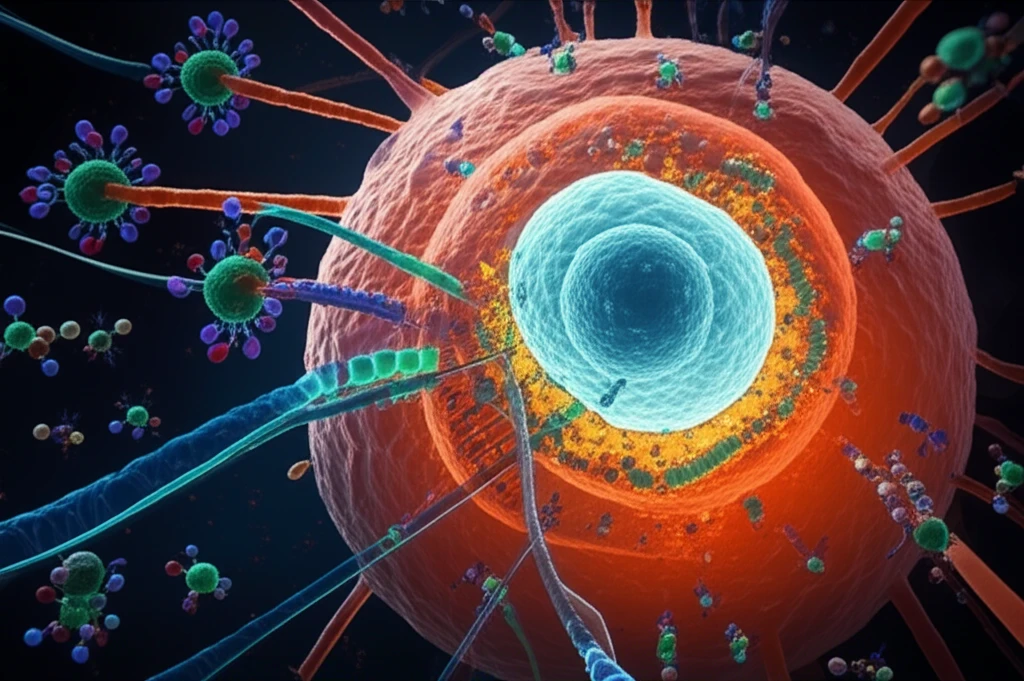
Surreal illustration of Wee1 inhibitor disrupting cancer cell DNA repair, enhancing gemcitabine's effects.

Wee1 Inhibitors: The Key to Unlocking Gemcitabine's Cancer-Fighting Potential?

"New research highlights how Wee1 inhibitors can enhance the effectiveness of gemcitabine, a crucial chemotherapy drug, by disrupting cancer's stress response mechanisms."


Chemotherapy, while a cornerstone of cancer treatment, often faces the challenge of drug resistance. Nucleoside analogues like gemcitabine, used against various solid tumors, including pancreatic cancer, frequently encounter this obstacle. Finding ways to boost their effectiveness is critical for improving patient outcomes.

A promising strategy involves inhibitors targeting checkpoint kinases – enzymes that regulate cell cycle progression and DNA repair. Cancer cells often bypass normal growth controls, becoming heavily reliant on specific checkpoints like intra-S and G2/M for survival. This dependence makes checkpoint kinases attractive therapeutic targets.

Recent studies have focused on inhibitors of Wee1, ATR, and Chk1, all vital checkpoint kinases. Combining these inhibitors with gemcitabine has shown potential in sensitizing tumor cells. Researchers are particularly interested in quantitative comparisons of how these inhibitors enhance gemcitabine's effectiveness and the underlying mechanisms, specifically how Wee1 inhibitors impact the ATR/Chk1 pathway.

How Wee1 Inhibition Amplifies Gemcitabine's Impact on Cancer Cells

Surreal illustration of Wee1 inhibitor disrupting cancer cell DNA repair, enhancing gemcitabine's effects.

A recent study investigated the chemosensitizing effects of Chk1, Wee1, and ATR inhibitors on pancreatic and osteosarcoma cancer cells. Researchers used pharmacological inhibitors—SB 218078, MK-1775, and VE-821, respectively—to assess their impact on gemcitabine's efficacy. The efficiency of these inhibitors was confirmed by observing their effects on their respective substrates within the cell.

The study focused on long-term effects, monitoring cell growth over one to two weeks after treatment. Cancer cells were treated with inhibitors, both with and without gemcitabine, for 24 hours. Cell growth was then tracked using bright-field microscopy and automated image analysis to determine how the inhibitors enhanced gemcitabine's ability to slow cancer cell proliferation.

  • Enhanced Sensitivity: Combining Wee1 or ATR inhibitors with gemcitabine significantly slowed cell growth compared to using a Chk1 inhibitor.
  • Increased DNA Damage: Inhibiting Wee1, ATR, or Chk1 with gemcitabine led to increased DNA damage, indicated by higher levels of phosphorylated H2AX (γH2AX).
  • Apoptosis Confirmation: Experiments with a caspase inhibitor confirmed that γH2AX accumulation was a direct result of DNA damage, not just apoptosis.
  • Wee1's Unique Impact: Wee1 inhibition alone increased γH2AX levels and significantly impaired cell survival, suggesting a critical role in managing replicative stress.
Interestingly, the team noted that Wee1 inhibition had a more pronounced effect on increasing γH2AX levels and reducing cell survival compared to Chk1 or ATR inhibitors. Further investigation revealed that Wee1’s influence might be epistatic, meaning it could regulate the ATR/Chk1 pathway. This led to exploring how Wee1 inhibition specifically affects Chk1 phosphorylation and the overall DNA damage response in gemcitabine-treated cells.

Future Implications for Cancer Therapy

The study highlights that Wee1 inhibition effectively disrupts ATR/Chk1 signaling, enhancing the DNA damage response when combined with gemcitabine. By impairing ATR/Chk1 activity, Wee1 inhibition increases replicative stress, especially when cells are exposed to false-incorporated nucleoside analogues. This leads to stalled and collapsed DNA replication forks, triggering a heightened DNA damage response and ultimately impairing cell survival.

About this Article -

This article was crafted using a human-AI hybrid and collaborative approach. AI assisted our team with initial drafting, research insights, identifying key questions, and image generation. Our human editors guided topic selection, defined the angle, structured the content, ensured factual accuracy and relevance, refined the tone, and conducted thorough editing to deliver helpful, high-quality information.See our About page for more information.

Everything You Need To Know

1

What exactly are Wee1 inhibitors and what do they do?

Wee1 inhibitors are substances that block the activity of the Wee1 kinase. Wee1 is an enzyme that plays a critical role in regulating the cell cycle, particularly at the G2/M checkpoint, which is the point where the cell prepares to divide. By inhibiting Wee1, the cell cycle is disrupted, especially in cancer cells that rely on this checkpoint to repair DNA damage before dividing. This disruption makes cancer cells more vulnerable to treatments like chemotherapy.

2

What is gemcitabine, and how does it work against cancer?

Gemcitabine is a type of chemotherapy drug known as a nucleoside analogue. It works by mimicking the building blocks of DNA and RNA, causing errors during DNA replication in cancer cells. This leads to DNA damage and ultimately causes the cancer cells to stop growing or die. Gemcitabine is often used to treat various solid tumors, including pancreatic cancer, but its effectiveness can be limited by drug resistance.

3

What are ATR and Chk1, and how are they related to Wee1 inhibition?

ATR and Chk1 are checkpoint kinases involved in the DNA damage response. When DNA damage occurs, ATR and Chk1 are activated to pause the cell cycle, allowing time for the damage to be repaired. Cancer cells often heavily rely on these checkpoints. Inhibiting ATR and Chk1 can prevent cancer cells from repairing damaged DNA, making them more susceptible to chemotherapy drugs like gemcitabine. However, the study suggests that Wee1 inhibition has a more pronounced effect, possibly because it regulates the ATR/Chk1 pathway.

4

How does combining Wee1 inhibitors with gemcitabine affect cancer cells?

The combination of Wee1 inhibitors and gemcitabine leads to increased DNA damage within cancer cells. Inhibiting Wee1 impairs the ATR/Chk1 pathway, increasing replicative stress, particularly when cells are exposed to nucleoside analogues like gemcitabine. This results in stalled and collapsed DNA replication forks, triggering a heightened DNA damage response and impairing cell survival more effectively than gemcitabine alone.

5

What is replicative stress, and why is it important in the context of cancer treatment?

Replicative stress refers to the difficulties cells encounter during DNA replication, especially when cancer cells are exposed to chemotherapy drugs like gemcitabine. When Wee1 is inhibited, cancer cells cannot manage this stress effectively. This leads to stalled or collapsed replication forks, increased DNA damage, and ultimately, cell death. This highlights Wee1's role in helping cancer cells manage the stress caused by DNA replication, making it a valuable target for cancer therapy.

Newsletter Subscribe

Subscribe to get the latest articles and insights directly in your inbox.