
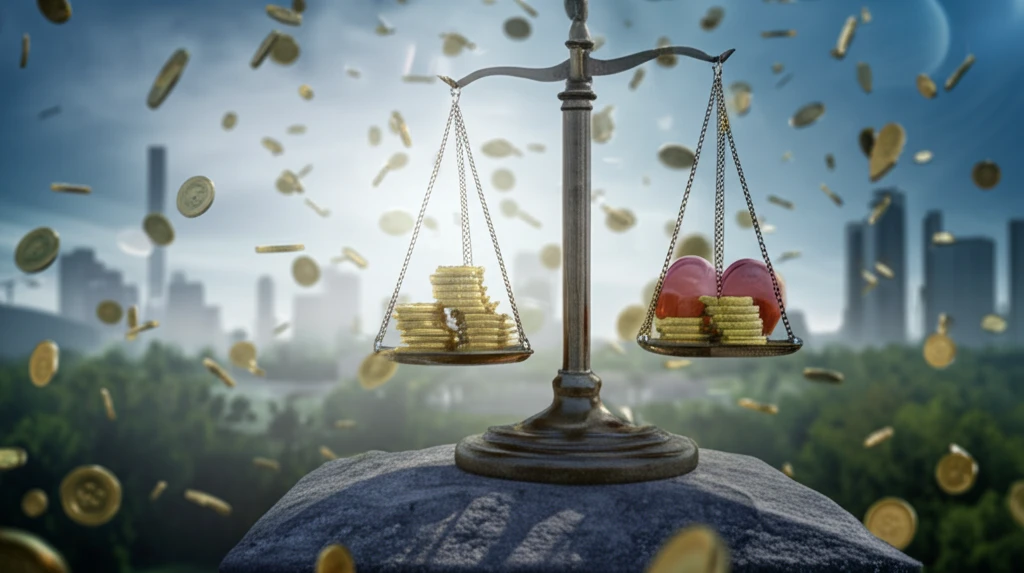
Scales balancing gold coins and hearts, symbolizing wealth and well-being.

Wealth Inequality: Can Morality and Economics Find Common Ground?

"Explore how redistribution and consumption morals can reshape our economy for a more equitable future."


Wealth inequality isn't just a statistic; it's a pressing global issue affecting societies worldwide. Recent data paints a stark picture: the richest 10% control a staggering 76% of the world's wealth while also securing 50% of its income. This imbalance, reflected in high Gini index scores, signals potential social unrest and economic instability. As these disparities widen, the urgency to find effective solutions becomes ever more critical.

The United Nations recognizes this challenge, embedding the reduction of inequality into its Sustainable Development Goals. Global forums, like the World Economic Forum, echo this concern, placing inequality reduction high on their agendas. But to truly address this issue, we need to re-examine the very economic relationships that perpetuate it. It's time to ask: How can we reshape our economic systems to foster greater equity and opportunity for all?

Traditional economic models often fall short in capturing the nuances of wealth distribution because they tend to focus on single representative agents rather than considering the complex interactions between diverse individuals. New approaches are needed to incorporate factors such as moral values, consumption habits, and the dynamics of wealth exchange. By integrating these elements, we can move closer to understanding and building a more balanced and sustainable economic future.

Redistribution and Consumption Morals: What Role Do They Play?

Scales balancing gold coins and hearts, symbolizing wealth and well-being.

To understand how we can influence wealth inequality, it’s essential to consider the roles of redistribution and consumption morals. These morals aren't just abstract philosophical concepts; they are practical parameters that can be integrated into economic models to assess their impact. Redistribution morals involve the degree to which wealth is shared or transferred among individuals, while consumption morals relate to the level of frugality or restraint in spending.

Researchers have begun to explore these concepts by coupling macroeconomic models—which traditionally deal with capital, consumption, and utility—with econophysical models that simulate the interactions of wealth exchange. By introducing redistribution and consumption thresholds, economists can observe how different moral parameters affect wealth inequality and overall utility within a population. The goal is to find a balanced approach where both inequality is reduced and economic well-being is enhanced.

  • Over-Redistribution and Stinginess: While seemingly beneficial, excessive redistribution coupled with extreme frugality can actually reduce overall utility. If people are too restricted in their consumption, the economy stagnates, and individual well-being suffers.
  • Under-Redistribution and Waste: Conversely, a system that doesn't redistribute wealth effectively and encourages wasteful consumption exacerbates inequality. The rich get richer, the poor get poorer, and resources are depleted unsustainably.
  • Balanced Moderation: The most promising approach involves a moderate moral compass. Balancing redistribution and reasonable consumption can lead to reduced inequality and increased utility. This approach allows for economic activity while ensuring a fairer distribution of resources.
These findings align with moral principles found in philosophy, anthropology, and religion, providing renewed economic and numerical support for their importance. The revival of redistribution and consumption morals should promote a transformation to a human mutual-aid economy, as indicated by philosopher and anthropologist, instead of the capitalist economy that has produced the current inequality. The practical challenge is to implement bottom-up social business, on a foothold of worker coops and platform cooperatives as a community against the state and the market, with moral consensus and its operation.

Building a More Equitable Future

The journey toward a more equitable economy requires a collective commitment to moral principles, balanced policies, and innovative solutions. By embracing redistribution and consumption morals, and by empowering communities to build wealth from the bottom up, we can pave the way for a future where prosperity is shared by all. The road ahead may be challenging, but the potential rewards—a more just, sustainable, and thriving society—are well worth the effort.

About this Article -

This article was crafted using a human-AI hybrid and collaborative approach. AI assisted our team with initial drafting, research insights, identifying key questions, and image generation. Our human editors guided topic selection, defined the angle, structured the content, ensured factual accuracy and relevance, refined the tone, and conducted thorough editing to deliver helpful, high-quality information.See our About page for more information.

This article is based on research published under:

DOI-LINK: https://doi.org/10.48550/arXiv.2405.13341,

Title: Wealth Inequality And Utility: Effect Evaluation Of Redistribution And Consumption Morals Using Macro-Econophysical Coupled Approach

Subject: econ.gn cs.ma physics.soc-ph q-fin.ec

Authors: Takeshi Kato, Mohammad Rezoanul Hoque

Published: 22-05-2024

Everything You Need To Know

1

What are redistribution morals and consumption morals, and how do they influence wealth inequality?

Redistribution morals refer to the degree to which wealth is shared or transferred among individuals, affecting how resources are distributed within an economy. Consumption morals relate to the level of frugality or restraint in spending habits. Research indicates that these morals significantly influence wealth inequality. For example, excessive redistribution can decrease overall utility if it stifles economic activity, while insufficient redistribution combined with wasteful consumption exacerbates inequality. A balanced approach, which involves moderate redistribution and reasonable consumption, is crucial for reducing inequality and increasing overall utility, aligning with moral principles from philosophy, anthropology, and religion.

2

How do macroeconomic and econophysical models contribute to understanding wealth inequality in the context of moral principles?

Macroeconomic models, traditionally focused on capital, consumption, and utility, are combined with econophysical models that simulate wealth exchange interactions to assess the impact of moral principles on wealth distribution. By integrating redistribution and consumption thresholds into these models, economists can observe how different moral parameters affect wealth inequality and overall utility within a population. This approach allows for a more nuanced understanding of how moral values influence economic outcomes, offering insights into building a more balanced and sustainable economic future. These models help in evaluating the impact of redistribution and consumption morals, leading to a better understanding of their influence on inequality.

3

What are the potential negative consequences of over-redistribution and excessive frugality within an economic system?

While redistribution is often seen as beneficial, over-redistribution coupled with extreme frugality, or stinginess, can negatively affect the economy. When people are excessively restricted in their consumption, the economy can stagnate, leading to a reduction in overall utility. This stagnation limits economic activity and can decrease individual well-being. Therefore, a balance is needed to ensure that redistribution does not stifle economic growth or individual prosperity.

4

What are the implications of under-redistribution and wasteful consumption on wealth distribution and economic stability?

A system characterized by under-redistribution and wasteful consumption exacerbates wealth inequality. In such a scenario, the rich tend to accumulate more wealth while the poor become poorer, widening the gap between the economic classes. This also leads to unsustainable resource depletion. The imbalance can create social unrest and economic instability. Therefore, a balance is needed to ensure that redistribution and consumption are managed to promote fairer distribution of resources and economic stability.

5

How can society move towards a more equitable future, according to the discussed perspectives?

Moving towards a more equitable future requires a collective commitment to moral principles, balanced policies, and innovative solutions. Embracing redistribution and consumption morals is essential. This involves finding a balance between redistribution and reasonable consumption to reduce inequality and increase utility. Additionally, empowering communities to build wealth from the bottom up can foster a more just, sustainable, and thriving society. The transformation involves moving away from a capitalist economy and embracing a human mutual-aid economy, supported by worker coops and platform cooperatives, grounded in moral consensus and community operation.

Newsletter Subscribe

Subscribe to get the latest articles and insights directly in your inbox.